The relentless pursuit of automotive safety hinges on precise and reliable data, especially during the extreme conditions of crash testing. For decades, the industry has relied on sophisticated instrumentation to capture every critical moment of impact. However, the very forces designed to be measured often pose a significant threat to the delicate electronics and optical devices tasked with recording them. Cameras, sensors, and data acquisition systems mounted within a test vehicle must endure immense G-forces, vibrations, and potential physical trauma, all while functioning flawlessly to provide the crucial information needed to improve vehicle design and occupant protection. Data loss, even for a fraction of a second, can render an entire test inconclusive and costly.
Japan-based crash test agency Photron, a veteran in this high-stakes field, understands these challenges intimately. They have long grappled with the inherent fragility of electronic components when subjected to the violent environment of a simulated collision. A primary concern has been the physical positioning and mounting of essential recording equipment. Even the most robust cameras can have their focus disrupted, or vital data streams interrupted, by the jarring effects of an impact, particularly when their placement is compromised. This has historically led to situations where valuable data, especially visual evidence captured at the most critical junctures of a crash, becomes unusable, forcing costly retests and delaying crucial design iterations.
Bridging the Gap with Additive Manufacturing
To overcome these persistent obstacles and ensure the integrity of their crash test data, Photron has forged a strategic partnership with Andy Schaefer, the visionary owner and sole engineer behind Germany-based Additive Printing Solutions (APS). Founded just five years ago, APS has rapidly established itself as a leader in providing innovative design and 3D printing solutions, with a particular focus on additive manufacturing (AM) for industrial applications. Schaefer’s expertise extends beyond mere printing; he actively coaches manufacturers on adopting AM principles and fostering an "AM mindset" within their organizations.
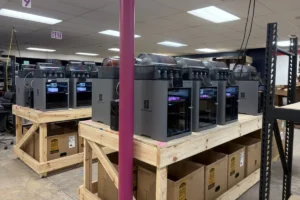
This collaboration has yielded a series of bespoke, high-performance solutions specifically tailored to Photron’s demanding crash testing requirements. Leveraging the advanced polymer-composite 3D printing capabilities of Markforged and their robust Onyx material, APS has successfully engineered components that not only withstand the extreme conditions of crash tests but also actively enhance data capture reliability. The combination of Markforged’s industrial-grade 3D printers, known for their precision and ability to produce parts with exceptional strength and durability, and the unique properties of Onyx – a high-strength nylon reinforced with chopped carbon fiber – has proven to be a game-changer for Photron. This approach allows for the creation of parts that are both lightweight and incredibly resilient, a critical balance in the confined and high-impact environment of a test vehicle.
Innovations in Camera Security and Focus Maintenance
One of the most prevalent challenges Photron faced involved the mounting of small, high-speed cameras strategically placed within the test vehicle. These cameras, often positioned in tight or obstructed locations such as under seats or behind the steering wheel, are essential for documenting occupant movement and vehicle deformation. However, the intense forces experienced during a crash could easily cause these cameras to shift, even minutely, leading to a loss of focus and resulting in blurry, uninterpretable images at the precise moment they were needed most.
APS, under Schaefer’s direction, has developed custom-designed camera casings that significantly improve camera stability and maintain focus. These innovative casings are engineered to securely house the cameras and are affixed using readily available zip ties, a common and effective fastening method in crash test assemblies. This seemingly simple solution provides a rigid and reliable mounting platform, preventing camera movement during impact. The design prioritizes shock absorption and vibration dampening, ensuring that the camera remains precisely aimed and focused, thus capturing crisp, clear imagery critical for detailed analysis of crash dynamics. The durability of these 3D-printed casings means they can withstand multiple impacts, further contributing to cost-effectiveness.
Streamlining Data Connectivity with Adaptable Cabling Solutions
Beyond securing the visual recording devices, Schaefer’s expertise has also addressed a critical bottleneck in data transmission: the cabling infrastructure. In crash test setups, cameras are linked to data collection consoles, typically located in the rear of the vehicle. While the camera housings themselves are often standardized, the length of the cables connecting them to the console can vary significantly. This variation previously necessitated different cable entry points or adapters, adding complexity and potential points of failure.
"If they have a 3-meter cable or an 8-meter cable, they need different adapters," Schaefer explains. "They don’t want to have to make another housing for the cameras, so I make them adapters so they can always use the same housing."
To resolve this, APS has designed and produced puck-shaped adapters that ensure a robust and consistent cable connection, regardless of cable length. These adapters are manufactured in three distinct sizes, accommodating the various cable diameters commonly employed by Photron. This modular approach allows Photron to maintain their existing camera housing infrastructure while seamlessly integrating cables of different lengths. The precision of the 3D printing process ensures a snug fit, minimizing the risk of signal degradation or disconnection due to vibration. The puck design also offers a degree of protection to the cable entry point itself, further enhancing its resilience.
Enhancing Data Console Reliability Through Advanced Cable Management

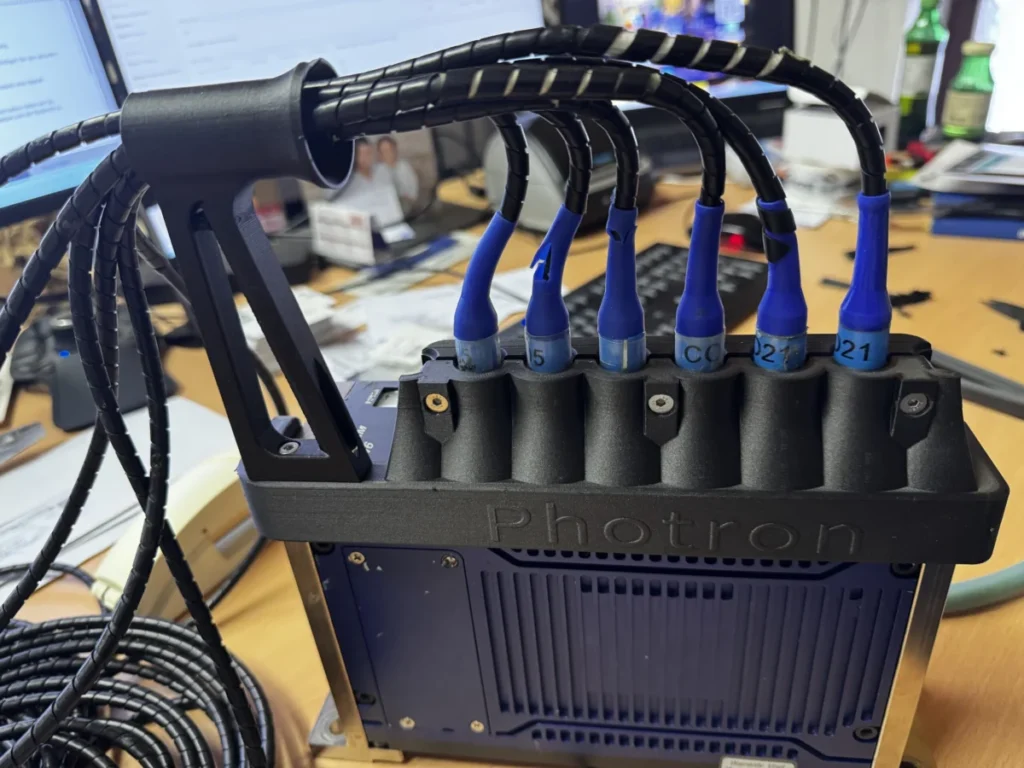
The final, and perhaps most complex, challenge addressed by APS pertains to the data collection console itself. With numerous instruments feeding vital information into this central hub, maintaining uninterrupted cable connectivity during a crash is paramount. Photron had observed instances where cables would momentarily disconnect from the console during impact, leading to the loss of critical data segments. This issue threatened the completeness of the data record and the overall validity of the test results.
Schaefer collaborated closely with Photron to develop a 3D-printed solution that could be integrated with the existing console without requiring any modifications to the original equipment. The initial iteration involved a support structure for the plug connections, secured to the console using zip ties. This "zip tie" approach, as Schaefer notes, is often the most practical and effective solution in the high-pressure environment of crash testing: "Zip ties are everywhere in crash test assemblies. If you can zip it with a tie, it’s the easiest solution."
The subsequent and current iteration of this cable management tooling represents a significant advancement. It features a sophisticated two-part construction designed to fully encompass each cable, providing enhanced security and strain relief. The outer support, which faces the camera’s perspective, snaps directly onto the console. It is further secured using screws that engage with existing mounting holes on the device, ensuring a firm and stable attachment. The inner support, designed to cradle the cable, attaches to the outer support via screws, utilizing embedded nuts that are seamlessly integrated during the 3D printing process. This embedded nut technology is a hallmark of Markforged’s advanced printing capabilities, allowing for the creation of parts with integrated, high-strength fastening points.
Leveraging Fiber Reinforcement for Unparalleled Durability
For the outer section of the cable carrier, Schaefer strategically employed Markforged’s Eiger software and its unique fiber-reinforcement capability to impart exceptional stiffness and strength. This involved incorporating four distinct sections of continuous fiberglass reinforcement, each comprising 12 meticulously printed layers. This targeted reinforcement significantly enhances the structural integrity of the component, enabling it to withstand the immense forces exerted during a crash without deforming or failing.
Adding another layer of protection and data integrity, a third component of the assembly extends upwards, raising the cables approximately 100 mm away from the console. This elevated position plays a crucial role in maintaining a stable data signal by significantly reducing stress on the wires at the connection point. This increased clearance prevents the cables from being subjected to sharp bends or excessive pulling during impact. Furthermore, this tall support structure incorporates three strategically placed fiberglass regions oriented in the direction of the vehicle’s travel. These reinforced sections are designed to absorb and dissipate impact energy, ensuring the support’s unwavering integrity throughout the entire crash event.
Economic Viability and the Paradox of Durability
The impact of APS’s 3D-printed solutions extends beyond just data integrity and safety. The durability of these components has proven remarkable, allowing them to survive multiple crash tests and be reused repeatedly. This reusability represents a significant cost-saving for Photron, reducing the need for frequent replacements of specialized tooling.
Schaefer humorously acknowledges this unexpected benefit: "This is the problem," he quips. "On the one hand, I’m very happy about this fact that they don’t break down on the crash test. But on the other side I don’t sell them much, because they are reused so often." This testament to the quality and longevity of the 3D-printed parts underscores the value proposition of advanced additive manufacturing in specialized industrial applications. It highlights how investing in high-quality, durable components, even if it means fewer repeat sales, ultimately delivers superior long-term value and operational efficiency for the end-user.
Implications for the Automotive Safety Landscape
The successful integration of 3D-printed solutions by APS for Photron represents a significant advancement in the field of automotive crash testing. It demonstrates how additive manufacturing can be effectively deployed to address niche but critical challenges that traditional manufacturing methods struggle to overcome.
The ability to create highly customized, robust, and precisely engineered components on demand offers several key implications:
- Reduced Testing Costs: By minimizing data loss and the need for repeat tests due to equipment failure, Photron and other agencies can significantly reduce the overall cost of crash testing.
- Accelerated Development Cycles: Reliable data allows engineers to make faster, more informed decisions about vehicle design. This can lead to quicker iteration of safety features and a more streamlined path to market for safer vehicles.
- Enhanced Data Fidelity: The improved stability and connectivity of recording equipment mean that the data captured is more accurate and comprehensive, leading to a deeper understanding of crash dynamics.
- Democratization of Custom Solutions: 3D printing lowers the barrier to entry for creating specialized tooling. This empowers smaller agencies or research institutions to develop bespoke solutions without incurring the prohibitive costs associated with traditional manufacturing.
- Material Innovation: The use of advanced materials like Markforged’s Onyx, combined with fiber reinforcement, showcases the potential for additive manufacturing to produce parts that rival or even surpass the performance of traditionally manufactured components in extreme environments.
The Future of Crash Test Instrumentation
As automotive safety standards continue to evolve and vehicles become increasingly complex, the demands placed on crash test instrumentation will only grow. The partnership between Photron and APS serves as a compelling case study for how innovative approaches, particularly those leveraging advanced additive manufacturing, can provide the robust and reliable solutions necessary to meet these future challenges. The ability to design, iterate, and produce highly specialized components rapidly and cost-effectively positions 3D printing as an indispensable tool in the ongoing mission to enhance automotive safety worldwide. The future of crash test data integrity is being built, layer by layer, with the precision and resilience of additive manufacturing.