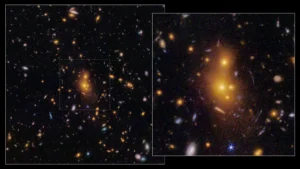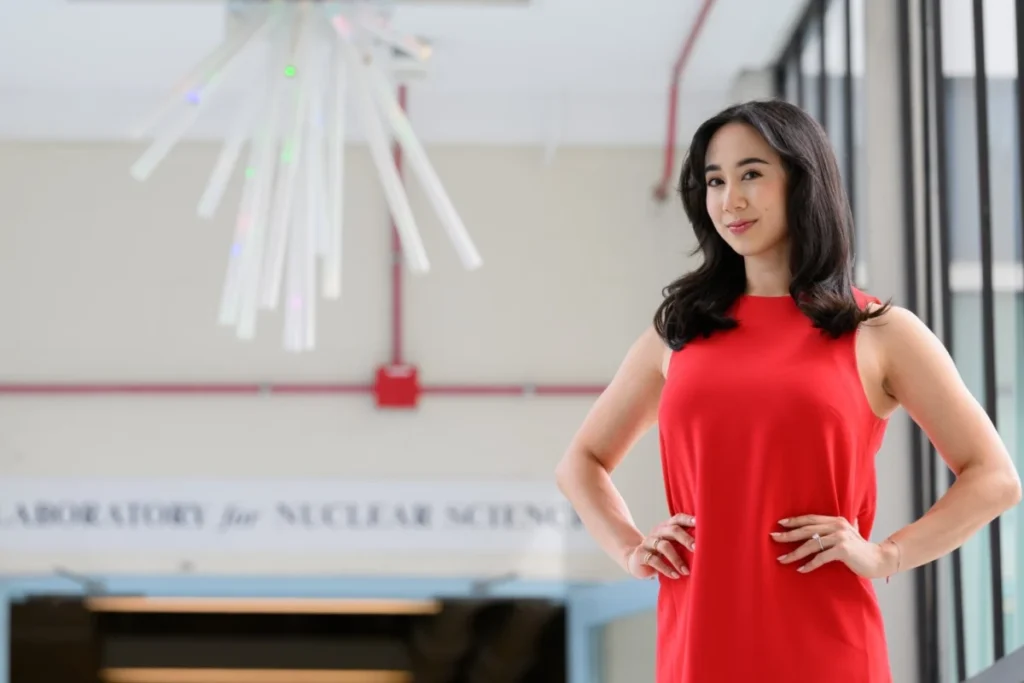
The pursuit of the fundamental building blocks of the universe has long been the primary objective of modern physics, yet one of the most significant components of our cosmos remains entirely unseen. Scientists currently estimate that approximately 85 percent of all matter in the universe is comprised of "dark matter," a substance that does not emit, absorb, or reflect light, making it invisible to traditional astronomical instruments. Despite its elusive nature, its gravitational influence is undeniable, dictating the rotation of galaxies and the structural evolution of the universe itself. Jessica Fry, a fifth-year PhD candidate at the Massachusetts Institute of Technology (MIT) Laboratory for Nuclear Science (LNS), stands at the forefront of this global hunt. Her journey to the heights of particle physics is as unconventional as the particles she seeks, involving a high-stakes transition from the stages of Broadway to the sophisticated laboratories of Cambridge and Stanford.
The Enigma of Dark Matter and the Axion Hypothesis
To understand the significance of Fry’s research, one must first grasp the "missing mass" problem that has perplexed astrophysicists for nearly a century. In the 1930s, Swiss astronomer Fritz Zwicky observed that galaxies within clusters were moving much faster than the visible mass should allow. Decades later, Vera Rubin provided further evidence by showing that stars at the edges of galaxies rotate as quickly as those near the center, suggesting a massive, invisible "halo" of matter providing extra gravitational pull.
While various candidates for dark matter have been proposed—ranging from Weakly Interacting Massive Particles (WIMPs) to primordial black holes—Fry is focused on the axion. Originally theorized in the late 1970s by Roberto Peccei and Helen Quinn to solve the "strong CP problem" in quantum chromodynamics, the axion has emerged as a leading dark matter candidate. Unlike WIMPs, which are heavy, axions are theorized to be incredibly light—orders of magnitude smaller than an electron. At such a scale, axions behave less like individual bullets and more like a pervasive, coherent wave that flows through the galaxy.
Fry’s work involves the development and operation of ultra-sensitive detectors designed to catch the faint signal of these waves. If an axion passes through a strong magnetic field, theory predicts it should convert into a photon, creating a tiny, oscillating electric current. Detecting this "rip current" amidst the cacophony of cosmic and thermal noise is the central challenge of Fry’s doctoral work.
A Duality of Disciplines: From Dance to Detection
Fry’s path to MIT was paved with a unique combination of artistic rigor and scientific curiosity. Raised in the San Francisco Bay Area, she grew up in the shadow of the SLAC National Accelerator Laboratory, an environment that normalized high-level scientific inquiry. However, her first passion was dance. Beginning at age three, Fry rose through the ranks of competitive dance, eventually competing on national stages. This early exposure to performance instilled a "no half-measures" mentality—a trait she carries into her current research.
Her transition into serious physics began in high school when a teacher provided her with two decommissioned detectors from SLAC. Rather than treating them as relics, Fry researched 1960s-era experimental papers, replicated the original results, and documented the process. This experience provided her first glimpse into the intersection of abstract theory and physical reality. By the time she enrolled at Stanford University, she was unwilling to choose between her two worlds, opting instead to double major in physics and theater and performance studies.
The Broadway Interval and the Return to Science
The trajectory of Fry’s career took a dramatic turn during her sophomore year at Stanford. A talent agent recruited her for a Broadway revival of David Henry Hwang’s M. Butterfly. The timing was precarious, coinciding with her midterm examinations. In a display of the stamina that would later define her graduate studies, Fry flew to New York for the audition and returned immediately to California to complete her exams.
After a month of silence, during which she assumed she had failed the audition, Fry secured a prestigious summer research internship at CERN, the European Organization for Nuclear Research in Switzerland. It was while she was in Geneva, immersed in the world’s most advanced particle physics environment, that she received the call: she had been cast in the Broadway show.
Fry spent two years in New York, performing at the highest level while undergoing intense training in ballet, jazz, contemporary dance, and even specialized forms like Peking opera-style movement and Māori dance. However, the professional theater world presented psychological challenges that differed from the objective metrics of the laboratory. Fry noted that the constant cycle of auditions and external judgment often led performers to value others’ opinions over their own self-worth. Recognizing that the industry was altering her character in ways she didn’t like, she made the difficult decision to leave the stage and return to Stanford to finish her degrees.
Technological Frontiers: ABRACADABRA and DMRadio
Upon returning to academia and subsequently joining MIT, Fry channeled her performance-honed discipline into experimental design. She is currently a key contributor to two major axion search experiments: ABRACADABRA (A Broadband/Resonant Approach to Cosmic Axion Detection with a Bayesian B-Ring Apparatus) and DMRadio (Dark Matter Radio).
ABRACADABRA
Operating at MIT, ABRACADABRA utilizes a toroidal (donut-shaped) magnet. According to the laws of electromagnetism, if axions exist, they should interact with the magnetic field inside the toroid to produce a small oscillating magnetic field in the center where there is otherwise no field. A superconducting pickup loop then detects this change. The experiment is "broadband," meaning it can look for a wide range of axion masses simultaneously.
DMRadio
DMRadio, which Fry is currently helping to construct at Stanford, represents the next generation of this technology. It functions similarly to a highly sensitive AM/FM radio. Just as a radio is tuned to a specific frequency to catch a broadcast, DMRadio is tuned to specific frequencies corresponding to potential axion masses. Because the signal is expected to be incredibly weak—submerged under thermal and electronic noise—the experiment utilizes quantum amplifiers and operates at temperatures near absolute zero to minimize interference.
Supporting Data and Experimental Challenges
The difficulty of Fry’s work cannot be overstated. The axion’s interaction with electromagnetism is hypothesized to be incredibly "feeble." To find it, researchers must account for:
- Thermal Noise: Even at millikelvin temperatures, the vibration of atoms can mimic a signal.
- Environmental Interference: Radio stations, cellular signals, and even the Earth’s magnetic field must be meticulously shielded.
- Mass Uncertainty: Because the mass of the axion is unknown, the search space is vast. Scientists must "scan" through frequencies, a process that can take years of continuous data collection.
Fry’s role involves the complex data analysis required to distinguish a potential axion signal from these background fluctuations. She describes the signal as having a "distinctive shape," a specific spectral signature that differentiates it from random noise.
Mentorship and the Collaborative Spirit at MIT
At MIT’s Laboratory for Nuclear Science, Fry works under the guidance of Professor Lindley Winslow, a leader in the Neutrino and Dark Matter Group. Winslow, who also navigated a path between different passions before committing to physics, sees Fry’s theatrical background as an asset rather than a distraction. According to Winslow, the "fearlessness to deliver" when the "curtain rises"—or when an experiment goes live—is a quality that sets Fry apart.
The MIT LNS provides a unique ecosystem for this research. The laboratory’s scale and the collaborative nature of its four principal investigators allow PhD candidates like Fry to gain exposure to multiple facets of nuclear and particle physics, moving beyond the narrow confines of a single subfield.
Chronology of Jessica Fry’s Academic and Professional Path
- Early Childhood: Begins dancing and develops an interest in the physical sciences in the San Francisco Bay Area.
- High School: Replicates SLAC detector experiments, confirming her interest in physics.
- Stanford University (Early Years): Double majors in Physics and Theater and Performance Studies.
- Sophomore Year: Auditions for Broadway; secures research position at CERN.
- Professional Hiatus: Moves to New York City for a two-year run in the Broadway production of M. Butterfly.
- Return to Academia: Completes undergraduate degrees at Stanford.
- Graduate Studies (Current): Joins MIT’s Laboratory for Nuclear Science; contributes to ABRACADABRA and DMRadio.
- 2024-2025: Recognized on the Forbes 30 Under 30 Science list for her contributions to dark matter research.
Broader Impact and Implications
The discovery of the axion would be one of the most significant events in the history of science. It would simultaneously solve the dark matter mystery and provide the first evidence for physics beyond the Standard Model. For Fry, the pursuit is not merely about professional prestige but about answering the "philosophical questions" she first encountered in high school.
The implications of her work extend into the realm of quantum sensing. The technologies developed for DMRadio, such as SQUIDs (Superconducting Quantum Interference Devices) and quantum-limited amplifiers, have applications far beyond dark matter, including quantum computing and medical imaging.
As Fry enters the final stages of her PhD, her focus remains on the data. She expresses a firm conviction that dark matter will be detected within her lifetime, framing the search as a matter of "when," not "if." By combining the precision of a physicist with the narrative drive of a performer, Jessica Fry is helping to write the next chapter of our understanding of the universe, proving that the most profound discoveries often require a perspective that spans multiple worlds.