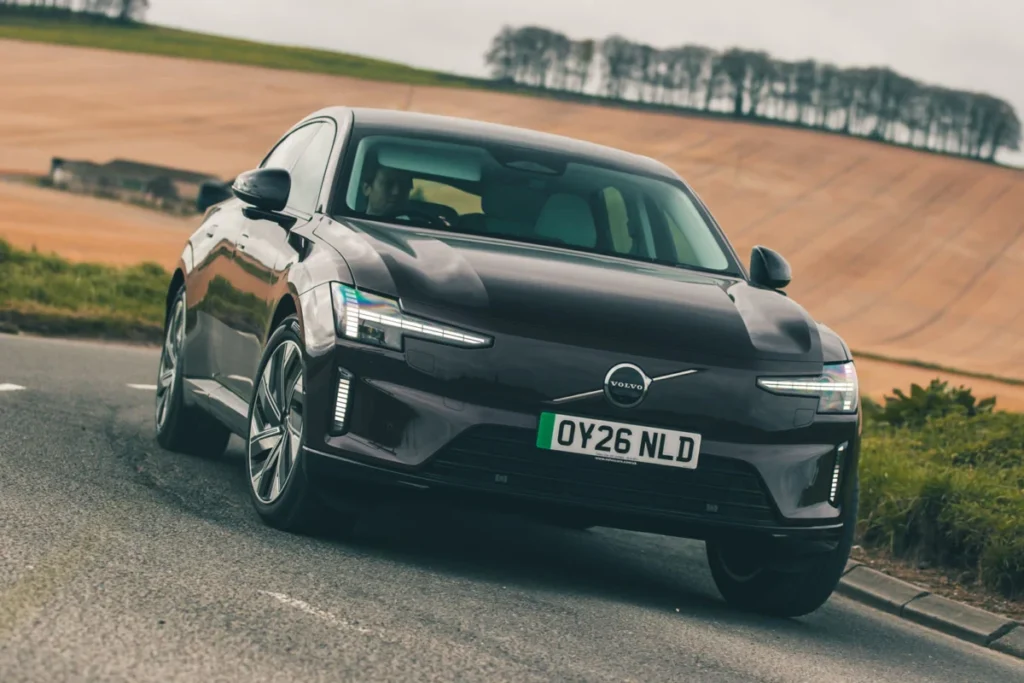
A groundbreaking software update is set to significantly bolster road safety for drivers of select Volvo models, including the EX60, EX90, and ES90. This advanced system leverages the vehicles’ sophisticated sensor and camera arrays to proactively detect larger roadside animals, such as deer and sheep, and vulnerable road users like pedestrians and cyclists, alerting drivers to potential hazards before they become critical. The innovation, detailed in recent communications from the Swedish automaker, represents a significant step forward in vehicle-to-vehicle (V2V) communication and proactive safety technology, aiming to prevent collisions and enhance the overall driving experience.
Intelligent Hazard Detection and Cloud-Based Alerts
The core of this new safety feature lies in the intelligent interpretation of data captured by the car’s onboard systems. Advanced sensors and high-resolution cameras meticulously scan the vehicle’s surroundings, identifying larger animals that pose a significant risk to drivers. Upon detecting such a hazard, the Volvo system not only warns the driver within the vehicle but also instantaneously uploads the precise positional data of the hazard to a secure cloud platform. This data is then disseminated to other compatible Volvos – specifically the EX60, EX90, and ES90 – that are navigating within the immediate vicinity. As these vehicles approach the location of the detected hazard, they receive a timely alert, providing crucial seconds for the driver to react, reduce speed, or take evasive action, thereby potentially averting a collision.
Beyond animal detection, the software update also incorporates a similar mechanism to identify and alert drivers to vulnerable road users. This expansion of the system’s capabilities means that pedestrians and cyclists, often less visible and more susceptible to serious injury in traffic incidents, will also trigger warnings for approaching vehicles. Furthermore, the system is designed to detect and flag roadworks, a common source of unexpected hazards and traffic disruptions, further contributing to a safer and more predictable driving environment.
European Data for Road Safety: A Collaborative Approach
A key aspect of this initiative is its integration with the broader European Data for Road Safety program. This collaborative effort allows other vehicles connected to this network, regardless of manufacturer, to receive and interpret the alerts generated by Volvo’s system. This interoperability is crucial for maximizing the impact of such safety technologies, as it extends the protective bubble beyond a single brand’s ecosystem. By contributing to and benefiting from a shared pool of real-time road safety data, the program aims to create a more harmonized and safer road network across Europe. The program’s objective is to harness the power of connected vehicle data to proactively identify and mitigate risks, moving from a reactive to a predictive safety paradigm.
The Role of Enhanced Computational Power
According to Åsa Haglund, Volvo’s safety chief, the successful implementation of these advanced warning systems is directly attributable to the significant improvements in computational power found in Volvo’s newer models. Compared to previous generations, the EX60, EX90, and ES90 are equipped with more robust processing capabilities, enabling them to handle the vast amounts of data generated by their sensor suites in real-time. This enhanced computational capacity is essential for sophisticated algorithms that can accurately distinguish between genuine hazards and innocuous environmental features, a critical factor in ensuring the system’s effectiveness.
Haglund emphasized that the development process placed a paramount focus on ensuring that drivers are not overwhelmed by a constant barrage of information. The goal is to deliver "trustworthy" warnings that are contextually relevant and actionable. "We need to make sure that whenever we warn you, it makes sense to you," Haglund stated. "If every second time it doesn’t make sense, that’s when you’re going to stop trusting the system." This highlights Volvo’s commitment to a user-centric approach, where the technology serves to augment, rather than detract from, the driver’s situational awareness.
The new cars’ advanced technological platforms are central to achieving this precision. "Now, when we have this data, the new [technological] platform with the capability of collecting that amount of data and being able to analyse and train [software models] on it, that’s when we are mature enough to kind of train the system to be very precise and alert people when relevant and leave them alone when not," Haglund explained. This sophisticated data analysis and machine learning capability allows the system to learn and adapt, improving its accuracy over time and minimizing the occurrence of false positives, which can erode driver confidence.
A Measured Approach to Innovation
Volvo’s strategy with these new safety features underscores a deliberate approach to technological deployment. The company prioritizes reliability and proven effectiveness over being the first to market with a new function. Haglund articulated this philosophy: "If we acted on any idea and just sent it out there, could we be quicker? For sure. Would it make the world safer? I doubt it." This indicates a commitment to rigorous testing and validation before releasing any new safety system to the public. The potential for false positives, she added, can "deteriorate trust" in driver assistance systems, a sentiment that guides Volvo’s product development.
This measured approach is crucial in building and maintaining consumer confidence in advanced driver-assistance systems (ADAS). As these technologies become more integrated into our vehicles, ensuring their dependability is paramount. Drivers need to feel assured that the system will alert them when it matters most and remain silent when it is unnecessary, thereby fostering a sense of partnership between the driver and the vehicle’s intelligent systems.
The Future of Driver Support: Augmenting Human Capabilities
More broadly, Haglund outlined Volvo’s vision for the future of automotive safety. The company’s ambition is not to wrest control of the driving task away from the human operator, but rather to provide intelligent support that compensates for inherent human limitations. "We’re human – we are prone to making mistakes," she observed. "A machine can stay vigilant at all times. It does not get distracted, it does not get tired, and it can keep its eyes all around the car at the same time, right? That’s the move we have to make; what we need to train [systems] for and make sure that we can cover all those situations that come up."
This philosophy positions Volvo’s technology as an extension of the driver’s capabilities, a co-pilot that enhances awareness and reduces the likelihood of errors stemming from fatigue, distraction, or momentary lapses in judgment. Crucially, Haglund stressed the importance of maintaining driver engagement and clarity regarding the system’s role: "What we need to look out for is that as long as the driver is in the loop, it’s very clear what is needed and what is expected from them." This ensures that drivers remain active participants in the driving process, with the technology serving as a valuable assistive tool rather than a fully autonomous replacement.
Broader Implications for Road Safety
The introduction of this advanced animal and vulnerable road user detection system by Volvo has significant implications for the automotive industry and road safety as a whole. As more vehicles become equipped with sophisticated sensor suites and enhanced computational power, the potential for interconnected safety systems to prevent accidents grows exponentially.
Supporting Data and Context:
Road accidents involving animals are a persistent concern in many regions. In the United States, for instance, the Insurance Institute for Highway Safety (IIHS) estimates that over one million animal-vehicle collisions occur annually, resulting in billions of dollars in property damage and hundreds of fatalities. Deer are the most common animals involved in these incidents. In Europe, while specific aggregate data can vary by country, incidents involving livestock and wild animals on rural roads are also a significant safety issue. For example, in the UK, the Department for Transport reports thousands of accidents involving animals each year.
Similarly, the safety of vulnerable road users remains a critical challenge. The European Transport Safety Council (ETSC) consistently highlights the disproportionately high risk faced by pedestrians and cyclists. In 2021, pedestrians and cyclists accounted for over half of all road traffic fatalities in the EU. Initiatives that enhance the visibility and detection of these road users are therefore vital in reducing their vulnerability.
Analysis of Implications:
The Volvo system’s ability to leverage cloud-based V2V communication is particularly noteworthy. This technology moves beyond individual vehicle capabilities to create a collective safety network. As more manufacturers adopt similar V2V and V2X (vehicle-to-everything) communication protocols, the potential for proactive hazard mitigation becomes immense. Alerts about a deer crossing a rural road could reach vehicles miles away, allowing for a gradual and safe reduction in speed well before the animal is visible. Similarly, a pedestrian stepping out from behind an obstruction could be flagged to approaching vehicles, preventing a tragic accident.
The emphasis on "trustworthy" alerts is also a critical factor in the long-term success of ADAS. Driver complacency or distrust due to frequent false alarms has been a significant hurdle in the adoption and effectiveness of current systems. Volvo’s deliberate approach, focusing on precision and relevance, aims to overcome this by building a strong foundation of reliability. This, in turn, encourages drivers to pay attention to the warnings and integrate them into their driving decisions.
The broader impact extends to the development of future autonomous driving systems. The data collected and analyzed by these advanced sensor and communication systems will be invaluable for training and refining the algorithms that underpin self-driving technology. Understanding how to accurately detect and respond to a wide range of real-world scenarios, from a flock of sheep on a country lane to a cyclist navigating a busy intersection, is fundamental to achieving robust and safe autonomous operation.
Reactions from Related Parties (Inferred):
While specific public statements from other automotive manufacturers or road safety organizations regarding this particular Volvo update are not detailed in the initial report, it is logical to infer that such advancements are met with keen interest and potentially encouragement.
- Other Automotive Manufacturers: Competitors will likely be studying Volvo’s implementation closely. The success of this system could accelerate their own development and deployment of similar V2V and V2X safety features, driven by both competitive pressure and a shared commitment to improving road safety. The European Data for Road Safety program suggests a collaborative environment where such innovations are shared and built upon.
- Road Safety Advocacy Groups: Organizations like the ETSC, road safety charities, and national traffic safety agencies would likely welcome this development. They have consistently advocated for technological solutions that reduce road fatalities and injuries, particularly for vulnerable road users and in areas prone to animal collisions. Such systems align directly with their mission to create safer roads.
- Regulatory Bodies: Government agencies responsible for vehicle safety standards and road infrastructure may see this as a positive step towards achieving national and international road safety targets. The success of such systems could influence future regulatory requirements and incentives for the adoption of advanced connectivity and safety technologies.
In conclusion, Volvo’s latest software update represents a significant leap forward in proactive road safety. By intelligently leveraging vehicle sensors, cloud connectivity, and advanced computational power, the company is not only enhancing the safety of its own drivers but also contributing to a broader ecosystem of connected vehicle safety. The focus on reliability and user trust, coupled with a commitment to supporting rather than replacing the driver, positions this innovation as a key development in the ongoing effort to make roads safer for everyone.