In a significant development for the industrial automation sector, CNC Solutions, a prominent machine-tool provider, has unveiled a groundbreaking "Technology Package" that seamlessly integrates advanced software, motion control, and robotics to address the increasing complexity of modern manufacturing workflows. This innovative solution, leveraging ENCY Robot offline programming software, Beckhoff motion controllers, and Stäubli industrial robots, is engineered to transform the landscape of CNC-class operations, moving beyond the limitations of traditional teach-in methods and unlocking higher levels of precision, efficiency, and versatility.
The Evolving Landscape of Industrial Automation
For decades, industrial automation relied heavily on manual teach-in methods for programming robots, a process where an operator physically guides a robot through a sequence of movements, recording each point. While effective for simple, repetitive tasks such such as pick-and-place operations, this approach has become increasingly inadequate for the sophisticated demands of contemporary CNC-class workloads. Modern manufacturing processes, including multi-axis milling, abrasive sanding, high-speed trimming, and intricate laser or plasma cutting, necessitate the management of millions of motion points with exacting precision and consistency. The sheer volume and complexity of these trajectories far exceed the capacity for manual teaching, making computer-aided manufacturing (CAM) not merely beneficial, but absolutely essential.
CNC Solutions has been at the forefront of supporting projects that have steadily grown in complexity. Their experience revealed a critical gap: traditional controller-centric methods, which typically involve programming a robot through its proprietary teach pendant, often result in fragmented workflows. This disconnect leads to inefficiencies, extended commissioning times, and inconsistencies, particularly when aiming for CNC-level accuracy and speed required for advanced material processing. The imperative was clear: a unified workflow that begins with robust CAM, allows for comprehensive simulation of the entire manufacturing cell, and culminates in a robot controlled with the precision and responsiveness historically associated with dedicated CNC machine tools.
Addressing Complexity: The Genesis of the Technology Package
The conceptualization of the Technology Package stemmed from CNC Solutions’ recognition that the convergence of robotics and CNC machine tool capabilities was not just an aspiration but a necessity for their clients. The goal was to empower industrial robots to execute complex, continuous path movements with the accuracy and repeatability of traditional CNC machines, thereby expanding their utility into high-value applications previously considered beyond their scope. This required a re-evaluation of the entire programming and control paradigm, moving away from the robot-centric model towards a more integrated, CAM-driven approach.
The development journey for this integrated stack was iterative and meticulous. Over a period of refinement, CNC Solutions’ engineers painstakingly optimized robot axis motions and control algorithms, ensuring that the commissioning process could yield the consistency and quality hallmarks of a CNC machine. This incremental improvement strategy ultimately led to a standardized, robust solution that integrators could readily deploy in a diverse array of manufacturing cells. The culmination of this effort is a system that allows operators to shift their focus from laborious manual intervention and troubleshooting to optimizing production parameters, maximizing throughput, and ensuring consistent product quality.
A Tripartite Foundation: Software, Motion Control, and Robotics
The core of CNC Solutions’ innovative Technology Package is built upon three pillars, each contributing critical functionality to create a cohesive and powerful manufacturing solution. This integrated approach ensures that the entire workflow, from design to execution, is streamlined and highly efficient.
ENCY Robot: The Brains Behind the Operation
At the heart of the offline programming layer is ENCY Robot, an advanced offline programming software from ENCY. This software platform is pivotal in transforming how industrial robots are programmed and deployed for complex CNC tasks. Traditional robot programming often requires extensive online teaching, where the robot remains idle for hours or even days while an operator manually programs each movement. This directly impacts productivity and increases downtime.
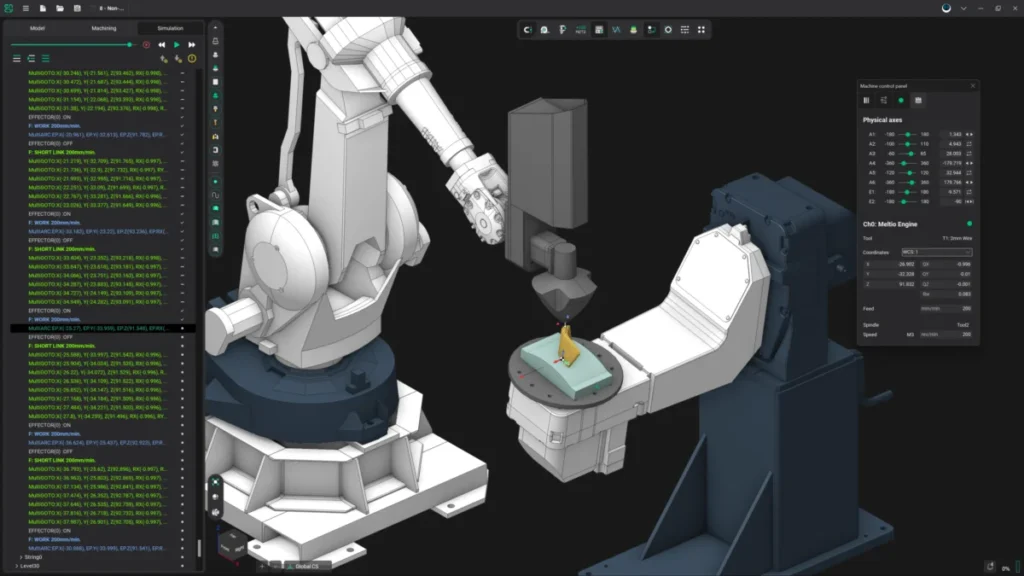
ENCY Robot fundamentally alters this paradigm by enabling comprehensive simulation of the entire manufacturing cell in a virtual environment. This digital twin capability allows engineers to calculate intricate toolpaths, check for axis limits, identify and avoid singularities (robot arm configurations that can lead to unpredictable movements or control loss), and perform full collision control before any physical operation begins. By conducting these critical checks and optimizations offline, ENCY Robot effectively converts what was once unproductive commissioning time into highly productive planning and simulation time.

The platform offers an all-in-one environment that spans design, technology setup, toolpath calculation, and simulation. Its "zero-code digital-twin builder" simplifies the creation of virtual representations of the physical cell, further accelerating the setup process. Extensive libraries of robot models, tools, and processes provide a rich foundation for various applications. Crucially, ENCY acts as a sophisticated translator, directly converting trusted CAM strategies – typically used for designing and optimizing cutting paths for traditional CNC machines – into reliable, executable robot instructions. This seamless translation ensures that the complex geometric data and process parameters defined in CAM are accurately and efficiently transferred to the robot, minimizing errors and maximizing precision.
ENCY’s selection was driven by its broad functionality, capable of handling everything from relatively simple two-axis tasks to highly complex multi-axis cells. Its ability to manage code paths and models internally ensures transparent system behavior, providing users with a clear understanding and control over the robot’s actions. The software comes with a comprehensive suite of out-of-the-box processes, including but not limited to milling, grinding, deburring, polishing, blasting (wet/dry), plasma and laser cutting/welding, waterjet cutting, cladding, painting, cleaning, and gluing. This extensive library offers validated starting points for diverse industrial applications, further accelerating deployment.
Beckhoff: Precision Motion Control at the Core
The second critical component of the Technology Package is the Beckhoff motion controller. Beckhoff Automation, renowned for its PC-based control technology, provides the robust and flexible hardware and software infrastructure necessary to operate the Stäubli robot with the precision and responsiveness of a CNC machine. Unlike proprietary robot controllers that often have closed architectures, the Beckhoff system offers an open, PC-based control platform that seamlessly integrates with standard industrial automation protocols and programming languages.
This controller is responsible for executing standard CNC commands, including feeds (the rate at which the tool moves), modes (such as automatic, manual, or home positions), and frames (coordinate systems for tool and workpiece positioning). The Beckhoff controller effectively translates the sophisticated toolpath data generated by ENCY Robot into precise, real-time motion commands for each of the robot’s axes. This level of control is paramount for achieving the tight tolerances and smooth trajectories required in high-accuracy applications. Beckhoff’s TwinCAT automation software suite, often at the heart of their controllers, offers advanced motion control functionalities, including interpolation, kinematic transformations, and dynamic response optimization, all crucial for achieving CNC-level performance from an industrial robot. The use of a Beckhoff system also simplifies integration with other plant-level automation, PLCs, and HMI systems, creating a truly unified control environment.
Stäubli: Robust Robotics for Demanding Applications
The final cornerstone of the solution is the Stäubli industrial robot, which serves as the physical executor of the precisely calculated paths. Stäubli robots are highly regarded in the industry for their exceptional precision, repeatability, and robust construction. These characteristics are particularly vital for the demanding applications targeted by CNC Solutions’ Technology Package, especially those involving abrasive processes such as grinding and milling.
Stäubli robots are known for their high rigidity and low backlash gearboxes, which contribute directly to their superior accuracy and the ability to maintain consistent trajectories even under significant processing forces. Furthermore, their sealed construction is a critical feature, providing inherent resistance to dust, debris, and liquids common in harsh industrial environments. This sealed design ensures reliability and longevity, particularly in applications like abrasive sanding or plasma cutting where fine particles or spatter could otherwise compromise robot components.
The seamless integration of a CNC-style motion layer for trajectory execution with the Stäubli robot’s inherent capabilities is what truly differentiates this solution. It allows the robot to perform complex, continuous path movements with the smoothness and accuracy traditionally associated with dedicated CNC machines, rather than the point-to-point movements typically associated with general-purpose industrial robots. This combination of mechanical robustness and advanced motion control is indispensable for achieving the required quality and consistency in precision manufacturing.
Unpacking the "Technology Package": Features and Functionality
The comprehensive "Technology Package" is designed to be a ready-to-deploy solution for integrators, significantly reducing the complexity and time typically associated with setting up advanced robotic CNC cells. It represents a plug-and-play approach, where the Stäubli robot connects to the Beckhoff controller with a single cable, simplifying wiring and reducing potential points of failure.
The package includes predefined processes meticulously tailored to various applications and cell configurations. These "machine-tuned processes" for operations such as milling, welding, sanding, and laser cutting, provide integrators with a validated and optimized starting point, drastically cutting down on development and testing time.
Standard features within the package mirror those found in conventional CNC machine tools, ensuring a familiar and intuitive operating experience for skilled technicians. These include:
- CNC-style operating modes: Auto, Manual, and Home, allowing for flexible control depending on the operational phase.
- Feed overrides: Operators can adjust the processing speed in real-time, optimizing for material conditions or desired finish.
- Emergency-stop logic: Robust safety protocols are integrated to ensure immediate and safe shutdown in critical situations.
- Process I/O and communication interfaces: The system provides comprehensive input/output capabilities and integrates seamlessly with plant networks via standard industrial communication protocols like OPC UA, facilitating data exchange and supervisory control.
- Speed control during automatic operation: Dynamic adjustment of execution speed to meet process requirements.
- Manual moves using encoder-wheel controls: Providing tactile, precise control for setup and fine-tuning, mimicking traditional CNC pendants.
Recognizing that real-world manufacturing cells rarely perfectly match theoretical specifications, the Technology Package incorporates advanced features designed to compensate for these deviations, which typically require significant setup time and specialized expertise:

- Absolute, TCP, and frame calibration: Critical for accurately defining the robot’s base, tool center point (TCP), and workpiece coordinate systems, ensuring precise alignment and repeatable operations.
- Singularity management: Intelligent algorithms to detect and mitigate singularities, preventing unpredictable robot behavior.
- OPC UA connectivity: Enables robust, secure, and standardized communication with other systems and the broader Industrial Internet of Things (IIoT), facilitating data acquisition, analytics, and remote monitoring.
- Real-time path adjustments: The system can dynamically modify robot trajectories during operation to account for sensor feedback or minor environmental variations, maintaining precision.
- Tool-wear compensation: Algorithms that adjust toolpaths to compensate for tool wear, extending tool life and ensuring consistent part quality without manual intervention.
The core system comprises a Beckhoff motion cabinet equipped with a CNC-style Human-Machine Interface (HMI) and a handheld pendant, providing intuitive control. ENCY software handles offline programming, simulation, and critical collision or singularity checks. The streamlined single-cable connection to a Stäubli robot underscores the system’s focus on ease of deployment. All these components are delivered with the aforementioned predefined processes and engineered to perform reliably in real-world scenarios, complete with advanced calibration and compensation features. A key benefit is the elimination of the need to master vendor-specific robot programming languages; the entire stack operates as a unified CNC axis group, allowing existing expertise in PLCs, safety systems, fixturing, end-effectors, and process knowledge to be directly applied.
Operational Impact and Industry Implications
The introduction of CNC Solutions’ Technology Package marks a pivotal advancement in industrial automation, delivering substantial operational impacts and broad industry implications.
Streamlining Workflow and Reducing Time-to-Market
One of the most compelling metrics for integrators is the speed with which they can transition from robot installation to producing the first quality part. By completely eliminating the need for online robot teaching – a process notorious for consuming valuable robot uptime – ENCY allows engineering teams to dedicate their resources to critical aspects such as designing and optimizing fixtures, selecting appropriate tools, and fine-tuning process parameters. This shift significantly reduces idle robot time, accelerating project timelines and improving overall efficiency. The ability to simulate and validate entire processes offline means that when the robot is finally deployed, it is ready to perform with minimal on-site adjustments.
Expanding Capabilities and Elevating Value
The integrated solution empowers integrators to undertake higher-value applications that were previously considered too challenging or uneconomical due to the inherent limitations of traditional teach-in methods. Precision milling, intricate trimming of composite materials, and high-quality abrasive sanding are now within the reliable scope of robotic automation. These applications demand continuous path control, high accuracy, and consistent force application, which the combined Stäubli, Beckhoff, and ENCY system is designed to deliver. This expansion of robotic capabilities enables manufacturers to automate more complex processes, improve product quality, and reduce reliance on highly skilled manual labor for repetitive, yet precise, tasks.
Furthermore, the "no need to master vendor-specific robot languages" aspect is a game-changer for skill development and resource allocation. Instead of investing heavily in training personnel on multiple proprietary robot programming languages, companies can leverage existing expertise in CNC programming, PLC logic, and process engineering. This lowers the barrier to entry for advanced robotic applications and allows integrators to focus on their core competencies, adding value through specialized tooling, safety integration, and overall cell design, rather than struggling with complex robot kinematics and programming syntax.
A New Paradigm for Integrators
For integrators, the Technology Package introduces a new paradigm characterized by standardization and reduced risk. The solution is delivered as a stable, proven system, meaning more project elements can be reused rather than developed from scratch for each new application. This standardization drastically reduces delivery risk and minimizes warranty exposure, as the underlying technology stack has been thoroughly tested and validated. Integrators can confidently expand their offerings into more complex robotic applications, knowing they have a reliable and robust foundation.
CNC Solutions now commercially offers this Technology Package to integrators as a stable, field-proven solution. It is currently operating effectively in various shops, industries, and applications, demonstrating its versatility and reliability in real-world manufacturing environments.
The Future of Robot-Driven CNC
The convergence of industrial robotics and CNC machine tool capabilities, as exemplified by CNC Solutions’ Technology Package, represents a significant leap forward in manufacturing automation. This trend is driven by the demand for greater flexibility, higher precision, and increased efficiency in production processes. By enabling industrial robots to operate with the sophistication and control of traditional CNC machines, this solution blurs the lines between these two historically distinct domains. It promises a future where complex, multi-axis machining and finishing tasks can be performed by versatile robots, adapting quickly to new product designs and production requirements.
As manufacturing continues its evolution towards Industry 4.0 and smart factories, integrated solutions like this will be crucial. They facilitate seamless data flow, enable advanced analytics for process optimization, and support greater automation autonomy. The ability to program, simulate, and control complex robotic movements offline, coupled with robust hardware and an open control architecture, positions manufacturers to tackle the challenges of mass customization, shorter product lifecycles, and the relentless pursuit of operational excellence. The Technology Package is not just a new product; it is a foundational element for the next generation of intelligent, adaptable manufacturing.