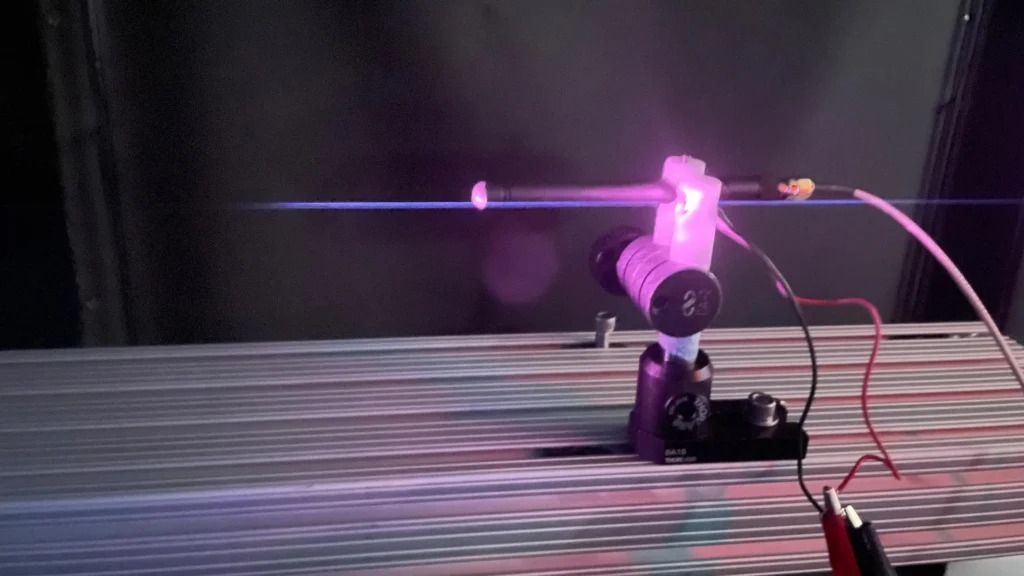
In a significant departure from over a century of traditional radio frequency engineering, researchers at North Carolina State University have successfully demonstrated a functional radio antenna composed not of solid metal, but of laser-induced plasma. This breakthrough technology, which manifests visually as a glowing beam reminiscent of a science-fiction lightsaber, utilizes high-intensity lasers to ionize the air, creating a conductive path capable of transmitting radio waves. The development marks a pivotal moment in the evolution of telecommunications, offering a glimpse into a future where antennas are no longer fixed, rigid structures, but dynamic, tunable, and entirely digital components of a communication system.
The research, led by a team of engineers at NC State in collaboration with scientists from Texas A&M and Princeton University, addresses a fundamental limitation in modern wireless technology: the physical constraints of metal. For decades, the size and shape of an antenna have dictated its operational frequency and efficiency. By replacing copper and aluminum with a laser-steered plasma filament, the team has introduced a level of flexibility previously thought impossible, with profound implications for satellite deployment, military radar, and deep-space exploration.
The Science of Atmospheric Ionization and Plasma Filaments
At the heart of this innovation is the concept of a plasma filament. Plasma, frequently referred to as the fourth state of matter, is created when a gas is energized to the point where its electrons are stripped from their parent atoms or molecules. This resulting "soup" of charged particles—ions and free electrons—becomes highly conductive, allowing it to interact with electromagnetic fields much like a traditional wire.
To create this antenna in the open air, the research team utilized a high-power laser. By precisely controlling the laser’s intensity and beam diameter, they were able to achieve atmospheric ionization along a specific path. This process creates a thin, concentrated channel of plasma known as a filament. Unlike the diffuse plasma found in neon signs or the upper atmosphere, a laser-induced plasma filament is highly localized and can be projected over specific distances.
Prya Darshni, a Ph.D. student at North Carolina State University and the lead author of the study, explains that the visual similarity to a lightsaber is more than just a cosmetic coincidence; it represents a concentrated column of energy. "The plasma beam antenna is tunable, meaning we should be able to transmit across a broad range of frequencies," Darshni noted. While the current experiments focused on transmission, the physics of electromagnetism suggests that these filaments should be equally capable of acting as receivers, potentially replacing the entire physical antenna array of a communication station.
Overcoming the "Physical Connection" Barrier
One of the primary technical hurdles in developing a plasma antenna has always been the method of "feeding" the signal into the plasma. In a conventional radio system, a coaxial cable or waveguide physically connects the radio transmitter to the metal antenna. However, physically touching a high-energy plasma filament with a metal wire would disrupt the ionization process and potentially damage the equipment.
The NC State team solved this through the development of a "contactless antenna feed." This innovative mechanism utilizes a metal ring that acts as a capacitor. The laser beam is fired through the center of this ring without making physical contact. When the radio frequency (RF) generator sends a signal to the capacitor ring, it creates a localized electromagnetic field. As the plasma filament passes through this field, the energy is transferred into the plasma via induction.
This arrangement allows the researchers to modulate the plasma filament with radio data without ever touching it. During their proof-of-concept experiments, the team successfully transmitted a signal at 30 megahertz (MHz), which falls within the Very High Frequency (VHF) band. This frequency range is commonly used for FM radio broadcasting, television, and long-range communication systems.
The Limitations of Traditional Metallic Architectures
To understand the impact of this research, one must consider the rigid requirements of traditional antenna design. The efficiency of a metal antenna is intrinsically tied to its length, specifically its relationship to the wavelength ($lambda$) of the frequency it is intended to carry. A standard "half-wave dipole" antenna must be exactly half the length of the radio wave it is transmitting.
If a system needs to switch from a low-frequency signal (which has a long wavelength) to a high-frequency signal (which has a short wavelength), the physical antenna must either be replaced or mechanically adjusted. In complex environments, such as a naval vessel or a satellite, this requires heavy mechanical masts, telescoping components, or multiple separate antennas, all of which add weight, consume space, and provide potential points of mechanical failure.
Furthermore, metal antennas are susceptible to physical damage and environmental degradation. In space, the deployment of large antenna arrays is a high-risk operation, as evidenced by the complex unfolding sequences required for instruments like the James Webb Space Telescope. A laser-based system eliminates the need for these mechanical deployments, as the antenna is "created" on demand by the laser itself.
Strategic Implications for Aerospace and Space Exploration
The most immediate and transformative applications for plasma filament antennas are found in the aerospace sector. Spacecraft designers operate under "size, weight, and power" (SWaP) constraints, where every gram of mass added to a payload increases launch costs exponentially.
Paul Franzon, the Cirrus Logic Distinguished Professor of Electrical and Computer Engineering at NC State and co-author of the study, highlighted the potential for orbital applications. "In low earth orbit, there is sufficient air to form a plasma," Franzon stated. This suggests that satellites could use the trace gases in the thermosphere to generate antennas.
The advantages for space exploration include:
- Reduced Payload Weight: Removing heavy metal masts and deployment motors allows for more scientific instrumentation.
- Frequency Agility: A single laser source could generate antennas of varying lengths, allowing a spacecraft to communicate with different ground stations or other satellites across various bands (VHF, UHF, etc.) without needing multiple hardware sets.
- Beam Steering and Targeting: By shifting the direction of the laser using mirrors or optical steering, the "antenna" can be pointed toward a target with micro-second precision, far faster than any mechanical gimbal could achieve.
- Reliability: With no moving parts to jam or freeze in the vacuum of space, the reliability of communication links is significantly enhanced.
Data and Experimental Context
The findings, published in the IEEE Journal of Microwaves under the title "Laser-Induced-Plasma-Filament Antenna Transmitting 30 MHz VHF," represent the culmination of interdisciplinary efforts. The team’s success at 30 MHz is particularly notable because lower frequencies require longer antennas. Successfully creating a stable plasma filament long enough to resonate at 30 MHz demonstrates that the laser parameters can be scaled to meet significant engineering requirements.
Supporting data from the study indicates that the plasma filament maintains its conductivity as long as the laser pulse maintains the ionization threshold of the air. The researchers also explored the "tunability" aspect, showing that by adjusting the laser’s focal point and power output, they could effectively "grow" or "shrink" the antenna. This is a digital-to-physical bridge that allows software to control the physical dimensions of the hardware in real-time.
Arthur Dogariu, a researcher affiliated with both Texas A&M and Princeton, provided the critical experimental measurements that verified the signal strength and clarity of the plasma-transmitted waves. The team also credited the NC State Instrument Shop for the precision manufacturing of the contactless feed components, which had to be designed with extreme tolerances to allow the laser to pass through while maintaining the necessary electromagnetic coupling.
Future Directions: From Proof of Concept to Global Standard
While the demonstration of a 30 MHz transmission is a "big step," as lead author Darshni described it, several challenges remain before this technology becomes a commercial or military standard.
The first area of future research involves the "receive" side of the equation. While the physics of reciprocity in electromagnetism dictates that a conductor capable of transmitting should also be capable of receiving, the signal-to-noise ratio of a plasma filament in a "listening" mode must be quantified. Plasma inherently generates some thermal noise, and researchers need to ensure that this noise does not drown out weak incoming signals from distant sources.
The second area of focus is power efficiency. Currently, maintaining a high-power laser to keep air ionized requires a significant energy budget. For terrestrial applications, this might be less efficient than a simple metal wire. However, for specialized applications where flexibility and "steerability" are paramount—such as electronic warfare, where an antenna must be hidden until the moment of use, or in space, where mechanical failure is not an option—the energy trade-off is likely worth the cost.
Finally, the team aims to push the technology into higher frequency bands, such as the gigahertz (GHz) range used by 5G networks and modern satellite links. Higher frequencies require shorter filaments, which may actually be easier to maintain and stabilize than the longer filaments required for VHF.
A Paradigm Shift in Communication
The successful demonstration of the laser-induced plasma filament antenna marks the beginning of a new era in RF (Radio Frequency) engineering. By treating the atmosphere itself as the medium for the antenna structure, scientists have decoupled the function of communication from the limitations of solid matter.
In the long term, this could lead to "smart" communication environments where buildings or vehicles project invisible, temporary antennas only when needed, or where satellites "reach out" with beams of ionized gas to link with one another across the void. As the NC State team continues to refine the performance and efficiency of their "lightsaber" antenna, the boundaries between the digital and physical worlds continue to blur, promising a future of unprecedented connectivity.