Copenhagen, Denmark — In a groundbreaking scientific endeavor, researchers at the University of Copenhagen have successfully recreated the primordial state of matter that is believed to have pervaded the Universe just moments after the Big Bang. This monumental achievement, realized through sophisticated experiments at CERN, involved colliding atomic nuclei far smaller than previously considered capable of producing such extreme conditions. These microscopic "Little Big Bangs" offer an unprecedented window into the Universe’s earliest history and are poised to unravel some of the most profound mysteries in nuclear physics, particularly concerning the fundamental strong force.
The Universe, as we know it today, is a tapestry woven from stars, planets, and atoms. Yet, for a fleeting fraction of a second after its birth, it existed in a state utterly alien to our current reality. This was a realm devoid of protons and neutrons, where their constituent particles—quarks and gluons—roamed freely in an extraordinarily hot and dense "soup" known as quark-gluon plasma (QGP). Understanding this primordial state is crucial for deciphering the cosmic evolution that led to the formation of all visible matter.
The Quest for Primordial Matter: A Journey to the Dawn of Time
For decades, physicists have striven to answer the fundamental question: what was the Universe like before the existence of familiar forms of matter? The Large Hadron Collider (LHC) at CERN, the world’s most powerful particle accelerator, serves as humanity’s most advanced tool in this quest. By smashing atomic nuclei together at nearly the speed of light, scientists aim to momentarily reproduce the extreme energies and densities that characterized the early Universe.
The ALICE (A Large Ion Collider Experiment) collaboration, an international consortium of scientists including researchers from the Niels Bohr Institute at the University of Copenhagen, has been at the forefront of this endeavor. Their primary objective is to study the properties of quark-gluon plasma, a state of matter predicted by quantum chromodynamics (QCD), the theory governing the strong nuclear force. Early experiments at CERN’s Super Proton Synchrotron (SPS) and later at the Relativistic Heavy Ion Collider (RHIC) in the United States provided the first strong evidence for QGP formation, using collisions of very heavy nuclei like gold and lead. The LHC, with its significantly higher collision energies, has since refined these investigations.
A "Little Big Bang" on a Microscopic Scale
Historically, the scientific consensus held that the creation of quark-gluon plasma necessitated collisions between massive atomic nuclei, such as lead-208. The sheer number of protons and neutrons in these heavy nuclei was thought to be essential to generate the immense energy density required for quarks and gluons to deconfine. However, the recent experiments conducted by the ALICE collaboration have dramatically revised this understanding.
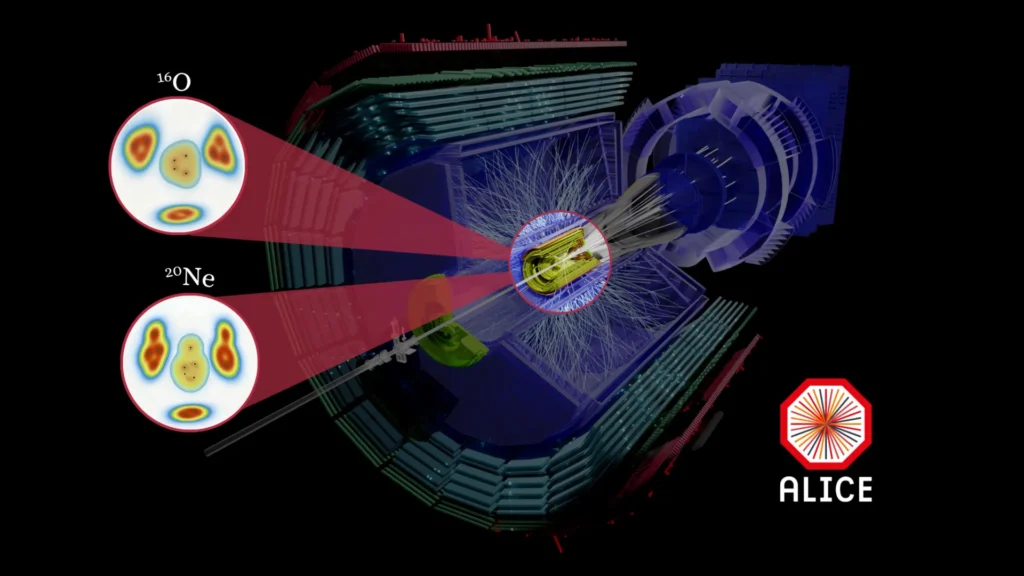
In a pioneering series of experiments, researchers successfully generated quark-gluon plasma by colliding much lighter atomic nuclei: oxygen-16 and neon-20. These nuclei are significantly smaller than lead, challenging long-held assumptions about the minimum size required for QGP formation. "We have pushed the boundary for how small the atomic nuclei can be while still recreating this primordial matter—what you could call a Little Big Bang. We now know more about the fundamental conditions required for matter to transition into this extreme state," explains Associate Professor You Zhou, who led the experiment and was formerly affiliated with the Niels Bohr Institute at the University of Copenhagen.
The implications of this discovery are profound. It suggests that the conditions for QGP formation might be more prevalent or easier to achieve than previously imagined, opening new avenues for research. The findings, a testament to years of meticulous experimental design and data analysis, were recently published in the prestigious journal Physical Review Letters, marking a significant milestone in high-energy nuclear physics.
Unveiling the Universe’s First Moments
The ability to create QGP with smaller nuclei offers an unparalleled opportunity to study the properties of this primordial soup with greater precision. The initial period after the Big Bang, roughly the first millionth of a second (or even less, down to picoseconds), saw temperatures reaching trillions of degrees Celsius and densities far exceeding that of an atomic nucleus. In this environment, the strong force, which normally binds quarks and gluons into composite particles like protons and neutrons, was overcome, allowing them to move freely.
As the Universe expanded and cooled, this quark-gluon plasma underwent a phase transition, much like water turning into ice. Quarks and gluons became confined within hadrons, primarily protons and neutrons. These particles then combined to form the first atomic nuclei, leading to the formation of the first atoms, stars, galaxies, and ultimately, all the complex structures we observe today.
"Hopefully, this will help us better understand how the plasma behaved during the first moments of the Universe—and how it later evolved into the forms of matter that everything around us is made of," You Zhou further elaborates. By studying these smaller QGP droplets, scientists can investigate how the plasma’s collective properties, such as its viscosity and temperature, depend on the size and initial geometry of the colliding system. This could provide crucial constraints for cosmological models describing the Universe’s earliest evolution and the nature of phase transitions in extreme matter.
A Glimpse into Nuclear Geometry: The Bowling Pin Signature
One of the most remarkable aspects of this research is its dual utility: not only does it shed light on the early Universe, but it also offers a novel method for probing the internal structure of atomic nuclei. When atomic nuclei collide at enormous speeds, the resulting quark-gluon plasma droplet, though ephemeral, expands and converts into a shower of other particles. While the plasma itself cannot be directly observed due to its fleeting existence (on the order of 10^-23 seconds), the patterns of these emergent particles carry crucial information about the plasma’s initial state and, by extension, the shape of the colliding nuclei.
The new results demonstrate that these particle movement patterns preserve a distinct "memory" of the original geometric shapes of the colliding nuclei. For instance, collisions between two oxygen nuclei, which are relatively spherical, generate a more rounded, isotropic pattern of emergent particles. In contrast, collisions involving neon-20 nuclei, which possess a prolate deformation (a shape akin to a bowling pin or an American football), create a distinctly elongated, "bowling-pin-shaped" pattern in the particle distribution.
"The particles from the primordial matter are directly governed by the geometric shape of the atomic nucleus. If the two nuclei we smash together are spherical, we get one pattern. If they are shaped like bowling pins, we get another. By studying how the particles move after the collision, we can gain insights into atomic nuclei that are otherwise difficult for physicists to obtain," explains Postdoctoral Researcher Emil Gorm Dahlbæk Nielsen from the Niels Bohr Institute, a co-author of the study. He likens the technique to "shining light on an object and seeing its shadow. You cannot see the object directly, but its shadow reveals its shape. In the same way, the movement of the particles reveals the geometric shape of the atomic nuclei that was present at the beginning of the collision."
Decades of Inquiry: The Strong Force and Nuclear Structure
The quest to understand the shapes and internal structures of atomic nuclei has been a cornerstone of nuclear physics for over 70 years. The Niels Bohr Institute, in particular, has a rich legacy in this field, highlighted by Aage Bohr (son of Niels Bohr) who, along with Ben Mottelson and James Rainwater, received the Nobel Prize in Physics in 1975 for their groundbreaking work on the collective model of the atomic nucleus. This model describes how nuclei can deform and exhibit collective motions like rotations and vibrations, departing from the simple liquid-drop model.
The shape of a nucleus is not merely a geometric curiosity; it provides profound insights into how protons and neutrons are arranged within the nucleus and, crucially, how the strong force operates at subatomic distances. The strong force is one of nature’s four fundamental forces, responsible for binding quarks together into protons and neutrons, and subsequently binding these nucleons into atomic nuclei. Despite its fundamental importance, a complete theoretical understanding of the strong force, especially in complex multi-nucleon systems, remains an active area of research. Nuclear deformation, for example, arises from the delicate balance of the strong force between nucleons and the repulsive electromagnetic force between protons.
Traditionally, physicists have investigated nuclear structure using relatively low-energy experiments, such as spectroscopy measurements that observe how nuclei rotate and vibrate, or electron scattering experiments that probe charge distributions. These methods provide valuable information but can be limited in their ability to resolve fine details of nuclear shapes, especially for short-lived or exotic nuclei.
A Paradigm Shift in Nuclear Probing
The new approach developed by the ALICE collaboration represents a significant departure from traditional methods. Instead of gently probing nuclei at low energies, researchers are now using the extreme conditions of high-energy collisions to essentially "image" their shapes. By analyzing the "shadow" or imprint left by the QGP’s expansion, they can reconstruct the initial geometry of the colliding nuclei.
"A precise understanding of nuclear structure helps us understand the strong force. But instead of carefully investigating nuclei at low energies, we smash them together at the highest energies we can create and can now read their shape from the imprint they leave behind," You Zhou states. This high-energy technique offers a complementary and potentially more powerful tool for nuclear structure physics. It could be particularly valuable for studying exotic nuclei that are difficult to produce in sufficient quantities for traditional low-energy measurements or those that have very short lifetimes.
The researchers believe this technique has the potential to represent a paradigm shift in the field. If further developed and refined, it could offer scientists an entirely new experimental avenue to investigate atomic nuclei whose internal structures and deformations remain poorly understood, thereby enhancing our comprehension of the strong force’s complex dynamics.
The ALICE Collaboration and Global Effort
This groundbreaking research underscores the power of international scientific collaboration. The ALICE experiment at CERN involves over 2,000 scientists from more than 100 institutes across 30 countries. The successful operation of the detector, the collection of vast amounts of data, and the sophisticated analysis required to extract these insights are monumental undertakings that transcend national boundaries. The ALICE detector, an intricate system of sub-detectors, is specifically designed to measure thousands of particles produced in each heavy-ion collision, enabling the detailed reconstruction of the QGP’s properties and the emergent particle patterns. This collaborative spirit is essential for tackling the most complex questions in fundamental physics.
The Road Ahead: Pushing the Boundaries Further
Despite these significant advancements, scientists still face unanswered questions regarding quark-gluon plasma. A key goal for future research is to determine the precise lower limit for the size of a collision system that can still produce QGP. This boundary is crucial for understanding the transition from a collection of individual nucleons to a collective, deconfined state of matter.
The team plans to conduct additional experiments using even lighter atomic nuclei, with helium-4 (alpha particles) being a prime candidate. Collisions involving helium nuclei, with only two protons and two neutrons, would represent the smallest possible systems to explore QGP formation. "What is fascinating is that we can use the same experiment both to learn about the structure of atomic nuclei and to gain a better understanding of what happened during the birth of the Universe. These two things turn out to be much more closely connected than one might initially think," You Zhou concludes, highlighting the remarkable synergy between cosmology and nuclear physics.
Understanding Quark-Gluon Plasma: A Primer
Quark-gluon plasma (QGP) is an extreme state of matter that provides a window into the earliest moments of the Universe.
- Fundamental Constituents: It is composed of quarks and gluons, the elementary particles that are normally confined within protons and neutrons (collectively called hadrons).
- Deconfinement: Under ordinary conditions, quarks are never observed in isolation due to a phenomenon called "color confinement," a property of the strong force. In QGP, however, the temperature and density are so extreme that the strong force’s binding weakens, allowing quarks and gluons to move freely, or "deconfine."
- Extreme Conditions: QGP exists at temperatures exceeding 2 trillion degrees Celsius (2 x 10^12 K), making it the hottest matter ever created in a laboratory, far hotter than the interior of the Sun. Its density is also extraordinarily high, several times that of an atomic nucleus.
- Cosmic Significance: This state is believed to have existed during the first few microseconds (about 10^-6 seconds) after the Big Bang. As the Universe rapidly expanded and cooled, the QGP underwent a phase transition, solidifying into the protons and neutrons that would eventually form all the matter we observe today.
- Properties: Experiments have revealed that QGP behaves like a nearly perfect fluid with extremely low viscosity, a property that challenges conventional understandings of matter. Studying its properties helps physicists test the predictions of quantum chromodynamics (QCD) under extreme conditions.
Broader Implications for Science and Technology
The implications of this research extend beyond the immediate fields of cosmology and nuclear physics. A deeper understanding of matter under extreme conditions could inform other areas of physics, such as astrophysics, particularly in the study of neutron stars and black holes, where matter reaches incredible densities. The advanced detector technologies and sophisticated data analysis techniques developed for experiments like ALICE also have broader applications, including medical imaging and other scientific instrumentation.
Furthermore, by unraveling the mysteries of the strong force, these experiments contribute to a more complete picture of the Standard Model of particle physics, the most comprehensive theory describing the fundamental particles and forces that govern our Universe. Each step forward in recreating and understanding the Universe’s primordial matter brings humanity closer to comprehending its origins and the fundamental laws that shape reality. The "Little Big Bangs" generated at CERN are not just fleeting moments of extreme energy; they are profound messages from the past, guiding us towards a deeper understanding of everything.