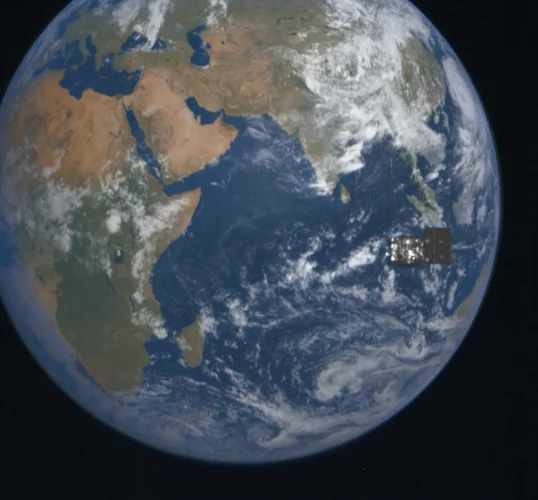
In a remarkable demonstration of advanced space engineering and the unexpected beauty of orbital maneuvers, the European Space Agency’s (ESA) Proba-3 mission has captured a unique image of Earth. While ostensibly focused on observing the Sun’s corona, one of Proba-3’s spacecraft, the Occulter, has provided a breathtaking view of our home planet, cleverly highlighting its own presence within the frame. This image, taken on July 10, 2024, offers a rare glimpse into the intricate operations of this ambitious solar science mission and its surprising artistic output.
A Hidden Observer in Plain Sight
The image, released by ESA, initially appears to be a standard, albeit stunning, photograph of Earth as seen from orbit. Dominating the frame is the vast expanse of the Indian Ocean, with the coastlines of Africa to the west and the archipelagos of Southeast Asia to the east clearly discernible. However, upon closer inspection, a subtle detail emerges: a spacecraft, the Proba-3 Coronagraph, is positioned to subtly obscure a portion of the Indonesian archipelago. This deliberate placement underscores the mission’s primary objective: to precisely position its two spacecraft to create an artificial eclipse of the Sun, enabling unprecedented observations of its elusive corona.
To make the Coronagraph’s presence more apparent, the image is presented with a movable slider. On the right side, the image is presented in its naturally captured, monochrome state, showcasing the Occulter spacecraft in stark black and white against the backdrop of Earth. Moving the slider to the left reveals an artificially colored version, designed to enhance the visibility of the spacecraft and make its integration into the scene more easily digestible for the public. This dual presentation serves not only as a visual aid but also as a testament to the sophisticated processing capabilities involved in presenting complex space data.
The Proba-3 Mission: A Symphony of Formation Flying
The Proba-3 mission is a groundbreaking endeavor by ESA designed to achieve a first-of-its-kind formation flying capability in space. It comprises two identical spacecraft, the Coronagraph and the Occulter, which are intended to fly in precise tandem at a distance of approximately 147 meters from each other. This close proximity is crucial for their scientific objectives. The Coronagraph is equipped with instruments to observe the Sun’s corona, the outermost layer of its atmosphere, which is typically hidden by the Sun’s bright disk. By precisely blocking the Sun’s light, the Coronagraph can capture detailed images of this dynamic and scientifically rich region.
The Occulter spacecraft plays a pivotal role in maintaining this precise formation. It is equipped with an advanced camera system, consisting of a wide-angle camera (WAC) and a narrow-angle camera (NAC). The WAC is designed to track a set of flashing LED lights mounted on the Coronagraph spacecraft. This allows the Occulter to autonomously adjust its position relative to its counterpart, ensuring they remain at the designated separation distance. The NAC provides more precise positioning data, refining the formation and enabling the mission to achieve its scientific goals.
This intricate dance of formation flying is not just about scientific observation; it also presents opportunities for unique imaging. As demonstrated by this recent capture, when the orbital geometry and operational parameters align, the Occulter’s camera system can provide stunning views of Earth. These images, while secondary to the mission’s primary scientific agenda, offer valuable public outreach and a compelling reminder of the human endeavor to explore the cosmos from our own planetary vantage point.
Timeline of a Remarkable Capture
The image captured on July 10, 2024, was not a spontaneous event but occurred during a routine operational phase of the Proba-3 mission. This period involved bringing the two spacecraft from a relatively safe, wider orbit into the critical close proximity required for their formation flight operations. The specific maneuver aimed to establish the 147-meter separation, a crucial step in preparing for extended periods of coordinated flight.
- Pre-Mission Calibration and Testing: Prior to this specific image capture, Proba-3 underwent extensive testing and calibration of its formation flying systems. This included ground-based simulations and initial in-orbit tests to refine the autonomous positioning capabilities of the Occulter spacecraft.
- July 10, 2024: Operational Maneuver: On this date, the mission executed a controlled maneuver to reduce the separation between the Coronagraph and Occulter spacecraft. This involved the Occulter’s camera system actively tracking the LEDs on the Coronagraph to achieve the target distance of 147 meters.
- Image Acquisition: During this maneuver, with the precise alignment of the Sun, the spacecraft, and Earth, the Occulter’s wide-angle camera captured the striking image of our planet, with the Coronagraph subtly visible in the frame.
- Data Processing and Release: Following acquisition, the raw image data was processed by the Royal Observatory of Belgium. This involved colorization of one version of the image to enhance public understanding and highlight the spacecraft’s presence. The processed images were then released by ESA.
Supporting Data and Technical Nuances
The Proba-3 mission is a testament to miniaturization and sophisticated engineering. The two spacecraft, while identical in structure, are equipped with distinct payloads tailored to their roles. The Coronagraph, focused on solar observation, carries instruments like the Sun-shielding coronagraph and a coronagraphic imager. The Occulter, on the other hand, is primarily equipped with the optical navigation system, including the WAC and NAC, as well as its own scientific instruments for complementary observations.
The effective aperture of the Coronagraph is designed to block the Sun’s direct light, creating an artificial eclipse. The diameter of the Occulter, which acts as the artificial moon, is carefully calculated to provide the necessary coverage at the specified distance. The precision required for maintaining the 147-meter separation is on the order of centimeters, highlighting the advanced control algorithms and sensor technology employed. The LED lights on the Coronagraph are specifically chosen for their brightness and spectral characteristics to be reliably detected by the Occulter’s cameras even against the bright backdrop of Earth or the Sun.
The processed image provides several key pieces of information:
- Location: The view is primarily over the Indian Ocean, with visible landmasses including parts of Africa, India, and Southeast Asia. This indicates the orbital path and orientation of the spacecraft at the time of capture.
- Spacecraft Visibility: The Coronagraph spacecraft is depicted as a small, dark object near the right edge of the planet. Its solar panel is also visible, a common feature of spacecraft for power generation.
- Image Split: The slider functionality allows for direct comparison between the raw monochrome data from the Occulter’s camera and an artificially colored representation. This demonstrates the post-processing steps involved in making space imagery more accessible and informative.
Broader Impact and Implications
The Proba-3 mission, even in its operational phase, is contributing significantly to our understanding of space technology and solar physics. The successful demonstration of precise formation flying at such close distances opens up new possibilities for future space missions. These include advanced astronomical observatories that require highly stable, synchronized platforms, and complex scientific instruments that benefit from precise relative positioning.
Beyond its scientific merits, the capture of this Earth image by Proba-3 carries significant implications for public engagement and education. Images like these serve as powerful tools to inspire interest in space exploration and STEM fields. They humanize the complex technical endeavors of space agencies, reminding the public of the beauty and wonder that drives scientific inquiry.
Furthermore, the ability of the Occulter’s camera system to autonomously adjust and capture such images, even incidentally, showcases the robustness and versatility of its optical navigation system. This technology could potentially be adapted for other applications, such as orbital debris monitoring or in-orbit servicing operations, where precise relative positioning of spacecraft is critical.
The successful implementation of Proba-3’s formation flying capability is a milestone for ESA and the international space community. It positions Europe at the forefront of this advanced space operational technique. As the mission progresses and the spacecraft begin their primary solar observations, further groundbreaking discoveries are anticipated, potentially reshaping our understanding of the Sun and its profound influence on our solar system. This Earth image, therefore, serves as a beautiful prelude to the scientific revelations that Proba-3 promises to deliver.