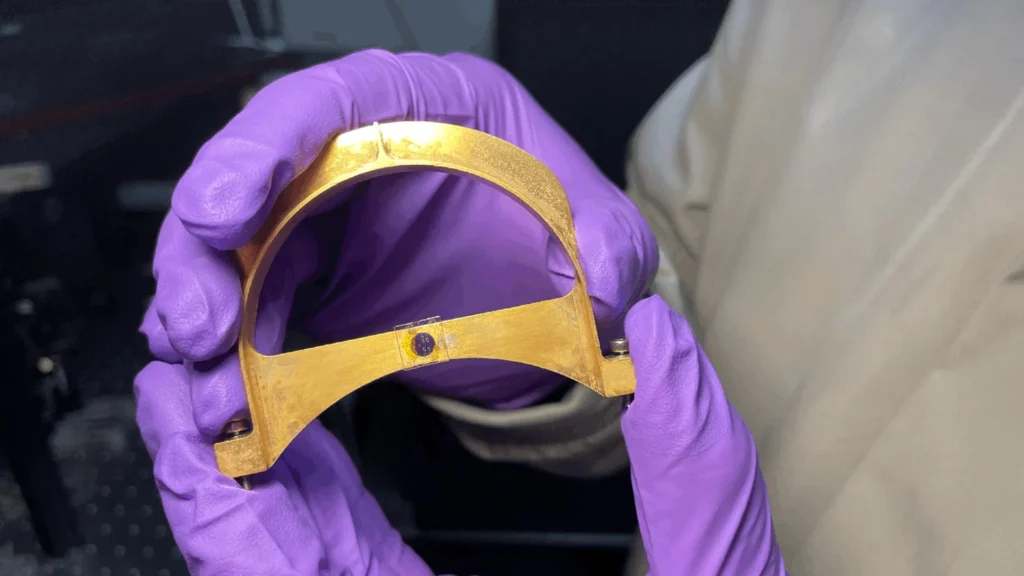
A significant hurdle in the advancement of quantum computing and communication — the necessity for extreme cryogenic temperatures — may soon become less formidable. Researchers at Stanford University have developed a groundbreaking nanoscale optical device that successfully functions at room temperature, establishing a crucial quantum link between light and electrons. This innovation represents a pivotal step toward smaller, more cost-effective quantum technologies capable of robust information transfer over considerable distances, potentially democratizing access to a technology currently confined to highly specialized, multi-million dollar laboratories.
The Quantum Cold War: A Persistent Challenge
For decades, the promise of quantum computing has been tempered by the immense practical challenges of maintaining the delicate quantum states required for computation and communication. These quantum states, embodying phenomena like superposition and entanglement, are incredibly fragile, susceptible to even the slightest environmental disturbances. To mitigate this vulnerability, most operational quantum computers today demand environments near absolute zero, a chilling -459 degrees Fahrenheit (-273 degrees Celsius), a temperature colder than deep space. Achieving and sustaining these conditions necessitates elaborate, energy-intensive cryogenic cooling systems, which are not only prohibitively expensive but also cumbersome in size and operation. This "quantum cold war" has limited quantum technology largely to research institutions and well-funded corporations, impeding its widespread adoption and integration into mainstream applications.
The global quantum computing market, despite these challenges, is projected to grow substantially, from an estimated $1.1 billion in 2023 to over $7.6 billion by 2028, reflecting intense interest and investment. However, a significant portion of this investment is dedicated to overcoming the very physical limitations this Stanford breakthrough aims to address. Reducing the dependence on super-cooling would dramatically lower entry barriers, accelerate research and development, and foster a new era of quantum innovation.
Stanford’s Breakthrough: A Warm Quantum Connection
The core of Stanford’s innovation lies in a novel nanoscale optical device that defies the conventional wisdom of quantum fragility. This device facilitates entanglement — a fundamental quantum phenomenon where two or more particles become inextricably linked, sharing the same fate regardless of distance — between photons (particles of light) and electrons, all while operating at ambient room temperature. This quantum connection is universally recognized as a foundational requirement for building future quantum communication networks, including the much-anticipated "quantum internet."
"The material in question is not really new, but the way we use it is," explains Jennifer Dionne, a professor of materials science and engineering at Stanford and the senior author of the study, recently published in Nature Communications. Dionne emphasizes the device’s ability to provide "a very versatile, stable spin connection between electrons and photons that is the theoretical basis of quantum communication." She notes that a critical challenge with many quantum materials has been the rapid loss of electron spin, rendering them impractical for sustained quantum operations. This new approach appears to circumvent that limitation, preserving the crucial quantum property for longer, useful durations.
Architecting Entanglement: Twisted Light and Exotic Materials
The ingenious design of the Stanford device marries a thin, patterned layer of molybdenum diselenide (MoSe2) with a nanopatterned silicon substrate. Molybdenum diselenide belongs to a fascinating class of materials known as transition metal dichalcogenides (TMDCs), which have garnered significant attention from researchers due to their exceptional optical and quantum properties. These two-dimensional materials, often just a few atoms thick, exhibit unique electronic and optical behaviors that make them ideal candidates for next-generation quantum technologies.
The critical innovation, according to the researchers, resides in the silicon nanostructures. These structures are not merely passive components; they actively generate what the team describes as "twisted light." Feng Pan, a postdoctoral scholar in Dionne’s lab and the paper’s first author, elaborates: "The Silicon nanostructures enable what we call ‘twisted light.’ The photons spin in a corkscrew fashion, but more importantly, we can use these spinning photons to impart spin on electrons that are the heart of quantum computing." This transfer of orbital angular momentum from light to electron spin is the key mechanism behind the stable, room-temperature entanglement.
The precision involved in crafting these components is staggering. Professor Dionne highlights the minuscule scale of the patterned nanostructures: "The patterned nanostructures are imperceptible to the human eye, about the size of the wavelength of visible light." She adds, "But they help us manipulate photons very precisely to make them spin — to twist them — in a specific direction, for example, up or down." This exquisite control over light’s fundamental properties at the nanoscale is what enables the quantum interface.
From Qubits to Quantum Networks: A Simpler Path
This ability to generate twisted light and entangle it with electron spins forms the bedrock for creating qubits, the fundamental building blocks of quantum information systems. Unlike classical bits, which can only represent 0 or 1, qubits leverage quantum mechanical effects like superposition (being both 0 and 1 simultaneously) and entanglement to process and transmit information in exponentially more complex and powerful ways.
The pervasive challenge of decoherence — the rapid loss of delicate quantum information due to environmental interactions — has historically necessitated extreme measures, primarily deep cryogenic cooling, to stabilize quantum states. The Stanford device’s capacity to operate at room temperature fundamentally bypasses this major obstacle, offering a dramatically simpler and more accessible pathway to developing robust quantum technologies. Furthermore, the compact and nanoscale design of the device suggests a relatively inexpensive and practical alternative to the bulky, complex, and high-maintenance quantum systems currently in use.
The implications of such a breakthrough are far-reaching. If successfully scaled and integrated, this technology could catalyze significant advancements across numerous fields. These include ultra-secure communications, where quantum entanglement can enable unbreakable encryption; advanced sensing, allowing for unparalleled precision in measurement; high-performance computing, tackling problems currently intractable even for supercomputers; and the next generation of artificial intelligence algorithms, capable of processing information in fundamentally new ways.
The Material Advantage: Why TMDCs Shine
The research team’s deliberate selection of TMDC materials, specifically molybdenum diselenide, was central to their success. They collaborated closely with Stanford researchers Fang Liu and Tony Heinz, who are renowned specialists in these advanced materials. TMDCs possess unique electronic band structures that allow for strong light-matter interaction and exhibit spin-valley coupling, meaning that the electron’s spin state is tied to its momentum in the material, which can be optically addressed.
"It all comes down to this material and our Silicon chip," Pan emphasizes. "Together, they efficiently confine and enhance the twisting of light to create a strong coupling of spin between photons and electrons. This stabilizes the quantum state that makes quantum communication possible." This synergistic combination of material properties and nanoscale engineering allows for an unprecedented level of control over quantum states, enabling the necessary interaction between light and matter that preserves their fragile quantum properties for communication and computation tasks. The strong exciton binding energies in TMDCs at room temperature are particularly advantageous, as they allow for efficient light emission and absorption that can be harnessed for quantum information processing.
Building the Quantum Future: Challenges and Horizons
While this development marks a significant leap, the researchers are keenly aware that it is a foundational step in a longer journey. Their immediate next steps involve refining the device’s performance, exploring other TMDC materials and various material combinations to optimize efficiency and stability further. They are also investigating whether these novel room-temperature systems might unveil entirely new quantum capabilities not yet conceivable under current cryogenic constraints.
The ultimate, longer-term vision involves integrating devices like this into larger, scalable quantum networks. Achieving this ambitious goal will necessitate concurrent advancements in a suite of supporting technologies, including more efficient light sources, advanced modulators for encoding information, highly sensitive detectors, and robust quantum interconnects to link multiple quantum nodes. The infrastructure for a truly global quantum internet, capable of transmitting entangled particles across continents, is a monumental engineering challenge, but breakthroughs like this provide crucial building blocks.
The historical trajectory of computing, from room-sized mainframes to handheld smartphones, offers a compelling parallel. Researchers hope that quantum components can eventually be miniaturized to a degree that allows their incorporation into everyday electronics. This future, where quantum capabilities might reside in a cell phone, remains many years away, a "10-plus-year plan" as Pan playfully suggests. However, each breakthrough that reduces the physical overhead and cost of quantum technology brings that future closer, making quantum capabilities more accessible, practical, and pervasive. This work by the Stanford team is not just a scientific achievement; it’s a strategic move in the global race to harness the full potential of quantum mechanics for the benefit of humanity.