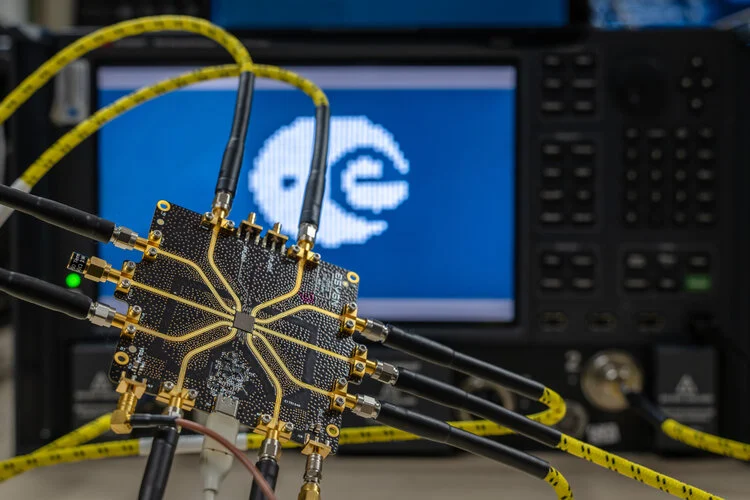
The intricate dance of radio waves, the invisible threads that connect our world from orbit to Earth, is undergoing a profound transformation, driven by miniaturized marvels of engineering. At the heart of this revolution lies a tiny, yet immensely powerful, black chip, a component that acts as the conductor of an electronic orchestra, precisely steering radio beams with unprecedented agility. This critical capability is the bedrock of phased array antennas, a technology poised to redefine the landscape of satellite communications, navigation, Earth observation, and a host of other vital space and terrestrial applications.
Traditionally, antennas have relied on a physical, mechanical ballet to maintain their connection with distant targets. Imagine a satellite dish, painstakingly rotating and tilting to keep a lock on its celestial counterpart. This mechanical approach, while effective for decades, is inherently limited by its physical constraints. It introduces points of failure, increases power consumption, and restricts the speed and precision with which a signal can be redirected. The advent of phased array antennas liberates us from these limitations, offering a paradigm shift where the antenna dish itself remains stationary, and the radio beam is steered electronically.
This electronic steering is orchestrated by specialized microchips, known as beamforming integrated circuits (ICs), nestled within the antenna’s core. These sophisticated devices meticulously control the phase and amplitude of the radio signals emitted or received by an array of antenna elements. By finely tuning these parameters, the beamformer can shape, direct, and even split the radio beam, allowing for rapid, precise, and multifaceted communication without a single moving part. This fundamental principle, known as beamforming, is the key to unlocking the full potential of modern antenna systems.
The journey towards these compact, powerful beamforming ICs has been a testament to the relentless progress in silicon semiconductor technologies. As these chips have become smaller, so too have phased array antennas. This miniaturization has not only enhanced their reliability and performance but has also made them significantly more affordable, paving the way for their widespread adoption across an ever-expanding spectrum of applications. From ensuring seamless global connectivity and enabling precise navigation systems to providing critical data for Earth observation and facilitating ambitious space missions, phased array antennas are becoming indispensable.
ESA’s Longstanding Commitment to Beamforming Innovation
The European Space Agency (ESA) has long recognized the strategic importance of beamforming technology. For decades, the agency has been at the vanguard, actively fostering research and development into innovative methods for electronically steering radio beams. This dedication spans both space-based and terrestrial applications, reflecting a deep understanding of the technology’s transformative potential.
"For decades, ESA has been at the forefront of beamforming technology, exploring innovative ways to electronically steer radio beams for space and terrestrial applications," stated Václav Valenta, an ESA engineer and a leading expert in phased array technology. His words underscore the agency’s sustained commitment to pushing the boundaries of what is possible in this domain.
The current trajectory of development, as highlighted by Valenta, signifies a pivotal moment. "Today, the focus is increasingly shifting towards highly integrated analogue and digital beamforming chips both designed and manufactured in Europe," he elaborated. This shift carries significant strategic weight, promising not only cutting-edge performance but also the crucial advantage of a secure, European-based supply chain. This is particularly relevant in an era where global supply chain vulnerabilities are increasingly scrutinized.
Asygn Unveils Next-Generation Beamforming Capabilities
A tangible demonstration of this European drive for innovation was recently showcased at ESA’s RF Active Technology Laboratory at ESTEC (European Space Research and Technology Centre). The French company Asygn, a key player in the advanced RF components sector, presented its latest generation of beamforming integrated circuits. This event served as a powerful testament to the maturity and sophistication of European semiconductor design and manufacturing.
To vividly illustrate the remarkable level of control Asygn’s microchip offers over the complex process of beamforming, the company’s engineers presented a visually captivating demonstration. They engineered the iconic blue-and-white ESA logo, not through conventional display methods, but by meticulously composing it from hundreds of individual dots. Each of these dots was precisely positioned by applying a specific amplitude and phase setting to the beamformer, a feat that elegantly visualizes the chip’s intricate command over radio wave propagation. This artistic yet scientifically profound display served as a powerful metaphor for the chip’s ability to sculpt and direct radio signals with unparalleled precision.
Clement Jany, Radio Frequency business unit co-director at Asygn, elaborated on the company’s strategic approach. "By designing single-chip solutions dedicated to specific frequency bands – notably X and Ka – we achieve the very high levels of performance required for mission-critical satellite communication applications," he explained. The X-band (8-12 GHz) and Ka-band (26.5-40 GHz) are crucial for modern satellite communications, offering high bandwidth and data rates, essential for applications like high-speed internet, advanced radar, and secure military communications.
Jany further emphasized the practical benefits of Asygn’s technology for the broader industry. "Our objective is to simplify system integration for phased array antenna manufacturers by delivering high-precision phase and amplitude control and an ultra-low noise figure on a single chip," he stated. This focus on integration and performance directly addresses key challenges faced by antenna designers, promising faster development cycles and more robust, efficient antenna systems.
The Technical Underpinnings: Precision Control and Low Noise
The core of beamforming technology lies in its ability to manipulate the phase and amplitude of signals across an array of antenna elements. Consider an array of, say, 100 individual antenna elements. To steer the main beam in a specific direction, the signal fed to each element must be precisely delayed or advanced relative to its neighbors. This precise phase shift, when applied across the entire array, causes the radio waves to constructively interfere in the desired direction, forming a focused beam. Simultaneously, controlling the amplitude of the signal to each element can further shape the beam, suppressing unwanted sidelobes and enhancing signal integrity.
Asygn’s new generation of beamforming ICs reportedly excel in providing this granular control. For X-band applications, which are common in weather radar, satellite communications, and air traffic control, achieving phase resolution of a fraction of a degree and amplitude resolution of a tenth of a decibel is critical for accurate targeting and interference mitigation. Similarly, for Ka-band, where frequencies are much higher, the required precision in phase and amplitude control is even more demanding due to the shorter wavelengths involved.
The "ultra-low noise figure" mentioned by Jany is another critical performance metric. Noise, in electronic systems, is an unwanted random fluctuation that can degrade signal quality. In sensitive receivers, a low noise figure is paramount to detect faint signals from distant sources, such as deep space probes or low-power Earth observation satellites. By integrating low-noise amplification directly within the beamforming chip, Asygn is likely reducing the number of discrete components required in a receiver chain, further contributing to miniaturization and cost reduction.
Implications for the Future of Connectivity and Space Exploration
The advancements demonstrated by Asygn, supported by ESA’s strategic vision, have far-reaching implications across multiple sectors.
Satellite Communications: The proliferation of small satellites (SmallSats and CubeSats) for various applications, from internet constellations to Earth monitoring, demands cost-effective, compact, and highly capable antennas. Beamforming ICs are instrumental in enabling these smaller, more agile platforms to achieve robust communication links. The development of European-designed and manufactured chips ensures a more secure and reliable supply for these growing constellations, reducing reliance on external suppliers.
Navigation Systems: Future satellite navigation systems, such as enhanced Galileo services, could leverage phased array antennas for improved accuracy, increased resistance to jamming and spoofing, and the ability to dynamically adapt beam patterns to user demand or challenging environments.
Earth Observation: Missions focused on climate monitoring, disaster management, and resource mapping will benefit from phased array antennas capable of rapid revisit times and flexible data acquisition. The ability to precisely steer beams to specific areas of interest, or to form multiple beams simultaneously, can significantly enhance the efficiency and utility of these vital missions.
Space Exploration: Deep space missions, often characterized by extreme distances and the need to communicate with very low-power spacecraft, can greatly benefit from the high gain and precise pointing capabilities offered by phased array antennas. The reliability and reduced complexity of solid-state phased arrays compared to mechanical systems are also crucial advantages for long-duration missions where mechanical failure is a significant risk.
Terrestrial Applications: Beyond space, phased array technology is already revolutionizing terrestrial applications like 5G and future wireless communication networks, radar systems for autonomous vehicles, and advanced sensing technologies. European leadership in beamforming ICs can therefore foster broader technological sovereignty and economic growth.
A Timeline of Progress and a Glimpse into the Future
The journey of phased array antennas and their core beamforming components can be traced back to the mid-20th century with early radar systems. However, the widespread adoption of sophisticated, miniaturized beamforming ICs is a more recent phenomenon, accelerating with advances in semiconductor fabrication processes in the late 20th and early 21st centuries.
- Early Concepts (1940s-1960s): Initial development of phased array radar systems for military applications. These were large, complex, and expensive, relying on discrete electronic components.
- Integration and Miniaturization (1980s-2000s): Advances in integrated circuit (IC) technology allowed for the integration of more functionality onto single chips, leading to smaller and more efficient beamforming systems. ESA’s early involvement in research during this period laid the groundwork for future European expertise.
- Modern Era (2010s-Present): The proliferation of silicon CMOS technology and specialized RF IC design techniques has enabled the creation of highly integrated, high-performance beamforming ICs. Companies like Asygn, supported by agencies like ESA, are now pushing the boundaries of analogue and digital beamforming, targeting specific frequency bands and applications.
- Future Outlook: The trend towards greater integration (e.g., System-on-Chip solutions), higher frequencies (e.g., sub-terahertz bands), and advanced AI-driven beam management is expected to continue. European companies, bolstered by initiatives like those from ESA, are well-positioned to be at the forefront of these future developments.
The recent demonstration by Asygn at ESTEC, with the visually striking ESA logo formed by precisely steered radio beams, is not merely a technical showcase. It represents a tangible step towards a future where communication is more agile, more robust, and more accessible, driven by European ingenuity and a strategic commitment to technological sovereignty. As the world increasingly relies on satellite-based services, the tiny black chip at the heart of phased array antennas is quietly orchestrating a revolution, connecting us all with unprecedented efficiency and precision.