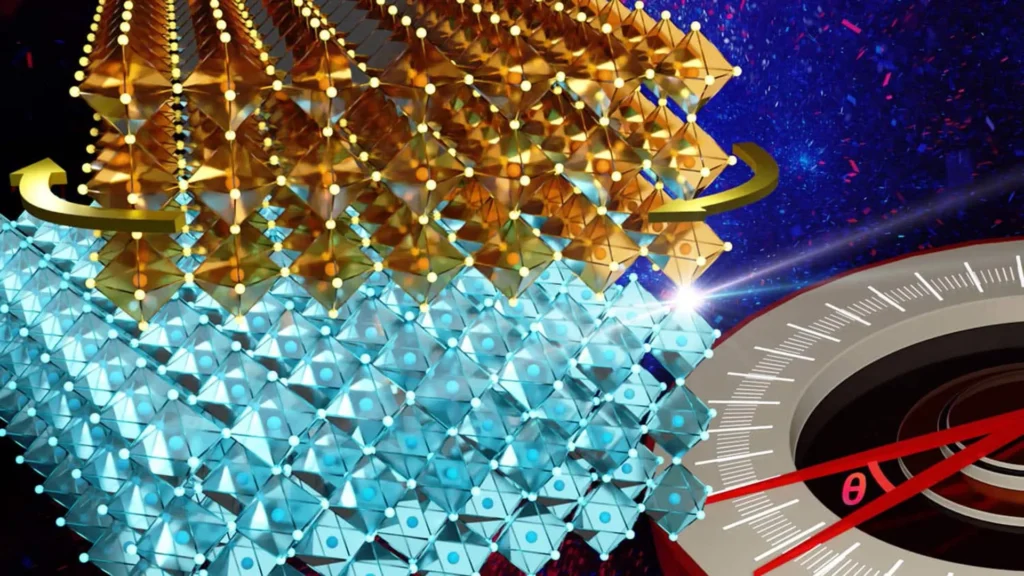
Researchers at North Carolina State University have pioneered a revolutionary method for fabricating twisted oxide materials over significantly larger surface areas than previously possible, while maintaining an unprecedented level of precision over the rotational alignment of individual layers. This breakthrough, detailed in a study published in the journal ACS Nano, represents a major leap forward for the burgeoning field of "twistronics." By granting scientists the ability to control both the macroscopic scale and the microscopic internal structure of these complex materials, the research provides a viable pathway toward the integration of twist-engineered components into practical, next-generation electronic devices.
Twistronics is a specialized branch of condensed matter physics that investigates how the electronic, optical, and mechanical properties of two-dimensional (2D) materials can be fundamentally altered by rotating—or "twisting"—one layer of the material relative to another. This rotation creates a Moiré pattern, a secondary interference lattice that can induce exotic quantum states, including unconventional superconductivity, magnetism, and topological insulation. Until now, the vast majority of twistronics research has been confined to materials held together by weak van der Waals forces, such as graphene or transition metal dichalcogenides. The NC State team’s work breaks this mold by applying these principles to complex oxides, which are characterized by much stronger chemical bonds and a far richer array of functional properties.
The Evolution of Twistronics: From Graphene to Complex Oxides
The field of twistronics gained global prominence in 2018 when researchers at the Massachusetts Institute of Technology discovered that "magic-angle" bilayer graphene—two sheets of graphene twisted at exactly 1.1 degrees—could act as either an insulator or a superconductor. This discovery ignited a race to find other materials that exhibited similar "tunable" properties. However, graphene and its 2D counterparts are primarily bonded by van der Waals forces—the same weak electromagnetic attractions that allow layers of graphite to slide off a pencil lead. While these weak forces make it relatively easy to stack and twist layers in a laboratory setting using the "Scotch tape" exfoliation method, they also limit the stability and the types of electronic interactions possible at the interface.
"The field of twistronics was developed using 2D materials that are bonded by weak van der Waals forces," explains Ruijuan Xu, the corresponding author of the paper and an assistant professor of materials science and engineering at North Carolina State University. "Our work here demonstrates it is possible to use layers of oxide materials that are connected by strong chemical bonds—while precisely controlling the twist angle between crystalline oxide membranes."
Complex oxides are a class of materials that exhibit a vast range of physical phenomena not found in graphene, including ferroelectricity (spontaneous electric polarization), piezoelectricity (electricity generated from mechanical stress), and high-temperature superconductivity. By bringing twistronics to the world of oxides, the NC State team is opening the door to a new "interfacial physics" where the strong chemical bonds between layers can be manipulated to create entirely new phases of matter.
Overcoming the Scalability and Precision Barrier
One of the primary hurdles in moving twistronics from the laboratory to the factory has been the issue of scale. Most twistronic experiments involve flakes of material only a few micrometers in size, which are often irregular in shape and difficult to align with high precision. To address this, the NC State researchers utilized a "deterministic fabrication" approach.
The team focused on sodium niobate (NaNbO3), a complex oxide known for its antiferroelectric properties and its potential in energy storage and electro-optic applications. Using advanced thin-film growth techniques, the researchers produced high-quality, crystalline NaNbO3 membranes. To solve the problem of alignment, they employed photolithography—a standard process in semiconductor manufacturing—to etch visual reference markers around the edges of each membrane. These markers acted as a high-precision "ruler," allowing the researchers to visualize the exact orientation of the membranes during the stacking process.
During the assembly phase, one NaNbO3 membrane was lifted and positioned atop a second membrane. By monitoring the alignment of the reference markers under a microscope, the team could set the rotation angle with extreme accuracy. This method effectively removes the "guesswork" often associated with stacking 2D materials, allowing for a repeatable and scalable manufacturing process.
The Role of Thermal Annealing and Chemical Bonding
Unlike van der Waals materials, which stay together primarily due to proximity, the oxide membranes in this study were engineered to form robust chemical bonds. Once the desired twist angle was achieved, the researchers subjected the stacked membranes to a specialized annealing process. Annealing involves heating the material to a specific temperature for a set duration, allowing the atoms at the interface to rearrange and form stable covalent or ionic bonds.
"The strong interlayer bonding we found between oxide layers suggests there may be entirely new interfacial phenomena to explore," says Xu. "We’ve demonstrated the ability to control many of the materials’ characteristics—including phase structure and domain configuration—in ways that offer new routes for designing materials and devices tailored to specific applications."
This chemical bonding is a critical differentiator. In van der Waals materials, the layers can sometimes "slip" or undergo atomic reconstruction that eliminates the twist. In the NC State experiment, the chemical bonds locked the twist in place, creating a permanent, high-integrity superlattice. Furthermore, the researchers found that these bonds were so strong that they actually reshaped the atomic lattice of the material at the boundary.
Synchrotron Analysis: Probing the Atomic Interface
To understand how the twist and the resulting chemical bonds affected the material at the atomic level, the team turned to the Advanced Photon Source at Argonne National Laboratory. Using synchrotron X-ray diffraction—a technique that uses high-energy light to map the positions of atoms—the researchers were able to look deep into the interface where the two layers met.
The data revealed a phenomenon known as "structural proximity effects." Because the bonds between the layers were so powerful, they forced the atomic lattices to distort. Instead of a sharp, abrupt transition between the two twisted layers, the X-ray diffraction showed a gradual rotation of the atomic lattice at the interface. This "lattice relaxation" or distortion suggests that the twist isn’t just a geometric arrangement; it is a physical force that redefines the material’s crystal structure.
"We found that the bonds between the two layers are so strong that they are distorting the atomic structure of the material—creating a gradual rotation of the atomic lattice at the interface between the layers," Xu notes. "We also found changes to the phase structure of the material. It remains to be seen how this will affect material properties, but that’s something we are exploring."
Implications for the Future of Electronics and Quantum Computing
The ability to create large-area, twisted oxide membranes has profound implications for several fields of technology.
- Non-Volatile Memory: Because many oxides are ferroelectric, the ability to control their phase structure through twistronics could lead to new types of high-density, low-power memory chips. By "twisting" the polarization of the material, engineers could potentially create multi-state memory cells that go beyond the binary 0 and 1.
- Neuromorphic Computing: The complex electronic behaviors induced by Moiré superlattices are ideal for mimicking the synaptic functions of the human brain. Large-scale oxide twistronics could provide the hardware foundation for AI hardware that is significantly more energy-efficient than current silicon-based processors.
- Quantum Sensors: The sensitivity of Moiré patterns to external stimuli (such as electric fields or mechanical strain) makes these materials excellent candidates for ultra-sensitive sensors in quantum metrology.
- Energy Harvesting: NaNbO3 and similar oxides are often used in piezoelectric applications. Engineering the twist could optimize the efficiency with which these materials convert mechanical vibrations into electrical energy.
"Scale matters for devices," emphasizes Xu. "Because these crystalline membranes can be fabricated over large areas and transferred onto different supports, this approach provides a practical path toward twist-engineered oxide electronics."
A Collaborative Scientific Effort
The success of the project was the result of an extensive collaboration involving multiple prestigious institutions. The paper, "Deterministic Fabrication of Large-Area, High-Crystallinity Oxide Moiré Superlattices," lists Reza Ghanbar and Eli Rodrigues as co-lead authors. Rodrigues, notably, contributed to the research as an undergraduate at NC State before moving into graduate studies.
The research team also included Ph.D. students Konnor Koons, Kabelo Lebogang, Yiming Ding, and Yueyin Wang, as well as undergraduate Doug Barefoot and Assistant Professor Yin Liu, all from North Carolina State University. External expertise was provided by Young-Hoon Kim and Miaofang Chi of Oak Ridge National Laboratory; Yan Li and Hua Zhou of Argonne National Laboratory; and Miaofang Chi’s dual affiliation with Duke University.
The study received financial backing from a diverse array of organizations, reflecting the high level of interest in the potential of oxide electronics. Funding sources included the National Science Foundation (grants 2442399 and 2340751), the American Chemical Society Petroleum Research Fund, the Army Research Office, and the U.S. Department of Energy. Additionally, the research was supported by a Scialog grant from the Research Corporation for Science Advancement, a program designed to accelerate high-risk, high-reward scientific breakthroughs.
Conclusion: The Horizon of Oxide Twistronics
While the current experiment utilized sodium niobate as a model system, the methodology developed by the NC State team is designed to be a universal platform. The researchers anticipate that the same photolithographic alignment and annealing techniques can be applied to a wide variety of complex oxides, such as strontium titanate (SrTiO3) or bismuth ferrite (BiFeO3).
The transition from small-scale lab curiosities to large-scale, chemically bonded membranes marks a turning point for the field. As scientists continue to explore the "interfacial phenomena" mentioned by Dr. Xu, the focus will shift from simply observing these materials to actively engineering them for the consumer electronics and industrial applications of the 2030s and beyond. "It’s an exciting time for oxide twistronics," concludes Xu, "with new opportunities to engineer complex oxide functionalities through twist."