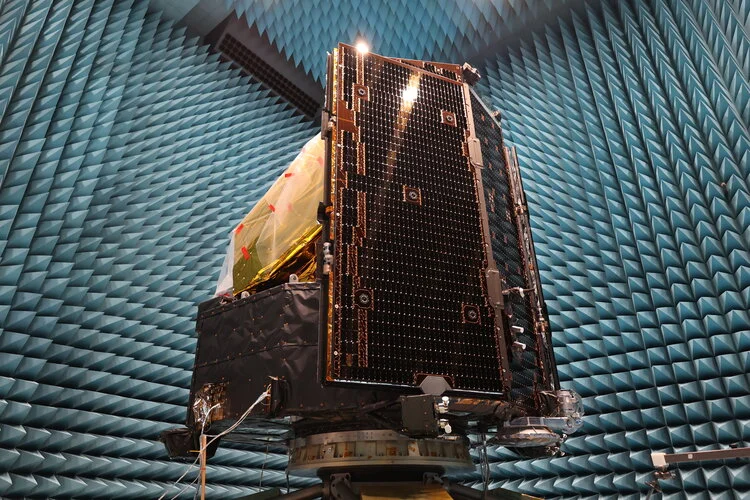
The European Space Agency’s (ESA) ambitious terrestrial planet hunter, Plato, has successfully navigated a critical phase of its pre-launch preparations, demonstrating its readiness for the rigors of space. The spacecraft recently underwent a series of stringent electromagnetic compatibility (EMC) tests within the specialized Maxwell Test Chamber at ESA’s technical heart, ESTEC, in the Netherlands. This milestone signifies that Plato’s intricate electronic systems are robust and will not interfere with each other or with essential communication channels during its deep-space mission.
The Maxwell Test Chamber itself is a marvel of engineering designed to replicate the electromagnetic isolation of space. Its shielded enclosure, fortified with conducting metal walls, floor, and ceiling, functions as a highly effective Faraday cage, meticulously blocking all external electromagnetic interference. This creates a pristine environment where the spacecraft’s internal electronic behavior can be assessed with absolute clarity. The chamber’s imposing 9-meter height is further enhanced by a lining of foam spikes, meticulously arranged from floor to ceiling. These spikes are engineered to absorb stray electrical signals and sound waves, effectively mimicking the silent, signal-free vacuum of space.
Within this controlled environment, engineers remotely activated and commanded Plato’s electronic equipment. The tests involved operating a complex array of instruments and modules simultaneously, a crucial step to identify and mitigate any potential electromagnetic crosstalk. Crosstalk, in this context, refers to unwanted signals or interference generated by one electronic component that can disrupt the proper functioning of another. In the unforgiving vacuum of space, where heat dissipation is different and the absence of atmospheric dampening can alter electronic behavior, such interference could have catastrophic consequences, jeopardizing the mission’s scientific objectives or even leading to irreparable damage to the spacecraft. The successful completion of these tests provides a high degree of confidence that Plato’s electronic architecture is sound and resilient.
This vital EMC testing is part of a comprehensive suite of rigorous examinations that Plato has been undergoing. These assessments are designed to ensure the spacecraft can withstand the extreme conditions it will encounter from launch through its operational life. The Maxwell Test Chamber tests mark the final major hurdle in this extensive evaluation process, effectively granting Plato its "graduation" for launch.
A Phased Approach to Space-Readiness
Plato’s journey to space-readiness has been a meticulously planned, multi-stage process, underscoring ESA’s commitment to mission success. The rigorous testing regimen commenced earlier this year, in January, with a series of vibration and acoustic tests. These initial trials were designed to simulate the immense forces and noise levels experienced during a rocket launch. The spacecraft was subjected to powerful vibrations mimicking the tremors of liftoff and the atmospheric buffeting, as well as intense acoustic waves that can stress sensitive components. Passing these tests confirmed Plato’s structural integrity and its ability to withstand the violent ascent into orbit.
Following the vibration and acoustic assessments, Plato embarked on a month-long sojourn within the Large Space Simulator (LSS). This facility is another critical piece of infrastructure at ESTEC, designed to replicate the extreme thermal and vacuum conditions of space. Inside the LSS, Plato was exposed to near-perfect vacuum and subjected to a carefully calibrated cycle of intense solar radiation and deep cold, simulating the harsh thermal environment it will experience in orbit. The spacecraft successfully "aced" these demanding tests, as previously reported, demonstrating its ability to maintain operational temperatures and withstand the vacuum, a testament to its advanced thermal control systems and materials.
The completion of the Maxwell Test Chamber’s electromagnetic compatibility evaluations represents the culmination of these extensive terrestrial trials. Each stage of testing builds upon the previous one, progressively verifying different aspects of the spacecraft’s resilience and functionality. This phased approach minimizes risks and allows engineers to identify and rectify any potential issues early in the development cycle, a crucial factor in managing complex space missions.
The Mission of Plato: Unveiling Exoplanetary Worlds
Plato, which stands for PLAnetary Transits and Oscillations of stars, is a flagship mission for ESA, tasked with a profound scientific objective: to discover and study a multitude of Earth-like exoplanets orbiting stars in our immediate cosmic neighborhood. Its primary focus will be on identifying rocky planets within the habitable zones of their host stars – the region where conditions might be suitable for liquid water to exist on the surface, a key ingredient for life as we know it.
The spacecraft will employ two primary methods for exoplanet detection: the transit method and asteroseismology. The transit method involves observing the slight dimming of a star’s light as a planet passes in front of it from our perspective. By precisely measuring the duration and depth of these dips in starlight, scientists can determine the planet’s size and orbital period. Asteroseismology, on the other hand, involves studying the subtle oscillations or "starquakes" on the surface of stars. These vibrations reveal crucial information about the star’s internal structure, mass, and age, which in turn allows for a more accurate characterization of the orbiting planets.
Plato’s innovative design includes an array of 26 telescopes, providing a wide field of view and the capability to observe hundreds of stars simultaneously. This enables the mission to survey a vast number of stars with unprecedented efficiency, significantly increasing the chances of discovering new worlds. The mission’s target stars are generally brighter and closer than those observed by previous transit missions, allowing for more precise measurements and detailed characterization of the exoplanets found. This focus on nearby, Sun-like stars is expected to yield a rich harvest of potentially habitable planets, offering invaluable insights into the prevalence of Earth-like worlds beyond our solar system and advancing our understanding of planetary formation and evolution.
Launch Preparations and Future Trajectory
With all major ground-based tests successfully concluded, Plato is now one step closer to its ultimate destination: space. The spacecraft is scheduled to lift off on an Ariane 6 rocket, a testament to the ongoing collaboration between ESA and its European partners in space launch capabilities. Arianespace, the launch provider, has slated Plato’s launch for March 2027. This timeline allows for the final assembly, integration, and preparation of the spacecraft, as well as the rigorous testing and readiness procedures for the Ariane 6 launch vehicle.
The choice of Ariane 6 is significant. This new generation of European launch vehicles is designed to offer increased flexibility, performance, and cost-effectiveness, ensuring Europe’s continued access to space for its ambitious scientific and exploration programs. Plato’s launch will be a critical demonstration of the Ariane 6’s capabilities for complex scientific payloads.
Upon reaching its operational orbit, Plato will embark on a multi-year mission, diligently observing its target stars and meticulously analyzing the data to identify and characterize exoplanets. The scientific return from this mission is anticipated to be immense, potentially revolutionizing our understanding of planetary systems and the possibility of life elsewhere in the universe. The data gathered by Plato will contribute significantly to exoplanetary science, building upon the discoveries of missions like Kepler and TESS and paving the way for future, even more ambitious, exoplanet exploration endeavors.
The successful completion of these rigorous tests at ESTEC represents a significant achievement for the Plato mission and the entire ESA team. It underscores the dedication, expertise, and meticulous planning involved in developing and preparing complex spacecraft for the challenges of space exploration. As Plato moves closer to its launch date, the scientific community and the public alike eagerly anticipate the groundbreaking discoveries that this terrestrial planet hunter is poised to deliver.