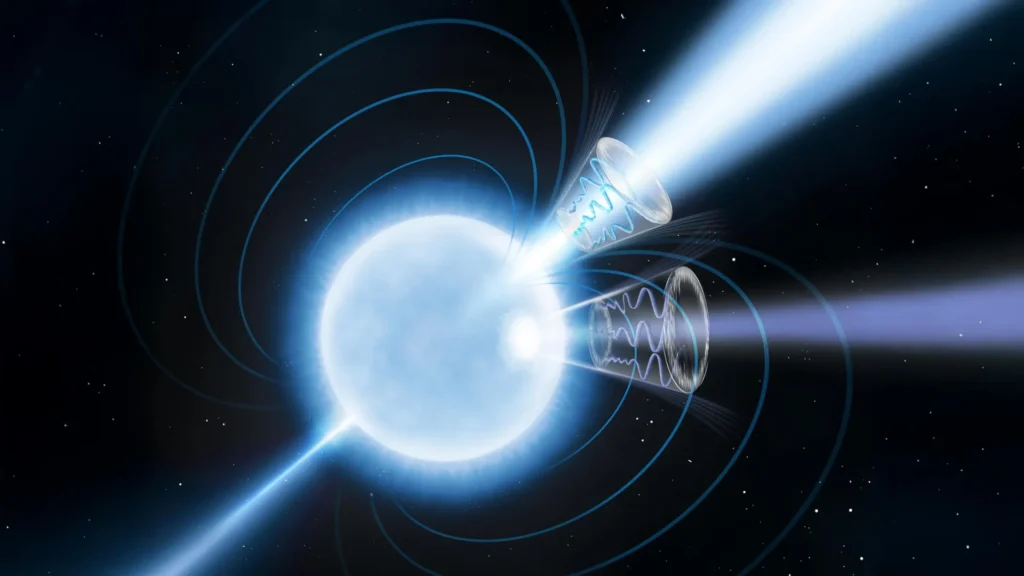
In a landmark study published in the journal Nature, an international team of researchers has unveiled what may be the most compelling evidence to date for vacuum birefringence, a mysterious quantum mechanical effect first predicted nearly a century ago. The discovery, led by astronomers including Dr. Marcus Lower from the Swinburne University of Technology, centers on observations of a magnetar—a specialized type of neutron star—known as 1E 1547.0-5408. By analyzing the way light behaves in the presence of the star’s colossal magnetic field, the team has potentially confirmed a fundamental tenet of Quantum Electrodynamics (QED) that suggests even a total vacuum is not truly empty, but rather a medium capable of influencing the trajectory and polarization of light.
The Quantum Nature of Nothingness
To understand the significance of vacuum birefringence, one must look back to the early 20th century. In 1936, Werner Heisenberg and Hans Heinrich Euler, pioneers of quantum mechanics, proposed a radical departure from classical physics. According to classical electromagnetism, a vacuum is a void—a state of absolute nothingness through which light travels unimpeded and unchanged. However, Heisenberg and Euler’s work in QED suggested that the vacuum is actually a "boiling soup" of virtual particles.
These virtual particles, consisting of electron-positron pairs, are constantly popping into and out of existence. Under normal conditions, they are impossible to detect and have no measurable effect on light. However, Heisenberg predicted that in the presence of an extraordinarily strong magnetic field, these virtual particles would become "polarized"—aligning themselves in a specific direction. This alignment transforms the vacuum into a sort of cosmic prism, causing it to act like a birefringent crystal. In such a medium, light is refracted differently depending on its own polarization, a phenomenon now known as vacuum birefringence.
For nearly 90 years, this prediction remained largely theoretical. The magnetic fields required to trigger the effect are so immense that they cannot be replicated in any laboratory on Earth. It was only with the advent of high-energy astrophysics and the discovery of magnetars that scientists found a natural laboratory capable of testing Heisenberg’s hypothesis.
Magnetars: The Universe’s Most Extreme Laboratories
Magnetars are a rare class of neutron stars, the collapsed cores of massive stars that have ended their lives in supernova explosions. While all neutron stars possess strong magnetic fields, magnetars are in a category of their own. Their magnetic fields are estimated to be 100 million to one billion times stronger than the most powerful magnets ever constructed by humans.
"Detecting vacuum birefringence requires a magnetic field that is over 100 million times stronger than any we’ve ever made on Earth," explained Dr. Marcus Lower. "Thankfully, nature has provided us with magnetars, which are the perfect cosmic laboratories to go looking for this effect."
The subject of this latest study, 1E 1547.0-5408, is one of the most active magnetars known. Located thousands of light-years away, it emits intense bursts of X-rays and radio waves. Because its magnetic field is so concentrated, the space immediately surrounding the star—the vacuum of the magnetosphere—is the ideal environment to observe QED effects in action.
Dissecting the Observations of 1E 1547.0-5408
The research team utilized a multi-wavelength approach to capture a comprehensive picture of the magnetar’s emissions. The primary data came from NASA’s Imaging X-ray Polarimetry Explorer (IXPE), a satellite launched in 2021 specifically designed to measure the polarization of X-rays from cosmic sources. IXPE provides a "polarization map" that allows scientists to see how the electric field of light is oriented as it travels through space.
Supporting these X-ray observations were data from the Neutron Star Interior Composition Explorer (NICER), an instrument located on the International Space Station, and Murriyang, the CSIRO Parkes radio telescope in Australia. The combination of X-ray and radio data allowed the researchers to track the magnetar’s behavior across a broad spectrum of energy.
The team’s analysis focused on the "polarization state" of the radio waves and X-rays as the magnetar rotated on its axis. They discovered two critical pieces of evidence:
- High Linear Polarization: The X-rays detected by IXPE showed an exceptionally high degree of linear polarization. This suggests that the light was not being scattered randomly but was being filtered or shaped by an external force as it left the star’s surface.
- Alignment of Polarization: The direction in which the light waves oscillated remained strictly tied to the direction of the magnetar’s magnetic field. Crucially, the polarization of the X-rays matched the polarization of the radio waves observed by the Murriyang telescope.
The Role of Geometric Alignment
A key factor in the success of this study was the specific orientation of 1E 1547.0-5408 relative to Earth. Through careful modeling and analysis on Swinburne’s Ngarrgu Tindebeek supercomputer, the team determined that the magnetar’s magnetic and rotational axes are nearly aligned. Furthermore, the star is positioned such that we view it from a "pole-on" perspective.
This "ideal viewing geometry" is essential for detecting vacuum birefringence. If the star were viewed from the side, or if its axes were wildly misaligned, the various signals could cancel each other out or become blurred, making it impossible to distinguish the quantum effect from other physical processes.
"By carefully tracking the direction the radio waves and X-rays oscillate as the magnetar rotates, the team found that the alignment of 1E 1547’s magnetic and rotational poles were ideal for detecting vacuum birefringence," Dr. Lower said. In this specific orientation, the vacuum surrounding the magnetar acts as a consistent filter, allowing the QED signature to emerge clearly in the data.
Chronology of a 90-Year Scientific Quest
The journey toward this discovery has been a long-term effort spanning decades of theoretical and observational progress:
- 1936: Werner Heisenberg and Hans Heinrich Euler publish their paper on the "Heisenberg-Euler Lagrangian," predicting that the vacuum can be polarized by strong fields.
- 1960s-70s: The development of the Standard Model of particle physics further refines the understanding of QED and the role of virtual particles.
- 1992: The first magnetars are identified, providing a potential venue for testing strong-field QED.
- 2016: An earlier study using the Very Large Telescope (VLT) found hints of vacuum birefringence in visible light from a different neutron star, but the results were considered suggestive rather than definitive.
- 2021: NASA launches IXPE, providing the specialized instrumentation needed to measure X-ray polarization with high precision.
- 2023-2024: The international team led by Dr. Lower analyzes data from 1E 1547.0-5408, leading to the current findings published in Nature.
Implications for Modern Physics and Future Research
If these findings are definitively confirmed by follow-up studies, the implications for physics are profound. First and foremost, it serves as a powerful validation of Quantum Electrodynamics in the "strong-field regime." While QED has been tested with extreme precision in low-energy environments (such as in atomic physics), its behavior in the presence of ultra-strong magnetic fields has remained largely experimental territory.
The detection of vacuum birefringence also provides a new tool for studying the stars themselves. By understanding how the vacuum affects light, astronomers can more accurately model the surfaces and atmospheres of neutron stars, which are composed of matter so dense that a single teaspoon would weigh billions of tons.
However, the scientific community remains cautious. Dr. Lower noted that while the current evidence is strong, further work is required to rule out all other possibilities. "Additional observations and more advanced computer simulations could help establish whether the signal truly comes from vacuum birefringence," he said. "Those improvements should make it easier for researchers to distinguish the predicted quantum signature from other physical processes taking place around magnetars."
The research team plans to continue monitoring 1E 1547.0-5408 and other magnetars using IXPE and ground-based telescopes. As more data is collected, the statistical significance of the detection is expected to grow.
A New Era of Quantum Astronomy
The study of vacuum birefringence represents a convergence of two traditionally separate fields: particle physics and astronomy. It demonstrates that the most minute, subatomic fluctuations of the universe can have measurable impacts on a cosmic scale.
The success of the IXPE mission and the collaboration between international facilities like Swinburne and CSIRO highlight the importance of multi-wavelength astronomy. By looking at the same object through X-ray, radio, and optical "eyes," scientists are able to piece together the complex puzzle of the quantum universe.
As the scientific community digests the results published in Nature, the consensus is that we are closer than ever to closing a chapter that began in the 1930s. "With these future data on hand and our updated simulations, we may finally be able to complete the quest started by Heisenberg nearly 90 years ago," Dr. Lower concluded. The discovery not only honors the legacy of the pioneers of quantum mechanics but also opens a new window into the fundamental nature of space and time.