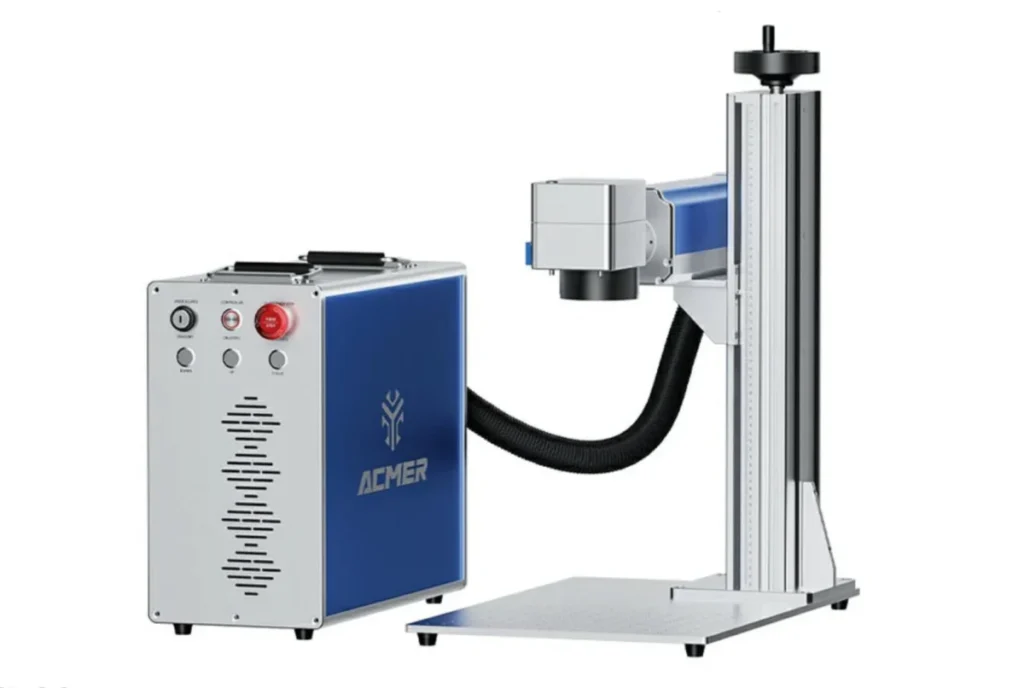
The Acmer SM 60W MOPA split laser marking machine represents a significant shift in the accessibility of industrial-grade fabrication technology for small-to-medium enterprises and advanced prosumers. Priced at approximately $6,299 as tested, this unit bridges the gap between entry-level diode lasers and the high-end industrial systems used in automotive and aerospace manufacturing. While the machine offers exceptional speed and precision, its arrival in the "maker" market brings with it a set of technical complexities and safety considerations that distinguish it from the user-friendly, enclosed consumer units common in the current desktop fabrication landscape.
Technical Specifications and Hardware Architecture
The Acmer SM series is marketed in four distinct configurations to meet various industrial needs: 30W and 50W standard fiber versions, and 60W and 100W MOPA (Master Oscillator Power Amplifier) versions. The MOPA technology is the primary differentiator in the higher-end models, such as the 60W unit reviewed here. Unlike standard Q-switched fiber lasers, MOPA lasers allow for independent control over pulse duration and frequency. This flexibility enables the operator to achieve specific thermal effects on materials, most notably the ability to produce a spectrum of colors on stainless steel and titanium, and to mark certain plastics with higher contrast and less burning.
The hardware is built around a Sino-Galvo scanner, a critical component that uses high-speed oscillating mirrors to direct the laser beam. This architecture allows the machine to reach marking speeds of up to 10,000mm/s—orders of magnitude faster than traditional gantry-style lasers that must move a heavy laser head along an X-Y axis. The "split" design of the Acmer SM refers to the separation of the laser source/control box from the marking column and head. This configuration provides the versatility to mark oversized or irregularly shaped objects that would not fit within a traditional enclosed cabinet.
Chronology of Setup and Assembly
The logistical requirements of the Acmer SM 60W underscore its industrial pedigree. The machine arrives in a heavy-duty crate, necessitating a two-person lift and specialized unboxing tools. This is a departure from the "plug-and-play" experience typical of consumer electronics.

The assembly process, while technically straightforward, requires careful handling of heavy components. A key design feature—and a potential limitation for some shop layouts—is the permanently attached fiber optic umbilical cord that connects the power supply unit to the laser head. This cable contains the delicate fiber optic line and cannot be disconnected by the user, meaning the two main components must be moved and positioned in tandem during setup.
Once the physical components are positioned, the assembly involves:
- Securing the marking column to the heavy aluminum base.
- Mounting the galvo head to the column.
- Connecting the control cables and the included industrial foot pedal.
- Installing the software drivers on a Windows-based PC.
Testing confirms that the physical build quality is robust, utilizing thick-gauge aluminum extrusions and precision-machined components designed to withstand the vibrations and thermal stresses of extended operation.
Operational Performance and Material Compatibility
The primary advantage of the 60W MOPA system is its efficiency in marking metals and hard plastics. In performance testing, complex vector engravings that would require minutes on a standard gantry laser were completed nearly instantaneously. The precision of the Sino-Galvo head ensures that even at high speeds, curves remain smooth and fine details are preserved without the "ghosting" effects sometimes seen in lower-quality scanners.
The material compatibility list for the Acmer SM 60W is specific. It is highly effective on:

- Metals: Stainless steel, aluminum, brass, copper, titanium, and various alloys.
- Stone: Granite, marble, and slate.
- Plastics: High-density plastics and some synthetic polymers.
However, the manufacturer issues a stern warning against using the machine on organic materials such as wood or paper. The 1064nm wavelength of the fiber laser is not efficiently absorbed by most organic materials, and the high power density can lead to immediate combustion rather than controlled engraving. This makes the Acmer SM a specialized tool for metalwork and industrial marking rather than a general-purpose hobbyist engraver.
Software Integration and User Experience
The Acmer SM 60W utilizes BsIAppSimple as its native software, though it maintains compatibility with industry standards such as LightBurn and EZCAD2. The user experience in the native software reflects a "function-over-form" industrial philosophy. Users accustomed to modern, intuitive UI designs may find the interface challenging. For example, the "fill" command—a standard feature for creating solid engraved areas—is labeled simply as "H" within the software.
Furthermore, the machine’s control system relies on a series of switches labeled with a specific order of operations (ON1, ON2, ON3). Deviating from this sequence can potentially lead to errors in the laser’s initialization. While the documentation provides a basic roadmap for operation, there is a steep learning curve regarding the optimization of MOPA parameters. Achieving the advertised color marking on metal requires the precise calibration of five distinct variables: power, frequency, speed, pulse width, and hatch spacing.
Safety Analysis and Environmental Requirements
The most critical consideration for the Acmer SM 60W is its safety profile. As an open-frame Class 4 laser system, it presents significant risks that must be managed by the operator. Unlike enclosed lasers that feature interlocked doors to prevent accidental exposure, the Acmer SM operates with an exposed beam path.
- Optical Safety: The 1064nm infrared beam is invisible to the human eye, meaning a stray reflection could cause permanent retinal damage before the operator is even aware of the danger. While Acmer includes safety glasses, industry experts strongly recommend verifying that any PPE is certified to OD7+ standards for the specific wavelength.
- Fume Management: The process of vaporizing metal and plastic creates hazardous particulates and gases. The Acmer SM does not include a built-in filtration system. Prospective users must install a high-volume fume extractor and ensure the workspace is properly ventilated to prevent the inhalation of toxic metallic dust.
- Operational Controls: The machine includes an emergency stop (E-stop) button and a keyed ignition switch, which are essential for preventing unauthorized use in a shop environment. However, the lack of a protective enclosure remains a primary concern for non-industrial settings.
Market Implications and Industrial Impact
The release of high-powered MOPA lasers at this price point has significant implications for small-scale manufacturing. Previously, the ability to perform high-speed serialized marking, deep metal engraving, and color etching was reserved for facilities with five-figure budgets. The Acmer SM 60W lowers the barrier to entry for:

- Small-batch manufacturing: Serializing parts and tools with permanent, high-contrast marks.
- Personalization businesses: Customizing high-end metal goods, such as watches, knives, and electronics.
- Prototyping: Rapidly iterating designs on industrial materials.
The inclusion of a foot pedal and the capability for 24-hour continuous operation suggests that Acmer is targeting the "prosumer" who intends to use the machine for revenue-generating production rather than occasional hobbyist projects.
Conclusion
The Acmer SM 60W MOPA Split Laser is a formidable industrial tool that offers professional-grade speed and versatility. Its MOPA source provides a level of control over the marking process that standard fiber lasers cannot match, particularly regarding color marking and plastic processing. However, the machine’s power is matched by its complexity and the significant safety responsibilities it places on the user.
For a well-ventilated industrial shop or a professional fabrication environment, the Acmer SM represents a cost-effective path to high-speed metal marking. For the home user or hobbyist, however, the requirements for additional safety enclosures, advanced fume extraction, and a rigorous understanding of laser physics make it a tool that demands respect and careful integration. As the market for fiber lasers continues to expand, the Acmer SM stands as a testament to the democratization of industrial technology, provided the operator is prepared for the technical and safety challenges that accompany such power.