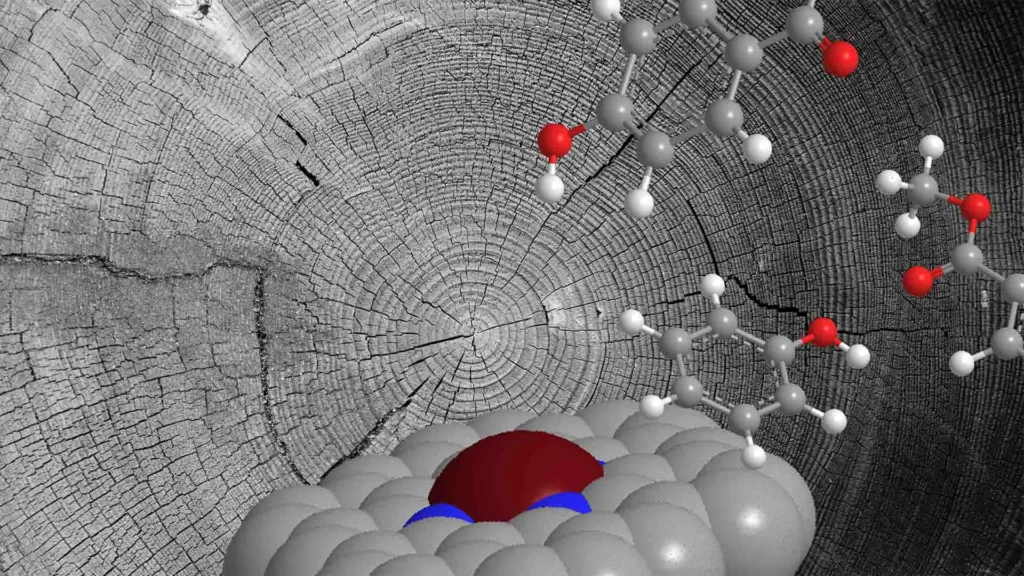
In a significant advancement for green chemistry and sustainable manufacturing, an international research team has unveiled a novel catalytic process capable of breaking down lignin, one of nature’s most resilient and complex organic polymers. The study, published in the prestigious journal ACS Catalysis, details the development of a "single-atom catalyst" (SAC) that targets the robust chemical bonds of lignin with unprecedented precision. Led by experts including Dr. Christopher Parlett, Xinyue Zhou, and Yutao Jiang from the Department of Chemical Engineering, the research provides a molecular-level blueprint for converting agricultural and forestry waste into valuable aromatic chemicals, potentially revolutionizing the transition from petroleum-based production to a circular bio-economy.
The Lignin Challenge: Nature’s Structural Fortress
Lignin is a primary component of the cell walls of terrestrial plants, providing the structural rigidity and water-transporting capabilities necessary for trees and crops to grow tall and survive environmental stressors. As the second most abundant natural polymer on Earth, after cellulose, lignin represents the largest renewable source of aromatic compounds—chemicals characterized by stable ring-like molecular structures that serve as the building blocks for countless industrial products.
Despite its abundance, representing up to 35% of the biomass generated by the global agriculture and forestry sectors, lignin has historically been treated as a low-value byproduct. In the paper and pulp industry, for example, millions of tons of lignin are produced annually but are typically burned for low-grade heat rather than being repurposed into chemicals. The reason for this underutilization lies in lignin’s "recalcitrance." Its molecular structure is a chaotic, three-dimensional web of carbon-oxygen (C-O) and carbon-carbon (C-C) bonds that are notoriously difficult to break without destroying the valuable aromatic rings themselves. Traditional methods of breaking down lignin often require extreme temperatures, high pressures, and corrosive chemicals, which frequently result in low yields and high environmental costs.
Engineering at the Atomic Scale: The Ru-N4 Catalyst
To overcome these structural hurdles, the research team focused on the emerging field of single-atom catalysis. Unlike conventional catalysts, which often consist of clusters or nanoparticles of metal where only the surface atoms are active, single-atom catalysts involve individual metal atoms isolated and anchored onto a supporting material. This approach ensures that every single metal atom is available for the chemical reaction, maximizing efficiency and minimizing the use of expensive noble metals.
The newly developed catalyst features individual ruthenium (Ru) atoms embedded within a nitrogen-doped carbon matrix. This specific configuration creates what the researchers identified as "Ru-N4 sites"—where a single ruthenium atom is coordinated with four nitrogen atoms. This atomic arrangement is the "engine" of the catalyst. By isolating the ruthenium atoms, the researchers prevented the metal from clumping together, a common failure point in industrial catalysts that reduces their effectiveness over time.
"The design allows us to deliver exceptional catalytic performance while using only a fraction of the metal required by traditional systems," explained the research team. This high "atom economy" is a cornerstone of sustainable chemistry, as it reduces the resource intensity of manufacturing the catalysts themselves.
Deciphering the Molecular Mechanism of Bond Cleavage
One of the most significant contributions of the study is the detailed mapping of how the catalyst interacts with lignin at the molecular level. For decades, the exact mechanism of lignin degradation has been a "black box" for scientists. Using a sophisticated combination of laboratory experiments and computational modeling—specifically Density Functional Theory (DFT)—the team was able to visualize the step-by-step process of bond cleavage.
The researchers discovered that the Ru-N4 sites possess a unique ability to activate oxygen molecules (O2) from the surrounding environment. Once activated, these oxygen molecules form highly reactive species that specifically target the strong chemical bridges holding the lignin monomers together.
The process follows a distinct chronology:
- Oxygen Activation: The isolated ruthenium atoms draw in O2, breaking its internal bonds to create active oxygen species.
- Targeted Attack: These species attack the ether bonds (C-O) and alkyl chains (C-C) that link the aromatic rings in lignin.
- Selective Fragmentation: The catalyst breaks these links without degrading the aromatic rings themselves, resulting in high-quality chemical fragments rather than a charred, unusable mess.
This precision is vital because the value of lignin lies in its aromatic rings. If the catalyst were too aggressive, it would break the rings apart, turning the material into simple gases like CO2; if it were too weak, the lignin would remain an unbreakable solid. The Ru-N4 site strikes a "Goldilocks" balance of reactivity.
Experimental Results: High Yields under Mild Conditions
The performance of the single-atom catalyst was tested first on "model compounds"—simplified molecules that mimic the structure of lignin—and then on real-world biomass samples. The results were remarkably consistent.
Under optimized laboratory conditions, the catalyst achieved nearly 100% conversion of model lignin compounds. More impressively, it produced high yields of phenol, a critical industrial chemical used in the production of plastics, adhesives, and pharmaceuticals. Unlike traditional methods that require temperatures exceeding 400°C and high-pressure hydrogen gas, this new process operates under significantly milder conditions.
"The ability to operate at lower temperatures and without the need for harsh, hazardous reagents is a game-changer," said Dr. Christopher Parlett, Lecturer in Chemical Engineering. "It lowers the energy barrier for bio-refineries and reduces the overall carbon footprint of chemical production."
Following the success with model compounds, the team applied the catalyst to "real" lignin extracted from various biomass sources, including agricultural residues. The catalyst successfully transformed these complex, "dirty" samples into a suite of valuable aromatic chemicals. This demonstrates the catalyst’s robustness and its potential for integration into existing industrial waste streams.
Economic and Environmental Implications
The implications of this research extend far beyond the laboratory. Currently, the global chemical industry is heavily dependent on petroleum and natural gas for the production of aromatics like benzene, toluene, and xylene (BTX). As the world seeks to meet net-zero carbon targets, finding renewable alternatives to these fossil-fuel-derived building blocks is essential.
By unlocking lignin as a viable feedstock, this research supports the "circular economy" model. In this framework, the waste from one industry (forestry and agriculture) becomes the raw material for another (chemicals and plastics).
Key potential impacts include:
- Decarbonization: Utilizing biomass waste reduces the demand for crude oil extraction.
- Waste Valorization: Converting agricultural "trash" into chemical "treasure" provides new revenue streams for farmers and the forestry sector.
- Supply Chain Resilience: Moving away from a reliance on volatile global oil markets toward localized biomass sources can stabilize chemical supply chains.
The chemical phenol, which the catalyst produces in high yields, currently has a global market value of over $20 billion. It is a precursor to polycarbonates and epoxy resins, which are essential for everything from medical devices to wind turbine blades.
A Roadmap for the Future of Green Catalysis
The study provides a clear guide for the future design of catalysts. By proving that specific atomic arrangements like the Ru-N4 site are responsible for bond cleavage, the researchers have given the scientific community a template for creating even more efficient materials.
"Understanding exactly how these catalysts work at the atomic level allows us to design better materials for converting renewable resources into valuable chemicals," Dr. Parlett emphasized. This "rational design" approach replaces the traditional "trial and error" method of catalyst development, significantly accelerating the pace of innovation.
The next steps for the research team involve scaling up the production of the catalyst and testing its longevity in continuous-flow industrial reactors. While the laboratory results are a major milestone, the transition to industrial-scale bio-refineries will require further engineering to ensure the catalyst remains stable over thousands of hours of operation.
As global policy shifts toward sustainability—evidenced by the European Green Deal and similar initiatives in North America and Asia—technologies that bridge the gap between waste management and high-tech manufacturing will be at the forefront of the next industrial revolution. The development of the ruthenium single-atom catalyst represents a vital link in that chain, proving that even the toughest of nature’s materials can be harnessed for a more sustainable future.