Researchers at the Massachusetts Institute of Technology (MIT) have developed a groundbreaking system called ShiftLens, which enables the creation of interactive objects without relying on fragile electronic circuits. This innovative technology allows for the fabrication of objects with mechanically switchable surface appearances, opening up new possibilities for adaptive warning signs, dynamic packaging, artistic installations, architectural prototypes, and engineering applications. The system, detailed in a paper to be presented at the ACM Symposium on User Interface Software and Technology, promises to streamline the rapid prototyping of adaptable objects by offering an intuitive, self-contained, and robust interactive display.
The core innovation behind ShiftLens lies in its ability to create dynamic visual states through mechanical interaction rather than electronic components. This addresses a significant limitation of current interactive technologies, which often employ delicate screens and complex circuitry that are susceptible to damage from environmental factors like water, harsh chemicals, or physical stress. Conventional methods that achieve surface appearance changes without electronics, such as static labels or curved lenses, typically offer limited interactivity, providing only static visual effects based on viewing angle. ShiftLens, in contrast, facilitates a more nuanced and responsive user experience by allowing objects to communicate information or change their appearance based on user manipulation.
The Mechanics of Mechanical Interactivity
At its heart, ShiftLens operates by integrating two optical layers onto an object’s surface. The top layer comprises an array of tiny lenticular lenses, specifically designed to refract light in different directions depending on the user’s viewing angle. Beneath this lens layer lies a patterned backplane, which contains strips of images corresponding to the various visual states an object can display. The magic of ShiftLens occurs when the user manipulates the relative position between these two layers. This motion causes different portions of the underlying patterned backplane to come into view. The lenticular lenses then magnify these visible portions, effectively altering the object’s surface appearance.
"The biggest challenge in this project was to make sure all moving parts align," explained Yunyi Zhu, a graduate student in MIT’s Department of Electrical Engineering and Computer Science (EECS) and the lead author of the research paper. "We need to make sure that the optical effect, mechanical linkages, and computational graphics align with one another." This intricate alignment is crucial for achieving the desired visual transitions and ensuring the system’s functionality.
The system’s design process has been meticulously engineered for user-friendliness. Researchers have developed a software tool that automates the complex task of generating a ShiftLens-ready 3D model. This tool requires minimal input from the user, typically involving images of the desired visual states and specifications for the object’s shape and curvature. This approach significantly democratizes the creation of interactive objects, making the technology accessible to individuals without specialized expertise in optics or complex mechanical engineering.
"Another challenge is to communicate to users who are not familiar with optics or mechanical structures and let them specify and achieve what they have in mind," Zhu added. The development team has therefore focused on intuitive design interfaces and clear communication regarding the system’s capabilities and limitations. ShiftLens is most effective when incorporated into objects that inherently allow for the required shifting motion between layers, or when an explicit actuation mechanism, such as a switch, knob, or roller, is integrated into the design. This ensures a seamless and intuitive user experience, where the object’s appearance directly responds to user input.
Addressing the Fragility of Electronic Displays
The development of ShiftLens emerges from a recognized need for more robust interactive technologies. The proliferation of smart devices and the increasing integration of digital interfaces into everyday objects have highlighted the limitations of current approaches, particularly in demanding environments. Many interactive products, from consumer electronics to industrial equipment, rely on sensitive electronic displays and touch sensors. While these technologies offer sophisticated functionality, their vulnerability to physical damage, extreme temperatures, and exposure to liquids or corrosive substances poses a significant challenge.
For instance, consider the scenario of an outdoor warning sign. Traditional electronic signs might require specialized, weather-proof enclosures, increasing cost and complexity. Even with such measures, prolonged exposure to harsh elements can degrade electronic components, leading to malfunctions. Similarly, dynamic packaging designed to alert users to tampering or damage during transit often relies on embedded electronics. However, the rigors of shipping—including impacts, vibrations, and potential exposure to moisture—can easily compromise these delicate circuits, rendering the alert system ineffective.
ShiftLens offers a compelling alternative by leveraging purely mechanical principles. This inherent robustness makes it ideally suited for applications where durability and reliability are paramount. The absence of electronics means that ShiftLens-equipped objects can potentially withstand a much wider range of environmental conditions and physical stresses without compromising their interactive capabilities. This could translate to longer product lifespans, reduced maintenance costs, and enhanced safety in critical applications.
Transforming Prototyping and Design Workflows
The end-to-end system developed by the MIT team is poised to revolutionize the rapid prototyping process across various disciplines. For artists, architects, and engineers, the ability to quickly iterate on designs for adaptable objects is invaluable. ShiftLens streamlines this process by translating a designer’s vision into a tangible, interactive prototype with relative ease. This acceleration in the design cycle allows for more extensive testing and refinement, leading to more innovative and effective final products.
The implications for artistic applications are particularly exciting. Artists could create sculptures or installations that change appearance in response to viewer interaction, ambient conditions, or even programmed sequences, all without the need for complex wiring or power sources. Imagine a kinetic artwork whose surface patterns shift and morph as people move around it, or a piece that subtly alters its coloration based on the time of day.
In architecture, ShiftLens could enable the creation of dynamic building components or models that visually demonstrate different states or functionalities. For example, an architect could prototype a façade element that changes its reflective properties based on sunlight intensity, or a modular interior panel that can be reconfigured to display different information or aesthetics.
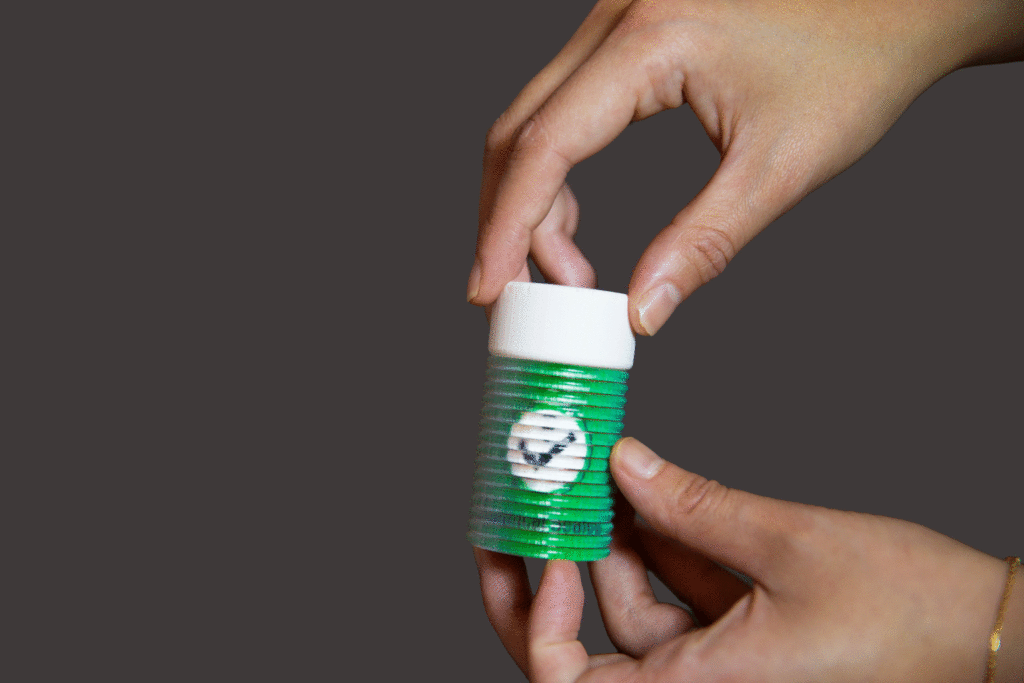
For engineers, the applications are equally diverse. The ability to create self-indicating components—objects that can communicate their status or operational state through their surface appearance—offers a significant advantage. This could range from simple visual cues for assembly instructions to complex feedback mechanisms for machinery. The chemical bottle example provided by the researchers, which changes color and displays a warning symbol when the cap is loose, is a prime illustration of this potential. Such a feature could enhance safety and prevent accidental spills or improper use of sensitive chemicals.
A Timeline of Innovation and Future Directions
The research leading to ShiftLens represents a culmination of efforts in the field of human-computer interaction and tangible interfaces. While the specific timeline of the ShiftLens project is not detailed in the provided text, the publication of their findings at a prominent academic symposium like the ACM Symposium on User Interface Software and Technology signifies a significant milestone. This event is known for showcasing cutting-edge research in user interface design and software, indicating that ShiftLens has undergone rigorous peer review and development.
The researchers involved bring a diverse set of expertise to the project. Yunyi Zhu, the lead author, is a graduate student with a focus on electrical engineering and computer science. Dingning Cao, an undergraduate, contributes to the team’s broader research efforts. Jeremy Mrzyglocki, a graduate student from the Technical University of Munich, suggests international collaboration and a global perspective on the research. Stefanie Mueller, an associate professor at MIT with joint appointments in EECS and Mechanical Engineering, and a member of the Computer Science and Artificial Intelligence Laboratory (CSAIL), provides senior academic leadership and interdisciplinary insight. Narjes Pourjafarian, a postdoc at Northeastern University, further broadens the team’s research network and academic reach. This collaborative environment, spanning multiple institutions and disciplines, has likely been instrumental in the successful development of the ShiftLens system.
Looking ahead, the research team has outlined several avenues for future exploration. One key area of focus is the development of more sophisticated algorithms. The goal is to create a system that can automatically generate ShiftLens structures with even fewer user inputs, further simplifying the design process. This could involve advanced computational techniques that can infer optimal lens and pattern configurations based on a broader range of design parameters.
Another important objective is to enhance the design tool’s versatility by enabling users to incorporate a wider array of actuation mechanisms. This would allow for greater creative freedom and the development of more complex and nuanced interactive functionalities. For instance, the system could be expanded to support multi-axis movements, rotational inputs beyond simple knobs, or even bio-feedback integration, where an object’s appearance changes in response to a user’s physiological signals.
The potential for scaling up these techniques for commercial and industrial applications is a significant aspect of the research. As Zhu noted, the technology could be applied to design piping systems that visually indicate leaks or damaged connections. This practical application underscores the tangible benefits ShiftLens can offer in industrial settings, where early detection of issues can prevent costly downtime and safety hazards. The sentiment expressed by Zhu – "The leaking sink in my apartment would be a lot easier to fix if it could tell me where the leak was coming from" – highlights the relatable, everyday problems that robust interactive surfaces could help solve.
Broader Implications and Future Impact
The advent of ShiftLens signifies a potential paradigm shift in how we conceive of and interact with objects. By decoupling interactivity from fragile electronics, the technology offers a pathway towards more sustainable, durable, and accessible interactive products. This could have profound implications for various sectors:
- Consumer Goods: Imagine everyday items like remote controls, kitchen appliances, or even furniture that can change their appearance or provide intuitive feedback without relying on power-hungry displays or complex circuitry. This could lead to more aesthetically pleasing and environmentally friendly products.
- Education and Training: Interactive learning tools that are robust enough to withstand repeated use by children or trainees could be developed. For example, educational toys that change their appearance to illustrate concepts or provide instructions.
- Healthcare: Medical devices and diagnostic tools could benefit from mechanically interactive surfaces that provide clear, unambiguous feedback in sterile or demanding environments where electronic failures are unacceptable.
- Accessibility: Objects that can adapt their visual presentation to suit users with different visual needs or cognitive abilities could be created, enhancing inclusivity in product design.
The research team’s success in creating a system that bridges the gap between digital interactivity and physical robustness is a testament to the power of interdisciplinary innovation. As the technology matures and its applications expand, ShiftLens has the potential to redefine our relationship with the objects that surround us, making them more informative, responsive, and resilient. The ACM Symposium on User Interface Software and Technology will likely serve as a platform for further discussion and exploration of this promising new frontier in interactive design.