Water, the ubiquitous solvent and lifeblood of Earth, covers approximately 71% of our planet’s surface, yet its fundamental properties continue to challenge scientific understanding, setting it apart from nearly every other known liquid. One of its most universally recognized yet peculiar traits is its expansion upon freezing, a phenomenon that allows ice to float, profoundly influencing aquatic ecosystems and global climate patterns. This counter-intuitive behavior, alongside other anomalies like its unusually high specific heat capacity and maximum density at 4°C, has long been attributed to the dynamic and complex changes in its microscopic structure as temperature and pressure fluctuate. However, the scientific community has historically struggled to establish a consistent, unified framework to describe, compare, and quantify these intricate structural transformations.
This long-standing challenge has now been addressed by researchers at the University of Osaka, who have leveraged the power of artificial intelligence (AI) to develop a novel system. This AI framework provides a standardized and unified methodology for comparing diverse structural descriptors of supercooled water, effectively identifying which descriptors most accurately capture its critical molecular features. The groundbreaking findings from this research were recently published in the esteemed journal Communications Chemistry, marking a significant advancement in our quest to comprehend one of nature’s most essential yet enigmatic substances.
The Enduring Mysteries of Water’s Anomalies
Water’s anomalous behavior is not merely a scientific curiosity; it is a foundational aspect of life on Earth. Most liquids contract continuously as they cool, becoming denser until they solidify. Water, however, behaves differently. As it cools from 100°C, it initially contracts, reaching its maximum density at approximately 4°C. Below this temperature, it begins to expand, becoming less dense until it freezes at 0°C, at which point it expands further by about 9% in volume. This unique property ensures that ice floats, insulating bodies of water below and preventing them from freezing solid from the bottom up, a crucial factor for aquatic life survival in cold climates.
Beyond its density anomaly, water exhibits a host of other unusual characteristics:
- High Specific Heat Capacity: Water requires a substantial amount of energy to raise its temperature, acting as a thermal buffer that moderates Earth’s climate and stabilizes body temperatures in living organisms.
- High Boiling Point: Given its small molecular weight (18 g/mol), water’s boiling point of 100°C is exceptionally high compared to chemically similar hydrides like hydrogen sulfide (-60°C) or ammonia (-33°C).
- High Surface Tension: Its strong cohesive forces create a high surface tension, allowing phenomena like capillary action and supporting small insects on its surface.
- Excellent Solvent: Known as the "universal solvent," water’s polarity enables it to dissolve a vast array of substances, facilitating biochemical reactions within living systems.
These anomalies are fundamentally rooted in the unique molecular structure of water, specifically the presence of hydrogen bonds. Each water molecule (H₂O) consists of one oxygen atom covalently bonded to two hydrogen atoms. The oxygen atom, being highly electronegative, pulls electron density away from the hydrogen atoms, creating a partial negative charge on oxygen and partial positive charges on hydrogen. This polarity allows water molecules to form transient, weak electrostatic attractions—hydrogen bonds—with neighboring molecules. Each water molecule can typically form up to four hydrogen bonds with others, creating a dynamic, three-dimensional network. This network is not static; hydrogen bonds are constantly forming, breaking, and reforming on timescales of picoseconds, giving water its fluidity while simultaneously imparting a degree of structural organization.
The Supercooled State: Pushing Water’s Limits
For liquid water to transition into its solid, crystalline form (ice), its molecules must arrange themselves into an orderly crystal lattice. This process typically initiates at a "nucleation site," a microscopic point or surface where ice crystals can begin to form and grow. These sites can be tiny impurities suspended in the water, dust particles, or even minute scratches on the inner surface of a container.
However, if these nucleation sites are meticulously absent, water can be cooled well below its normal freezing point of 0°C without solidifying. This metastable state is known as supercooled water. In laboratory settings, highly purified water in meticulously clean containers can be supercooled down to approximately -48°C before it spontaneously freezes, a phenomenon known as homogeneous nucleation. Under these extreme conditions, water’s already unusual properties become even more pronounced and complex, exhibiting dramatic changes in its density, compressibility, and specific heat capacity.
Scientists postulate that these exaggerated behaviors in supercooled water are linked to a delicate balance between two distinct, competing forms of liquid water at the molecular level: a high-density liquid (HDL) and a low-density liquid (LDL).
- Low-Density Liquid (LDL): Characterized by a more open, tetrahedral arrangement of molecules, akin to the structure of ice, with strong, directional hydrogen bonds forming an extended network. This structure is less compact.
- High-Density Liquid (HDL): Features a more disordered, compact packing of molecules, with a greater prevalence of ‘broken’ or distorted hydrogen bonds, allowing molecules to pack more closely together.
As the temperature of supercooled water rises, the more compact HDL structures are believed to become increasingly dominant over the more open LDL arrangements. The precise interplay and transition between these two hypothetical liquid forms are considered central to explaining water’s bulk anomalies. However, directly observing and definitively characterizing these subtle molecular differences has remained an immense experimental and computational challenge.
A Historical Conundrum: Describing Water’s Structure
Over decades of intensive research, scientists have proposed numerous theoretical and computational approaches to describe the local arrangement of water molecules. These "structural descriptors" aim to quantify specific aspects of the molecular environment, such as the tetrahedral bond order parameter (which measures the deviation from a perfect tetrahedral arrangement), local density, radial distribution functions, and various angular correlation functions.
The challenge inherent in this multitude of descriptors is their independent development. Each descriptor often utilizes different scales, dimensions, mathematical formulations, and types of information. This lack of a unified language has made it exceedingly difficult for researchers to directly compare their efficacy, determine which ones provide the most relevant insights, or even ascertain if they are all describing the same underlying physical phenomena from different perspectives. Without a consistent comparative framework, evaluating and refining these tools for studying water’s intricate molecular structure has been a slow and often ambiguous process.
The Dawn of AI in Molecular Science
The advent of artificial intelligence, particularly advanced machine learning techniques like neural networks, has revolutionized many scientific disciplines, offering unprecedented capabilities for pattern recognition, data synthesis, and complex problem-solving. In chemistry and materials science, AI is increasingly employed to predict material properties, design novel molecules, and analyze vast datasets generated from simulations and experiments. Its capacity to identify subtle, non-linear relationships within high-dimensional data makes it an ideal candidate for tackling the complexities of molecular structures.
"Past studies have shown that using machine learning to classify and understand structural data is effective," explains Kang Kim, a corresponding author of the Osaka University study, highlighting the growing confidence in AI’s utility in this domain. "We specifically wanted to incorporate a neural network model into this study to evaluate how accurate the descriptors were at capturing key structural information, in a way that is like human cognition." This statement underscores the ambition to move beyond mere data processing, aiming for an AI that can ‘learn’ and ‘recognize’ structural nuances in a manner analogous to human expert intuition, but with far greater speed and objectivity.
Osaka University’s Breakthrough: Unifying Water’s Descriptors
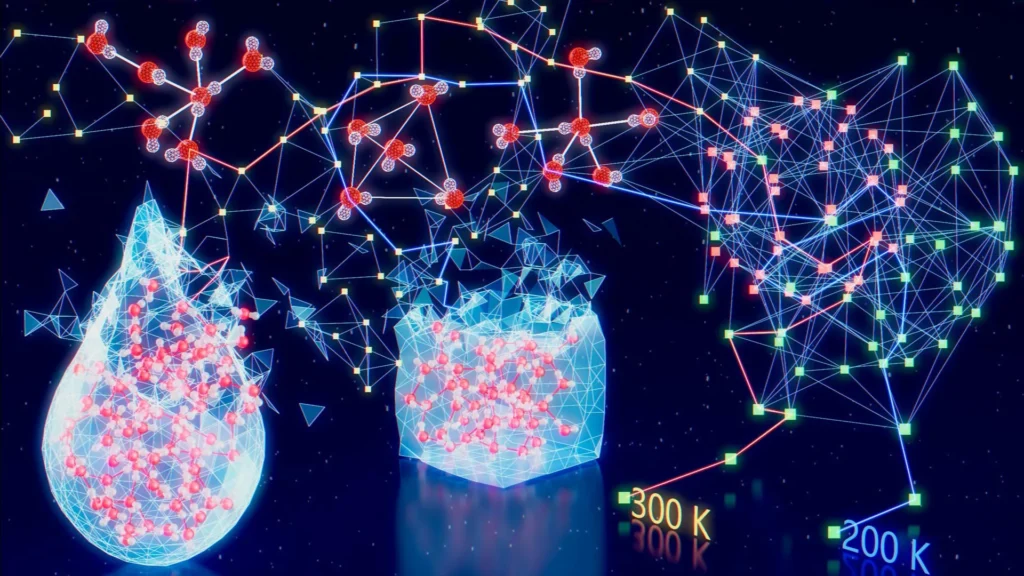
The Osaka University team designed an innovative AI system, centered around a sophisticated neural network, to overcome the long-standing challenge of descriptor comparison. To train this AI, the researchers fed the neural network an extensive dataset comprising structural information generated from molecular dynamics simulations of supercooled water. Molecular dynamics simulations are computational methods that model the physical movements of atoms and molecules over time, providing detailed insights into their trajectories and interactions. These simulations are particularly powerful for studying the dynamic nature of liquid water and its phase transitions.
Through repeated cycles of trial and error, the AI system meticulously analyzed this vast dataset, gradually learning to recognize meaningful patterns within the complex molecular structures of supercooled water. Its training involved distinguishing between the characteristic arrangements associated with the low-density liquid (LDL) and high-density liquid (HDL) states at various temperatures and pressures. This iterative learning process allowed the neural network to develop an internal representation of what constitutes ‘important’ structural information for differentiating these two hypothetical liquid forms.
"The network used what it had learned to compare how 16 descriptors differentiated between LDL and HDL structures at different temperatures," reports Nobuyuki Matubayasi, the senior author of the research. The 16 descriptors evaluated included a diverse range of metrics previously proposed in the literature, such as variations of tetrahedral order parameters, local density fluctuations, and different measures of hydrogen bond connectivity and angular distributions. By feeding the AI system data processed by each of these 16 descriptors, the researchers could quantitatively assess how effectively each descriptor helped the AI distinguish between LDL and HDL structures. "In this way, we determined the most efficient descriptors," Matubayasi concludes, emphasizing the practical outcome of their methodology. The AI provided an unbiased, data-driven ranking of these descriptors, identifying those that consistently and accurately captured the essential structural differences.
Implications for Fundamental Science and Beyond
The framework developed by the Osaka University researchers represents a significant methodological leap, with profound implications for improving scientists’ understanding of how microscopic structural changes in water are intricately connected to its macroscopic thermodynamic behavior. By providing a consistent and robust way to evaluate structural descriptors, this research paves the way for a more precise and unified language to discuss water’s molecular arrangements.
This newfound clarity is expected to accelerate research into the fundamental origin of water’s anomalous properties. A more accurate understanding of the balance and interconversion between HDL and LDL states could unlock secrets about water’s phase transitions, its behavior under extreme conditions (such as those found in planetary interiors or in biological systems undergoing cryopreservation), and even its role in the origins of life.
Beyond fundamental science, the practical applications of this research are far-reaching:
- Cryopreservation: Understanding water’s behavior in supercooled states is critical for improving cryopreservation techniques for biological materials, organs, and tissues, minimizing ice crystal formation that can cause cellular damage.
- Climate Modeling: More accurate molecular models of water can enhance the fidelity of climate simulations, particularly concerning cloud formation, atmospheric processes, and ice dynamics.
- Materials Science: Insights into water’s structure can guide the design of new materials that interact with water in specific ways, such as anti-icing coatings, advanced membranes for water purification, or hydrogels with tailored properties.
- Pharmaceutical Research: Water plays a crucial role in drug solubility, protein folding, and enzyme activity. A deeper understanding of its local structure around biomolecules could inform drug design and formulation.
- Astrobiology: The search for liquid water on other planets and moons is central to astrobiology. Understanding water’s behavior under diverse temperatures and pressures (potentially supercooled) can inform the interpretation of data from extraterrestrial environments.
The methodology itself—using AI to evaluate and unify disparate scientific descriptors—is a powerful paradigm shift. It demonstrates how AI can serve not just as a tool for prediction, but also as a meta-tool for assessing and refining the very language and metrics scientists use to describe complex phenomena. This approach could be replicated in other fields grappling with a multitude of theoretical descriptors, accelerating discovery across various scientific disciplines.
The Path Forward: Guiding Future Discoveries
The Osaka University team’s work is not merely a conclusion but a significant milestone that will guide the development of even better tools for studying water’s complex molecular structure. By pinpointing the most efficient descriptors, future computational models and experimental techniques can be refined to focus on the most relevant structural features, leading to more accurate simulations and more insightful interpretations of experimental data.
This research reinforces the growing symbiotic relationship between advanced computational methods and fundamental scientific inquiry. As AI capabilities continue to evolve, its application in unraveling the deep mysteries of matter, from the simplest water molecule to the most complex biological systems, promises to usher in an era of unprecedented scientific discovery. The seemingly simple molecule of water, so fundamental to our existence, continues to inspire innovation, and with the aid of artificial intelligence, its hidden structures are finally beginning to yield their secrets.