A faint background of extremely low frequency gravitational waves detected through networks of pulsars could contain clues to events that unfolded more than 13 billion years ago, including the emergence of some of the Universe’s earliest supermassive black holes. In a study published as a Letter in Physical Review D, Colgate University researchers Sohan Ghodla and Cosmin Ilie examined whether supermassive black holes that originated in the early Universe could eventually produce a significant share of the gravitational wave background now being measured by Pulsar Timing Arrays, or PTAs. The findings connect two areas of astronomy that may at first seem far apart: the observation of surprisingly massive black holes that already existed when the Universe was young, and the detection of gravitational waves generated billions of years later by pairs of supermassive black holes spiraling toward one another. The researchers found that one possible class of early black hole seeds, remnants left behind by supermassive Dark Stars, could potentially provide a dominant contribution to the PTA signal.
The Nanohertz Symphony: Pulsars as Cosmic Clocks
Pulsar Timing Arrays rely on rapidly spinning neutron stars known as pulsars, which act as extraordinarily precise clocks in space. These stellar remnants, the cores of massive stars that have gone supernova, rotate hundreds of times per second, emitting beams of radio waves that sweep across Earth like lighthouse beams. Because their rotation is so stable, any deviation in the arrival time of these pulses—measured in nanoseconds over decades—indicates a physical change in the space-time between the pulsar and the Earth.
When gravitational waves—ripples in the fabric of space-time predicted by Albert Einstein—pass through the cosmos, they cause space to stretch and compress. This oscillation causes tiny changes in the timing of the radio pulses. By tracking dozens of pulsars over long periods, international research teams, including the North American Nanohertz Observatory for Gravitational Waves (NANOGrav), the European Pulsar Timing Array (EPTA), and others, have recently found evidence for a "stochastic gravitational wave background." Unlike the sharp "chirps" detected by LIGO (Laser Interferometer Gravitational-Wave Observatory) from smaller stellar-mass black holes, this background is a low-frequency hum, a collective signal from countless massive sources across the universe.
The most widely accepted astrophysical explanation for this background is a population of supermassive black hole binaries (SMBHBs) gradually spiraling inward. These systems, where two black holes with a combined mass greater than a billion Suns orbit each other, emit waves at nanohertz frequencies. However, the origin of these titans remains one of the most significant mysteries in modern cosmology.
The Challenge of Cosmic Dawn: The Seed Problem
The discovery of the gravitational wave background coincides with a period of transformation in our understanding of the early universe, spurred largely by the James Webb Space Telescope (JWST). Astronomers have been surprised to find fully formed, supermassive black holes existing just a few hundred million years after the Big Bang.
Under standard models of stellar evolution, it is difficult to explain how a black hole could grow to millions or billions of solar masses so quickly. If a black hole starts as a "small" seed—the remnant of a typical early star—it would have to consume matter at a rate that exceeds the Eddington limit, the theoretical maximum at which a compact object can ingest material before radiation pressure pushes the remaining gas away.
This "seed problem" has led researchers to investigate more exotic origins. Ghodla and Ilie investigated whether the descendants of ancient, massive seeds could persist through cosmic time, grow alongside their host galaxies, eventually pair up, and generate the gravitational wave background detected billions of years later.
Dark Stars: A New Candidate for Black Hole Ancestry
The researchers explored two possible routes for producing massive black hole seeds in the early Universe: direct collapse black holes (DCBHs) and black holes formed through the collapse of supermassive Dark Stars.
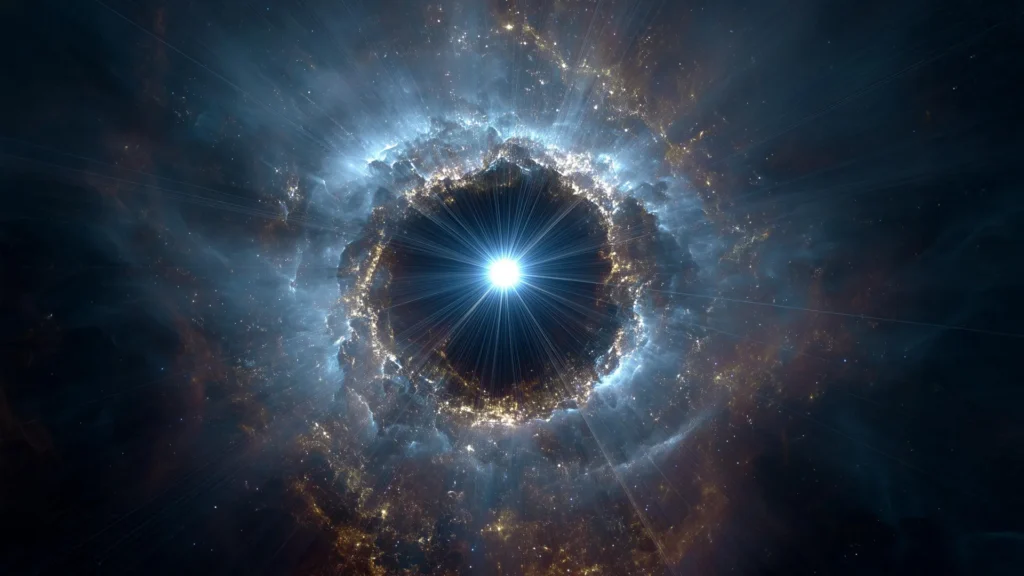
Dark Stars are hypothetical primordial objects that would have existed at the "Cosmic Dawn." Unlike modern stars, which are powered by nuclear fusion, Dark Stars would be fueled by the annihilation of dark matter particles—specifically Weakly Interacting Massive Particles (WIMPs). In this scenario, dark matter trapped within the star’s gravity annihilates, releasing energy that prevents the star from collapsing into a dense, hot core.
Because they are cooler and more extended than fusion-powered stars, Dark Stars can continue to gather material from their surroundings without the intense radiation pressure that halts growth in ordinary stars. Under the right conditions, they might grow to a million times the mass of the Sun or more. When the dark matter fuel eventually runs out, the Dark Star would collapse, leaving behind a massive black hole "seed" already weighing hundreds of thousands or millions of solar masses.
Comparative Modeling and Quantitative Findings
Ghodla and Ilie modeled how black holes produced through these pathways would evolve over 13 billion years. They followed the dark matter halos hosting these black holes, estimated how frequently the objects would merge as galaxies collided, and calculated the gravitational wave background those mergers would produce.
The study’s results indicate a stark difference between the two primary seed models:
- Dark Star Remnants: If remnants of supermassive Dark Stars existed at a number density of roughly $10^-3$ per megaparsec cubed ($Mpc^-3$), their descendants could provide a large, and possibly dominant, share of the gravitational wave signal measured by PTAs.
- Direct Collapse Black Holes (DCBH): These objects form when massive clouds of gas collapse directly into a black hole without forming a star first. However, the conditions required for DCBHs are thought to be rare. With characteristic densities near $10^-6 Mpc^-3$, these objects would contribute substantially less to the observed signal.
The findings suggest that the PTA signal is not just a measure of "recent" mergers (those occurring in the last few billion years) but is heavily influenced by the initial conditions of the universe. "Pulsar timing arrays are usually thought of as probes of supermassive black-hole binaries in the relatively recent Universe," said Ilie. "What our work shows is that the signal may also contain information about how the ancestors of those black holes formed at cosmic dawn."
Chronology of the Dark Star-PTA Connection
To understand the scope of this research, one must look at the timeline of events proposed by the Colgate University team:
- 100–200 Million Years After Big Bang (Redshift z > 15): Dark matter halos begin to form. Within these halos, Dark Stars are born, fueled by WIMP annihilation. They grow to massive proportions.
- 200–400 Million Years After Big Bang: Dark Stars exhaust their dark matter fuel and collapse into massive black hole seeds ($10^4$ to $10^6$ solar masses).
- 500 Million to 2 Billion Years After Big Bang: These seeds act as gravity wells, accelerating the formation of the first galaxies. They begin to merge as their host galaxies collide.
- The "Middle Ages" of the Universe: The black holes continue to grow through gas accretion and successive mergers, reaching the $10^9$ solar mass range.
- Recent Cosmic History (Last few billion years): The descendants of these seeds form binary pairs in the centers of merging massive galaxies. As they spiral toward each other, they emit the nanohertz gravitational waves that permeate the universe.
- The Present Day: Pulsar Timing Arrays on Earth detect the collective "hum" of these mergers, providing a data set that researchers like Ghodla and Ilie use to work backward to the Dark Star era.
Broader Impact and Cosmological Implications
The study provides a new observational link between several major questions in modern cosmology: the nature of dark matter, the formation of the first luminous objects, and the origins of supermassive black holes.
One of the study’s key conclusions is that current PTA measurements can place "upper limits" on how common the earliest seeds could have been. If there were too many massive seeds in the early universe, the gravitational wave background today would be much louder than what we observe. Specifically, seed densities in the $10^-2$ to $10^-1 Mpc^-3$ range would over-produce the signal, according to the researchers’ models.
"Produce too many of these massive seeds and you end up over-producing the PTA-detected signal. Produce too few, and you need other sources to efficiently assemble these supermassive black holes later in the life of the universe to match PTA observations," said Ghodla.
This allows PTAs to act as a "dark matter telescope." If Dark Stars are indeed the primary seeds of SMBHs, then the PTA signal is indirect evidence of WIMP dark matter. This is particularly significant because traditional particle physics experiments have yet to detect WIMPs directly.
The Future of Multi-Messenger Astronomy
As Pulsar Timing Array measurements become more precise through the integration of more pulsars and longer observation windows, the "hum" will resolve into more distinct components. This will allow researchers to distinguish between different seed models with greater clarity.
Furthermore, the upcoming Laser Interferometer Space Antenna (LISA), a space-based gravitational wave observatory scheduled for launch in the 2030s, will be sensitive to the mergers of black holes in the $10^4$ to $10^7$ solar mass range. This is the exact mass range of the initial seeds proposed in the Dark Star model. By combining PTA data (which tracks the most massive descendants) with LISA data (which will track the "teenage" versions of these black holes), astronomers will be able to map the entire life cycle of supermassive black holes.
The work by Ghodla and Ilie suggests that we are on the verge of a new era of "cosmic archaeology," where the ripples in space-time detected today serve as a bridge to the very first structures that formed in the darkness of the early universe. As Ilie noted, "Their descendants could leave a gravitational-wave imprint that persists all the way to the present-day Universe," turning the entire cosmos into a laboratory for the most elusive particles and objects in existence.