A team of researchers, primarily based in the United Kingdom, has achieved a significant breakthrough in robotics, demonstrating the development of tiny robots capable of flying, floating, and steering using only sound waves as their energy source and control mechanism. This innovative approach fundamentally challenges the conventional reliance on pneumatic and electronic systems, which have long been the bedrock of robotic locomotion. By harnessing acoustic energy, these scientists have opened a new frontier for ultra-miniature robotics, potentially enabling machines to operate in environments previously inaccessible to their motor-driven counterparts.
The Genesis of a Sound Idea: Helmholtz Resonance Reimagined
At the core of this groundbreaking technology lies a physical phenomenon known as Helmholtz resonance, a principle first rigorously investigated by the renowned German physician and physicist Hermann von Helmholtz in 1856. Helmholtz, celebrated for his extensive contributions to fields ranging from physics and physiology to psychology and music theory, described how air within a hollow cavity can resonate powerfully when exposed to sound waves matching its natural frequency. This resonance, under specific conditions, can generate a directed jet of air through an opening in the cavity. By increasing the internal pressure within such a resonator, this air jet can become potent enough to induce tangible mechanical movement.
While Helmholtz’s foundational work established the basic principle over a century and a half ago, the practical application of his findings for miniature robotics remained elusive due to technological limitations. The equipment available in the mid-19th century was inherently large and cumbersome, rendering it impractical for creating the tiny, precise structures required for micro-scale locomotion. The concept, though brilliant, lay dormant for decades awaiting the advent of advanced manufacturing capabilities. For context, the late 19th and early 20th centuries saw the burgeoning of electrical engineering, leading to the development of motors that would define robotics for generations, largely overshadowing niche acoustic propulsion concepts until material science and micro-fabrication caught up.
Overcoming Miniaturization Barriers with Precision Manufacturing
The modern era of advanced manufacturing has finally provided the tools necessary to translate Helmholtz’s theoretical insights into practical robotic systems. Crucially, contemporary techniques now allow for the creation of extremely small resonators with exquisitely controlled shapes and dimensions. A pivotal discovery in this research is that as these resonators are scaled down, their optimal operating frequency naturally shifts upwards, eventually entering the ultrasonic range. This characteristic is particularly advantageous because ultrasonic sound, which is beyond the human hearing spectrum (typically above 20 kHz), can be focused with remarkable precision. Unlike audible sound, which would require dangerously loud volumes (e.g., above 120 dB, potentially causing hearing damage) to achieve the necessary power for propulsion, ultrasonic waves can deliver targeted energy without causing acoustic discomfort or damage to human operators or nearby environments. This shift to the ultrasonic domain also minimizes acoustic interference with other systems or human activities.
To fabricate these minuscule resonators, the research team employed a cutting-edge technique known as two-photon 3D printing. This advanced additive manufacturing method enables the creation of complex, three-dimensional structures with feature sizes down to the sub-micrometer scale, far exceeding the resolution of conventional FDM or SLA 3D printing. Unlike traditional methods, which build objects layer by layer from a single plane, two-photon polymerization uses a highly focused femtosecond laser to cure light-sensitive resin at specific points within a larger volume. This precision allows for the construction of hollow structures with internal geometries that are not only incredibly small but also perfectly tuned for acoustic resonance, often requiring tolerances in the tens of nanometers. The ability to achieve such intricate and precise designs was crucial for experimentally testing the resonators and accurately comparing their performance against sophisticated computational fluid dynamics (CFD) simulations, optimizing their shape for maximum thrust and efficiency.
The challenges of miniaturization are profound when dealing with conventional robotic systems. Traditional motors, whether electric (DC, stepper, servo) or pneumatic, rely on a complex interplay of magnets, coils, bearings, and mechanical linkages. As these components are scaled down, maintaining sufficient magnetic force, structural rigidity, and mechanical stability becomes exponentially difficult. For instance, the magnetic fields generated by tiny coils become weaker, often scaling with the cube of the dimension, and the physical integrity of minuscule moving parts is compromised, leading to issues with friction, wear, and power efficiency. A typical micro-motor for a drone, even at a few grams, involves dozens of precision-machined parts. This often sets a practical lower limit on the size of motor-driven robots, typically in the centimeter range for functional flight. In stark contrast, the resonators developed by the UK team are primarily hollow structures, essentially micro-scale acoustical cavities. Their functionality derives from their precise geometry and the physics of sound wave interaction, rather than complex electromechanical components. This fundamental difference means that their size can potentially be reduced far beyond what would be feasible or practical for a conventional motor, opening up avenues for truly microscopic machines that could measure less than a milligram.
Demonstrations of Acoustic Locomotion: From Boats to Microfliers
The researchers initially demonstrated the efficacy of their technology using miniature boats, each measuring approximately 5 centimeters in length. These proof-of-concept vessels were equipped with multiple resonators, each carefully tuned to respond to different frequencies and designed to generate thrust in specific directions. By meticulously altering the pitch (frequency) emitted by an external ultrasonic speaker, the researchers could precisely control the boats’ movement, steering them across a liquid surface with unprecedented agility for a motor-less system. This initial success, reported in publications such as Live Science, validated the core principle of using modulated sound waves for controlled propulsion in a two-dimensional environment. The boats served as a crucial intermediate step, allowing for easier observation and calibration of the acoustic principles before tackling the complexities of three-dimensional flight.
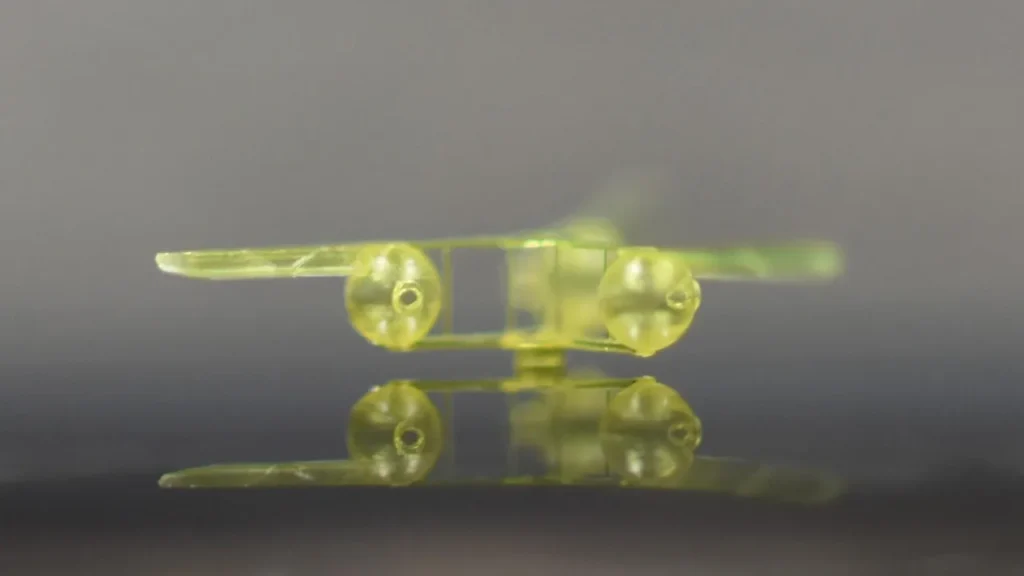
Building upon the success of the miniature boats, the team pushed the boundaries of miniaturization even further, creating "microfliers" that measured as little as 1 millimeter across. These incredibly small devices represent a significant leap in acoustic robotics. The microfliers employed different mechanisms for lift and propulsion. Some were designed to generate downward air thrust directly from their resonators, enabling them to levitate and move. Others featured sound-driven blades that rotated in a manner analogous to miniature helicopter rotors, demonstrating a versatile approach to acoustic propulsion. The ability to achieve both direct thrust and rotational motion through sound alone underscores the adaptability of this technology and its potential for diverse applications. For comparison, some of the smallest flying robots today, such as Harvard’s RoboBee, rely on complex piezoelectric actuators and weigh about 80 milligrams, still significantly larger than these millimeter-scale acoustic devices.
The historical context here is important: while the concept of using sound for mechanical effect might seem novel, the progression from Helmholtz’s laboratory apparatus to these millimeter-scale devices highlights over a century of scientific and engineering advancement. The missing link was always the ability to manufacture at such a precise, small scale and to control acoustic energy effectively. The convergence of advanced materials science, micro-fabrication techniques, and a deeper understanding of acoustic physics has finally closed this gap, transforming a theoretical curiosity into a tangible engineering solution.

Unprecedented Advantages and Future Potential
One of the most compelling advantages of this sound-driven approach is the complete absence of a conventional motor. As discussed, traditional motors face inherent physical limitations as their size decreases, primarily due to the "square-cube law" where volume (and thus mass and power requirements) scales much faster than surface area or force generation. By circumventing these challenges, the acoustic resonators offer a pathway to creating robots that are not only smaller but also potentially lighter, simpler in design, and more robust in certain environments. The reliance on external sound sources for energy means that the robots themselves do not need to carry heavy batteries or complex power management systems, further reducing their size and mass. This is a critical advantage, as battery weight often dominates the payload capacity of micro-drones.
Furthermore, this technology presents a fascinating paradigm shift where sound acts as both the energy source and the control signal. Instead of requiring separate systems for power delivery, communication, and actuation, a single acoustic field can theoretically provide all three functions. This simplification drastically reduces the complexity of the robotic system itself, opening up possibilities for truly autonomous micro-machines once integrated with rudimentary sensing and computational capabilities. For instance, varying the amplitude, frequency, and phase of ultrasonic waves could encode complex instructions and power requirements simultaneously.
Beyond mere propulsion, the researchers envision broader applications for this technology. They believe that sound could eventually be used not only to propel tiny robots but also to manipulate objects without physical contact. This concept, often termed acoustic levitation or acoustic tweezers, has been explored in various contexts for micro-particle manipulation. However, integrating this with propulsion allows for dynamic, controlled manipulation in three dimensions. Imagine microscopic grippers or tools that could precisely move delicate components or biological samples using finely tuned ultrasonic waves, without the risk of contamination or mechanical damage. This non-contact manipulation could have profound implications for fields such as micro-assembly in electronics, lab-on-a-chip diagnostics for medical research, and even targeted drug delivery within the human body, where traditional mechanical manipulation might be too invasive or cumbersome. Potential applications include the precise control of flexible structures, such as micro-fibers or biological tissues, and highly localized interaction with biomedical devices at a cellular or sub-cellular level, potentially even for non-invasive surgery or diagnostics.
Navigating the Road Ahead: Challenges and Practicality
While the ingenuity of these sound-powered robots is undeniable, the researchers are forthright about the significant work that remains before these systems become practical for widespread use. The current prototypes, while demonstrating impressive locomotion, primarily function within controlled laboratory environments. A key limitation is the absence of integrated sensors, on-board computing, and sophisticated navigation capabilities. A robot that can move but cannot perceive its surroundings, process information, or determine its own position in an uncontrolled environment offers limited utility beyond a laboratory setting. This gap represents the next major hurdle for the research team: integrating miniature cameras, accelerometers, gyroscopes, and processing units while maintaining the ultra-small form factor and leveraging acoustic power.
However, the potential for integration is what makes this technology truly exciting. If miniature electronics—capable of sensing, basic computation, and short-range communication—could eventually be seamlessly integrated into these sound-propelled systems, the possibilities would expand dramatically. Such hybrid robots could leverage sound for efficient propulsion and communication over distance, while their on-board electronics provide the intelligence needed for autonomous operation, decision-making, and interaction with their environment. This synergistic approach could give rise to an entirely new family of extremely small robotic devices, tailor-made for operating in challenging environments where conventional propulsion or communication systems are difficult or impossible to deploy.
Consider environments rich in electromagnetic interference (EMI), such as industrial facilities with heavy machinery, power plants, or certain medical imaging suites (e.g., MRI machines). Traditional radio-frequency communication and electrically driven motors can be severely hampered or even rendered inoperable in such conditions. Sound, however, is largely unaffected by EMI. Similarly, enclosed spaces like subterranean caves, ventilation ducts, or the internal structures of large industrial machines present significant challenges for GPS-based navigation and line-of-sight radio communication. Sound waves, particularly at ultrasonic frequencies, can propagate effectively through these confined and often tortuous pathways, offering a robust alternative for both command transmission and movement generation.
Long tubes and narrow hallways, common in infrastructure inspection (e.g., pipelines, HVAC systems) or search and rescue scenarios, represent particularly compelling applications. Sound propagates relatively easily and predictably through such conduits, making it an ideal medium. An external acoustic system could not only transmit commands to a small robot but also use the same acoustic environment for rudimentary mapping or to detect obstacles ahead, using principles akin to sonar. This dual-purpose acoustic sensing and actuation could eventually enable tiny robots to explore spaces that are currently inaccessible or dangerously confined for humans, all while maintaining an incredibly small and robust robotic footprint. Imagine a swarm of millimeter-sized robots acoustically guided through a collapsed building to locate survivors.
From a broader perspective, this research aligns with a growing trend in microrobotics to develop novel actuation mechanisms that transcend the limitations of conventional electromechanical systems. Other approaches include chemically powered robots, light-activated systems, and robots leveraging magnetic fields or surface tension. What distinguishes the sound-driven approach is its potential for fine-grained control and its inherent simplicity at the component level (hollow structures), which promises greater scalability for extreme miniaturization.
The Future of Micro-Robotics: A Symphony of Movement
The basic idea behind sound-powered robots is remarkably clever, representing a departure from how we traditionally conceptualize robotics. We typically think of sound as a medium for carrying information—voices, music, alarms. This research, however, vividly demonstrates that sound can also be a powerful force for generating physical movement, a form of kinetic energy transfer that has been largely underexploited in robotics. The elegance of using a single physical phenomenon for both energy and control is a hallmark of innovative engineering.
While many problems remain to be solved, including the development of robust control algorithms for complex navigation in dynamic acoustic fields, the integration of power-efficient micro-electronics that can operate on harvested acoustic energy, and the design of useful robotic functionalities at such scales, the foundational work is now in place. As engineers and scientists continue to push the limits of miniaturization and explore new principles of locomotion, sound could very well become an indispensable tool in the roboticist’s toolkit. It offers a unique pathway for moving machines into environments where conventional motors, with their inherent size and power constraints, simply cannot go. This breakthrough heralds a future where miniature robots, propelled and guided by the unseen waves of sound, could perform tasks ranging from delicate medical procedures to the exploration of the most remote and hazardous corners of our world, truly expanding the reach of autonomous systems. The symphony of movement has just begun to play.