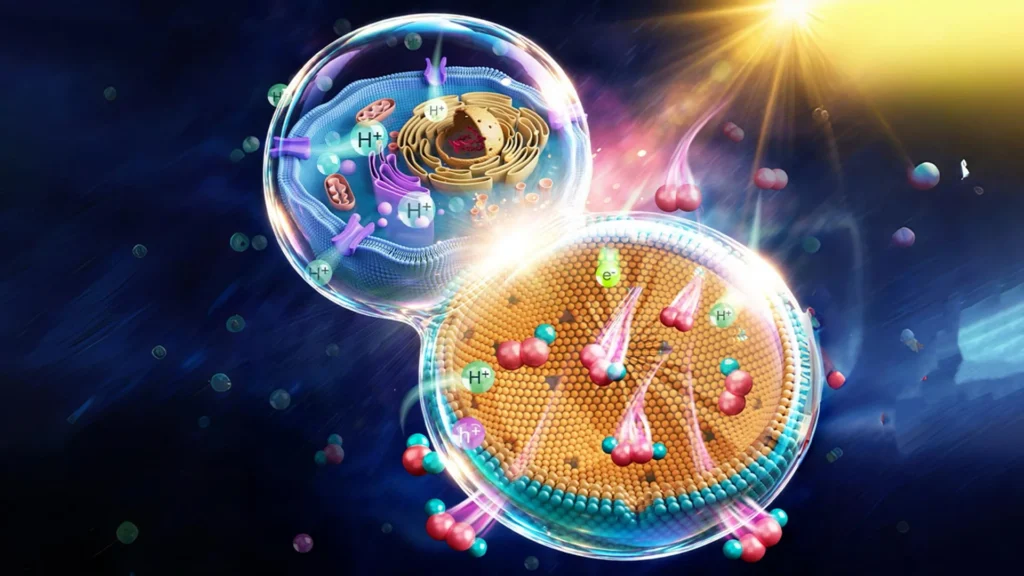
Researchers have unveiled a groundbreaking synthetic nanomaterial, a hollow CdS@polydopamine nanoreactor, meticulously engineered to mimic two critical functionalities found in living cells. This innovative design marks a significant stride in the field of artificial photosynthesis and nanocell engineering, offering a novel paradigm for replicating highly organized chemical processes within synthetic systems. The findings, which promise to open new avenues in sustainable chemistry and energy catalysis, were formally published in the esteemed Journal of the American Chemical Society. The pioneering research was spearheaded by Prof. LI Can at the Dalian Institute of Chemical Physics (DICP) of the Chinese Academy of Sciences (CAS), in close collaboration with Prof. Jian Liu’s team at Inner Mongolia University, bringing together interdisciplinary expertise to tackle one of chemistry’s most pressing challenges.
The Global Imperative for Sustainable Chemical Production
In an era defined by increasing environmental concerns and the urgent need for sustainable practices, the development of green chemistry methodologies has become paramount. Traditional industrial chemical synthesis often relies on energy-intensive processes, fossil fuel feedstocks, and can generate substantial waste products. Hydrogen peroxide (H2O2), a versatile chemical agent, stands as a prime example. H2O2 is indispensable across a myriad of industries, serving as an environmentally benign oxidant, bleaching agent in textiles and paper, disinfectant, and a crucial reagent in various chemical syntheses. The global market for hydrogen peroxide is projected to continue its growth trajectory, driven by demand in sectors ranging from pulp and paper to wastewater treatment and mining.
However, the conventional industrial production of H2O2, primarily through the anthraquinone process, is energy-intensive, involves multiple steps, and often requires precious metal catalysts. This method consumes significant amounts of electricity and generates byproducts, presenting an economic and environmental burden. Consequently, the scientific community has been tirelessly exploring alternative, more sustainable pathways for H2O2 synthesis, with photocatalytic production using only water, oxygen, and sunlight emerging as an exceptionally promising candidate. This "green" approach seeks to emulate natural photosynthesis, converting solar energy directly into chemical energy in the form of H2O2, thereby reducing reliance on fossil fuels and minimizing ecological impact.
Biomimicry at the Nanoscale: Learning from Life’s Master Architect
The remarkable efficiency and precision with which living cells conduct complex biochemical reactions have long captivated scientists. Cells achieve this extraordinary feat by orchestrating intricate molecular machinery within tightly regulated spatial compartments. Components are precisely arranged, enabling molecules to move, interact, and react under optimal and controlled conditions, minimizing energy waste and maximizing selectivity. This inherent cellular organization, honed over billions of years of evolution, provides a powerful blueprint for materials scientists and chemists.
The nascent field of nanocell engineering directly draws inspiration from these biological marvels. It aims to transcend the limitations of traditional catalyst design by creating synthetic, cell-like structures, often termed "nanoreactors." These engineered nanomaterials are designed with specialized surfaces, internal pores, or hollow cavities that mimic cellular compartments, allowing for the precise spatial and temporal control of chemical reactions. By integrating principles from cell biology and advanced nanotechnology, researchers seek to imbue synthetic systems with the same level of sophistication and functional efficiency observed in natural biological systems. The progression of biomimetic material science has seen researchers move from simply mimicking external structures to replicating complex internal functions and dynamic processes, paving the way for the development of highly advanced artificial systems.
Deconstructing the CdS@Polydopamine Nanoreactor’s Ingenious Design
The newly developed CdS@polydopamine nanoreactor represents a significant leap forward in this biomimetic endeavor, integrating two key cellular-inspired features that synergistically enhance its photocatalytic performance.
1. The Structural Ingenuity: Compartmentalization for Enhanced Reactivity
At its core, the nanoreactor boasts a sophisticated compartmentalized architecture. It features a nanoscale hollow cavity enveloped by a porous shell. This confined environment is not merely a passive container; it actively contributes to the reaction’s efficiency. By creating a spatially restricted reaction zone, the nanoreactor facilitates the accumulation of reactants, effectively increasing their local concentration. This heightened concentration drives the reaction forward, mirroring how enzymes in cellular organelles concentrate substrates to accelerate metabolic pathways. Furthermore, the porous shell is engineered to allow for controlled molecular diffusion, ensuring that reactants can ingress and products egress efficiently without diluting the catalytic environment. Crucially, this unique architecture also plays a vital role in photon management. The confined space and specific material properties help trap incoming visible light photons, maximizing their absorption by the photocatalytic material (CdS) and thereby ensuring that the light-driven reactions proceed with greater effectiveness. This photon trapping mechanism is essential for boosting the overall solar-to-chemical conversion efficiency.
2. The Dynamic Core: A Proton Relay Inspired by Life
The second, and perhaps most innovative, biomimetic element resides within the polydopamine shell: a dynamic catechol/o-benzoquinone redox pair. While living cells often employ complex protein-based proton pumps to actively transport protons across membranes, this synthetic analogue functions as a highly efficient proton relay. The catechol/o-benzoquinone pair cycles between its oxidized and reduced states, repeatedly accepting and releasing protons. This cyclical action significantly accelerates proton-coupled electron transfer (PCET), a fundamental process in many biological and chemical reactions where the movement of protons and electrons are intricately linked.
PCET reactions are critical for many energy conversion processes, including respiration and photosynthesis, because they allow for charge separation and directed energy flow. By facilitating rapid and efficient PCET, the nanoreactor ensures that the necessary protons are quickly delivered to the reaction sites, which is often a rate-limiting step in photocatalytic systems. This dynamic proton relay mechanism effectively bypasses the slower, less efficient diffusion of free protons, thereby enhancing the overall reaction kinetics and mimicking the sophisticated proton management systems found within biological membranes.
Material Choices: Synergistic Components
The selection of CdS (cadmium sulfide) and polydopamine as the constituent materials is strategic. CdS is a well-known semiconductor material prized for its excellent visible-light absorption properties and suitable band gap for photocatalytic applications. Its ability to generate electron-hole pairs upon light illumination is central to initiating the redox reactions. Polydopamine, on the other hand, is a synthetic polymer inspired by the adhesive proteins found in mussels. It is highly biocompatible, easily functionalized, and capable of forming stable, porous shells. Crucially, its chemical structure allows for the incorporation and dynamic cycling of the catechol/o-benzoquinone redox pair, making it an ideal choice for the biomimetic shell that governs proton relay.
Optimizing the Reaction: Balancing Half-Reactions and the Z-Scheme Mechanism
The efficient production of hydrogen peroxide from water and oxygen involves two distinct half-reactions: the reduction of oxygen (O2) to H2O2 and the oxidation of water (H2O) to replenish electrons. A major challenge in developing efficient photocatalytic systems is ensuring that these two half-reactions proceed at balanced rates. Imbalances can lead to charge recombination, reduced efficiency, and the formation of undesirable byproducts.
The nanoreactor’s dual biomimetic features – the proton relay and the compartmentalized structure – collectively address this challenge. The proton relay ensures a steady supply of protons for oxygen reduction, while the confined environment and efficient photon trapping promote both half-reactions. This synchronized operation helps maintain a delicate balance, which is crucial for maximizing H2O2 selectivity and yield.
To further enhance efficiency and stability, the researchers designed the photocatalytic system based on a Z-scheme heterojunction. The Z-scheme is a concept borrowed from natural photosynthesis, where two different photosystems (like Photosystem I and Photosystem II) work in tandem to overcome thermodynamic barriers and achieve efficient charge separation. In artificial photocatalysis, a Z-scheme heterojunction combines two semiconductor materials with staggered band alignments, allowing for improved charge separation and the retention of strong redox potentials. In this nanoreactor, the Z-scheme ensures that the photogenerated electrons and holes are effectively separated and directed to the appropriate reaction sites, minimizing recombination and maximizing the overall quantum efficiency of the H2O2 photosynthesis. This sophisticated electronic structure, combined with the biomimetic design, creates a highly optimized catalytic environment.
Performance Metrics and Scientific Validation
Under controlled conditions, specifically visible-light illumination in an aqueous solution, the CdS@polydopamine nanoreactor exhibited impressive performance. It achieved an H2O2 photosynthesis rate of 3.24 mmol gcat.-1 h-1. To contextualize this, while still a research-scale achievement, this rate demonstrates a significant improvement over many single-component or less-optimized photocatalytic systems. Furthermore, the system reached a solar-to-chemical conversion efficiency of 1.2%. For comparison, the theoretical maximum efficiency for direct solar-to-chemical conversion can be much higher, but current practical technologies for solar fuel production often operate within a range where even a few percent is considered a notable advancement in lab settings, especially for complex multi-electron reactions like H2O2 synthesis. The challenge lies in translating these laboratory efficiencies to industrial scales, where factors like catalyst stability, cost, and reactor design become critical.
To thoroughly understand and validate the intricate mechanisms at play, the research team employed a comprehensive suite of advanced analytical techniques. These included in situ spectroscopy, which allowed them to observe real-time changes in the chemical species and electronic states during the reaction; photochemical analysis, to precisely quantify reaction rates and product yields; finite element simulations, to model the distribution of light, reactants, and products within the nanoreactor; and theoretical calculations, such as density functional theory (DFT), to predict electronic structures, reaction pathways, and energy barriers at the atomic level. This multi-pronged approach provided irrefutable evidence for the proposed cell-inspired processes and definitively clarified the underlying Z-scheme heterojunction-based photocatalytic mechanism responsible for the efficient H2O2 production.
Towards Practical Applications: Recyclability and Sustainability
Beyond its impressive catalytic performance, the researchers also addressed a critical aspect for real-world application: recyclability and stability. A significant hurdle for many heterogeneous catalysts is their recovery and reuse, which often involves complex separation processes. To overcome this, the nanoreactors were ingeniously embedded within an environmentally benign sodium alginate hydrogel matrix. Sodium alginate, a natural polysaccharide derived from brown algae, is well-known for its biocompatibility, biodegradability, and ability to form stable gels.
This encapsulation produced solid, easily handled photocatalysts that retained their structural integrity and catalytic activity. The hydrogel matrix not only facilitated straightforward recovery and reuse but also enhanced the stability of the nanoreactors, preventing agglomeration and leaching of active components. Crucially, these hydrogel-immobilized photocatalysts demonstrated the ability to continuously synthesize H2O2 under natural sunlight while maintaining stable performance over extended periods. This innovation dramatically improves the practicality and economic viability of the system, aligning perfectly with the principles of green chemistry by offering a recyclable, stable, and sustainable platform for chemical production.
Expert Perspectives and Future Outlook
Prof. Li Can’s concluding statement underscores the profound implications of this research: "Our study provides a new strategy for engineering biomimetic nanoreactors that increasingly replicate the sophisticated functions of living cells, opening new opportunities in artificial photosynthesis, energy catalysis, and synthetic chemistry." This sentiment resonates strongly within the broader scientific community, which views this breakthrough as a significant milestone in the journey toward truly sustainable chemical manufacturing and energy conversion.
The successful demonstration of a synthetic nanoreactor capable of mimicking complex cellular functions like proton relay and compartmentalization is likely to spur further interdisciplinary research. Experts in biomimicry, catalysis, and materials science will undoubtedly explore variations of this design, experimenting with different photocatalytic materials, shell compositions, and structural architectures to further optimize performance and broaden the range of achievable reactions. Funding agencies and industrial partners will also be keenly observing these developments, recognizing the immense potential for translating such technologies from academic laboratories to commercial applications.
Broader Impact and Implications:
The implications of this research extend across several critical sectors:
- Energy Sector: This work represents a crucial step towards the development of efficient solar fuel production. By converting solar energy directly into a chemical fuel (H2O2), it offers a pathway to store intermittent solar energy in a chemical form, which can then be used for various applications, including fuel cells or as a chemical feedstock. This aligns with global efforts to decarbonize energy systems and develop sustainable energy carriers.
- Chemical Industry: The ability to produce hydrogen peroxide sustainably from abundant resources (water, oxygen, sunlight) could revolutionize the chemical industry. It offers a greener, potentially cheaper, and more decentralized method of H2O2 production, reducing the environmental footprint of current industrial processes. This paradigm shift could extend to the synthesis of other commodity chemicals, paving the way for a more sustainable chemical economy.
- Environmental Remediation: Hydrogen peroxide is a powerful oxidizing agent used extensively in wastewater treatment to break down pollutants. A sustainable and on-demand source of H2O2 could enhance the efficiency and accessibility of environmental remediation technologies, contributing to cleaner water and ecosystems.
- Fundamental Science: This research pushes the boundaries of artificial photosynthesis and biomimetic materials design. It deepens our understanding of how to engineer sophisticated catalytic systems that can precisely control complex reaction pathways, mirroring the elegance of biological systems. It will undoubtedly inspire new theories and experimental approaches in catalysis and nanotechnology.
- Economic Impact: While still in its early stages, successful scaling of such technologies could lead to reduced production costs for H2O2, creating new economic opportunities in green technology and potentially disrupting established markets.
Challenges and the Road Ahead
Despite its groundbreaking nature, this research also highlights the significant challenges that lie ahead. Scaling up from laboratory-scale experiments to industrial production remains a formidable hurdle. Factors such as long-term stability under continuous operation, the cost-effectiveness of materials and manufacturing processes, and the overall economic viability of large-scale reactors need to be rigorously addressed. Further research will focus on improving the solar-to-chemical conversion efficiency to approach commercially competitive levels, enhancing catalyst longevity, and exploring the applicability of this biomimetic design to a wider range of chemical reactions. The journey from a lab breakthrough to widespread industrial adoption is often long and complex, but the foundational work by Prof. Li Can and Prof. Jian Liu’s teams provides a compelling vision for a more sustainable and efficient chemical future, rooted in the elegant principles of nature.