Octopuses and cuttlefish are renowned for their extraordinary ability to vanish into their surroundings, rapidly altering both the color and texture of their skin with remarkable fluidity. This natural marvel, a testament to millions of years of evolution, has long captivated scientists, inspiring efforts to replicate such dynamic adaptability in synthetic materials. Now, researchers at Stanford University have reported a significant breakthrough in this quest. In a landmark study published in the prestigious journal Nature, the team describes a novel, flexible material capable of rapidly shifting its surface patterns and colors, forming intricate features smaller than a human hair. This innovation marks a pivotal step towards next-generation camouflage systems, advanced displays, and a host of other transformative applications, heralding a new era in biomimetic materials science.
The Quest for Adaptive Materials: Learning from Nature’s Masters
For decades, material scientists and engineers have looked to the natural world for inspiration, a field known as biomimicry. Among nature’s most sophisticated shapeshifters are cephalopods—octopuses, cuttlefish, and squid—whose camouflage capabilities border on the miraculous. These marine invertebrates possess an intricate biological toolkit that allows them to instantaneously blend into diverse environments, from rocky seafloors to sandy plains. Their secret lies in specialized organs embedded within their skin:
- Chromatophores: These pigment-filled sacs, controlled by muscles and neurons, can expand or contract to reveal or hide underlying colors like reds, yellows, browns, and blacks.
- Iridophores: Reflective cells that use stacked layers of proteins to create iridescent blues, greens, silvers, and golds by reflecting specific wavelengths of light.
- Leucophores: White cells that scatter all wavelengths of light, contributing to overall brightness and allowing the animal to match white backgrounds.
Beyond color, cephalopods can also dramatically alter their skin texture, transforming from smooth to spiky or bumpy in an instant. This is achieved through muscular contractions that raise or lower specialized dermal papillae. The combined effect of color and texture changes provides a truly immersive camouflage, making the animal virtually indistinguishable from its surroundings. Replicating this dual control – dynamic color and dynamic texture at a micron scale – in an artificial material has been a formidable challenge, requiring mastery over optics, mechanics, and material chemistry. Previous attempts often focused on one aspect (e.g., color-changing fabrics) or lacked the precision and speed of natural systems.
A Serendipitous Discovery Paves the Way
The Stanford breakthrough emerged from an unexpected observation. Siddharth Doshi, a doctoral student in materials science and engineering at Stanford and the lead author of the Nature paper, recounted the serendipitous origin of their discovery. While examining nanostructures on a polymer film using a scanning electron microscope for an unrelated experiment, Doshi made a crucial observation. Rather than discarding the samples after initial examination, he opted to reuse them. During subsequent tests, Doshi noticed that the regions of the film previously exposed to the electron beam behaved distinctly when introduced to water, displaying different swelling characteristics and, consequently, distinct colors.
"We realized that we could use these electron beams to control topography at very fine scales," Doshi stated, emphasizing the accidental nature of the discovery. "It was definitely serendipitous." This insight laid the groundwork for their innovative approach. The team realized they could precisely "program" the material’s response to water by strategically applying electron beams, essentially creating a blueprint for dynamic topographical changes.
The Mechanism: Precision Engineering at the Nanoscale
The core of the Stanford team’s innovation lies in a sophisticated marriage of established semiconductor manufacturing techniques with a novel polymer chemistry. They combined electron-beam lithography, a high-precision patterning technique widely used in the fabrication of integrated circuits, with a specially engineered water-responsive polymer film.
Here’s how the dynamic patterning works:
- Electron-Beam Exposure: A focused beam of electrons is directed onto specific regions of the polymer film. This exposure subtly alters the chemical cross-linking within the polymer structure.
- Differential Absorbency: The areas exposed to the electron beam become either more or less absorbent to water, depending on the precise exposure parameters and polymer composition. This creates regions with varying hydrophilic (water-attracting) or hydrophobic (water-repelling) properties.
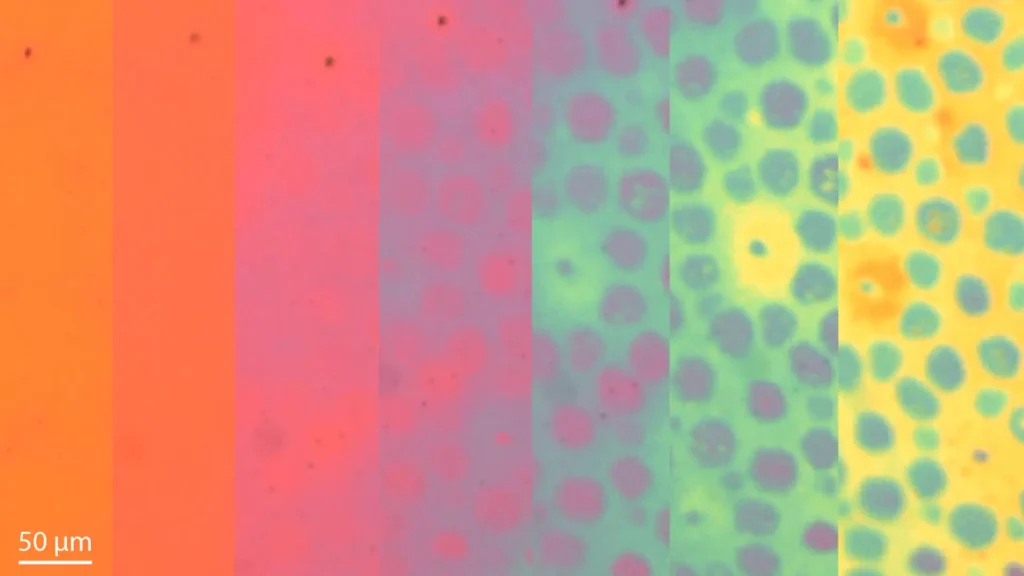
- Water-Induced Swelling: When the polymer film is subsequently immersed in water, the regions with higher water absorbency swell significantly more than the less absorbent regions. This differential swelling creates intricate, three-dimensional patterns on the surface of the material.
"Textures are crucial to the way we experience objects, both in how they look and how they feel," explained Siddharth Doshi. "These animals can physically change their bodies at close to the micron scale, and now we can dynamically control the topography of a material – and the visual properties linked to it – at this same scale." The ability to control surface features at the micron scale, where a micron is one-millionth of a meter (smaller than the diameter of a human hair), is critical for mimicking the fine details seen in natural camouflage. This precision allows for the creation of features that are not only visually impactful but also tactilely distinct, opening doors to highly realistic material transformations.
Beyond Flatness: Sculpting Light and Color
The precision afforded by this technique extends far beyond simple bumps and ridges. The researchers demonstrated the material’s ability to create remarkably detailed three-dimensional structures. As a proof of concept, they fabricated a miniature, dynamic relief of Yosemite’s iconic El Capitan. When dry, the polymer film’s surface remains perfectly flat and featureless. However, upon the controlled addition of water, the intricate contours of the famous granite monolith majestically rise from the film, forming a tangible, three-dimensional shape. This reversibility is key; by introducing an alcohol-like solvent, the water is removed, and the material returns to its original flat state, ready for its next transformation.
Moreover, the team discovered that by carefully adjusting the degree of swelling, they could precisely control how the material interacts with light. This allows for the dynamic alteration of the material’s optical properties, enabling it to switch between highly glossy and completely matte finishes. This level of dynamic optical control surpasses the capabilities of current static screens or displays, which typically offer fixed surface characteristics. Imagine a display that can not only change its image but also its textural appearance, adapting to ambient light conditions or user preference.
The same principles were applied to achieve complex color patterns. By strategically layering thin metallic films on both sides of the polymer, the researchers created structures known as Fabry-Pérot resonators. These optical cavities are designed to select and amplify specific wavelengths of light, effectively acting as tunable color filters. As the polymer film expands or contracts due to water absorption or solvent addition, the distance between the metallic layers changes. This alters the resonant wavelengths, causing the material to display different colors. With a precise balance of water and solvent, a previously plain surface can transform into a vibrant, dynamic array of hues and patterns.
Mark Brongersma, a professor of materials science and engineering and a senior author on the paper, underscored the significance of this aspect: "By dynamically controlling the thickness and topography of a polymer film, you can realize a very large variety of beautiful colors and textures. The introduction of soft materials that can expand, contract, and alter their shape opens up an entirely new toolbox in the world of optics to manipulate how things look." This ability to manipulate light at such a fundamental level, linking physical deformation to optical response, represents a paradigm shift in material design.
A Chronology of Innovation and Future Aspirations
The journey towards this breakthrough is rooted in decades of biomimicry research. Early efforts to create adaptive materials date back to the mid-20th century, often focusing on thermochromic or photochromic dyes. However, these lacked the dynamic textural changes seen in nature. The advent of advanced lithographic techniques and polymer science in the late 20th and early 21st centuries gradually opened new avenues.
The specific timeline for this Stanford project can be traced from Siddharth Doshi’s initial "earlier experiment" and the subsequent "serendipitous" discovery of the electron beam’s effect on polymer swelling. This pivotal moment, likely occurring within the last few years, ignited focused research and development. The meticulous characterization of the material, optimization of the electron-beam parameters, and integration of optical control mechanisms (like Fabry-Pérot resonators) would have followed. The culmination of these efforts was the publication in Nature, a journal known for presenting original, cutting-edge research of exceptional significance, marking this as a major milestone in 2024.
Looking ahead, the team is actively pursuing the automation of this dynamic material. Currently, achieving a specific background match requires manual tuning of water and solvent levels, a process that is time-consuming and not suitable for real-world applications. The ambitious next step involves integrating computer vision and artificial intelligence (AI) systems. These systems would analyze the material’s surroundings in real-time, identify the target patterns and colors, and then automatically adjust the material’s state to achieve seamless blending.
"We want to be able to control this with neural networks – basically an AI-based system – that could compare the skin and its background, then automatically modulate it to match in real time, without human intervention," Doshi elaborated. This future development would transform the material from a laboratory curiosity into a practical, responsive technology, capable of true autonomous camouflage.
Broadening Horizons: Beyond Traditional Camouflage
While the immediate and most striking application of this technology lies in advanced camouflage systems, the potential uses extend far beyond military or robotics stealth. The fine control over surface texture, color, and optical properties at the micron scale unlocks a myriad of possibilities across diverse fields:
-
Advanced Camouflage and Adaptive Robotics:
- Military: Development of adaptive uniforms, vehicle skins, and stealth technologies that can dynamically match changing terrains, weather conditions, or operational environments. This could provide a significant tactical advantage, making personnel and equipment virtually undetectable.
- Robotics: Robots could achieve unprecedented levels of integration with their surroundings, allowing them to blend into natural habitats for ecological research, operate discreetly in surveillance roles, or even enhance their ability to navigate complex environments by altering friction.
-
Flexible Displays and Wearable Technology:
- Imagine next-generation e-readers, smartwatches, or even augmented reality devices that can not only display images but also change their physical texture. This could lead to displays that are more tactile, more immersive, and seamlessly integrate into clothing or architectural surfaces, moving beyond rigid, flat screens.
- Wearable electronics could gain a new dimension of expression, allowing users to dynamically alter the appearance and feel of their garments or accessories.
-
Nanophotonics and Optics:
- The ability to control light at very small scales opens new avenues in nanophotonics. This could lead to ultra-compact optical switches, advanced sensors, and novel light-harvesting devices.
- Applications could include more efficient optical computing, enhanced data storage, and highly secure encryption methods by manipulating light’s properties in unprecedented ways.
- The creation of "smart windows" that dynamically adjust transparency, tint, or even display information.
-
Bioengineering and Medical Applications:
- Changes in surface structure at the nanoscale can profoundly influence how biological cells interact with materials. This offers exciting prospects in bioengineering, such as designing smart implants that can guide tissue growth or drug delivery systems that release medication in response to specific environmental cues.
- The material could be used to create bioreactors with dynamically tunable surfaces for cell culture, influencing cell differentiation and behavior.
-
Robotics with Adaptive Skins:
- The control over surface texture directly translates to the ability to regulate friction. Small robots equipped with this material could dynamically switch between highly adhesive surfaces for gripping and climbing, and smooth, low-friction surfaces for sliding or maneuvering in confined spaces. This would greatly enhance their dexterity and adaptability in complex tasks.
-
Art, Design, and Architecture:
- The team is already collaborating with artists to explore creative applications. Imagine architectural surfaces that dynamically change their appearance, responding to light, weather, or even human interaction. This could lead to living buildings, interactive art installations, or dynamic fashion pieces that adapt and evolve.
Nicholas Melosh, a professor of materials science and engineering and a senior author on the paper, eloquently summarized the vast potential: "There’s just no other system that can be this soft and swellable, and that you can pattern at the nanoscale. You can imagine all kinds of different applications. Small changes in the properties of soft materials over micron distances are finally possible, which will open up all sorts of possibilities. I think there are a lot of exciting things coming up."
Collaborative Research and Sustained Support
This groundbreaking research is a testament to the collaborative spirit of scientific inquiry. Professor Mark Brongersma holds appointments as a professor, by courtesy, of applied physics; a member of Stanford Bio-X, the Wu Tsai Human Performance Alliance, and the Wu Tsai Neurosciences Institute; and an affiliate of the Precourt Institute for Energy. Professor Nicholas Melosh is a member of Stanford Bio-X and the Wu Tsai Neurosciences Institute; an affiliate of the Precourt Institute for Energy; and a faculty fellow of Sarafan ChEM-H.
Additional Stanford co-authors who contributed to this significant work include Alberto Salleo, the Hong She and Vivian W. M. Lim Professor and professor of photon science; Associate Professor Polly Fordyce; postdoctoral researchers Nicholas A. Güsken and Gerwin Dijk; Stanford Microfluidics Foundry director Jennifer E. Ortiz-Cárdenas; and graduate students Johan Carlström, Peter Suzuki, and Bohan Li.
The extensive scope and complexity of this research were made possible through generous financial support from a consortium of prestigious institutions and foundations. Funding was provided by a Stanford Graduate Fellowship, a Meta PhD Fellowship, the Wu Tsai Human Performance Alliance at Stanford University and the Joe and Clara Tsai Foundation, the German National Academy of Sciences Leopoldina, the Department of Energy, the Air Force Office of Sponsored Research, and the National Science Foundation. This broad base of support underscores the recognized importance and potential impact of this pioneering work in materials science and engineering.
The development of this dynamic, cephalopod-inspired material represents a monumental leap forward in the field of adaptive materials. By bridging the gap between biological sophistication and engineering precision, Stanford researchers have not only unlocked new possibilities for camouflage and display technologies but have also laid the foundation for a new generation of smart materials that can dynamically interact with their environment in unprecedented ways, promising to reshape industries from defense to fashion, and medicine to robotics.