Achieving true precision in modern motion control applications demands an integrated understanding that extends far beyond the mechanical specifications of actuators. While repeatability, accuracy, and load capability remain fundamental metrics, the ultimate performance of a high-precision system is intrinsically linked to the sophisticated designs and capabilities of its drives and controls. This realization is particularly critical as industries push the boundaries of accuracy to micron and even nanometer levels, where traditional datasheet metrics often lose their full relevance and nuanced engineering decisions become paramount. This article, the third in a series, delves into the pivotal role played by drives and controls, positioning them as the intelligent core orchestrating the entire motion system.
The Evolution of Precision: A Historical Perspective
The landscape of industrial automation and scientific research has witnessed a profound transformation driven by advancements in motion control. Historically, motion systems were predominantly mechanical, relying on gears, linkages, and cams to achieve desired movements. Control was rudimentary, often involving simple on/off switches or variable frequency drives for speed regulation. The advent of electronics, particularly microprocessors in the latter half of the 20th century, catalyzed a paradigm shift. Motors could be controlled with greater finesse, leading to improved acceleration, velocity, and basic positioning.
This progression laid the groundwork for the modern mechatronic systems prevalent today, where mechanical, electrical, and computational engineering disciplines converge. The demand for higher throughput, superior product quality, and the ability to handle increasingly complex tasks across manufacturing, healthcare, semiconductor fabrication, and aerospace sectors has continuously driven the need for more precise, responsive, and intelligent motion control. Early programmable logic controllers (PLCs) provided sequential control, but the computational power of dedicated motion controllers, coupled with advancements in power electronics for drives, unlocked unprecedented levels of accuracy and dynamic performance. This chronological development underscores that while mechanics provide the physical framework, it is the drives and controls that imbue the system with intelligence and the capacity for true precision.
Drives and Controls: The Central Nervous System of Motion
Corey Foster, Director of Automation Sales & Application Engineering at Valin Corporation, highlights that system performance is too often superficially judged by mechanical specifications alone. While essential, the full picture emerges only through a comprehensive understanding of how mechanics, motors, drives, and controls interact. This series aims to equip engineers, designers, and system integrators with the insights needed to recognize the critical contribution of each layer. Previous installments explored the mechanics, addressing factors like bearing deflection and structural smoothness, and motors, examining their designs, construction, and quality. This third part focuses on the intricate designs and features of drives and controls, revealing how they serve as the "brains behind the motion."
The performance of drives and controls can be categorized into three general tiers, mirroring the system-wide performance classification: basic, specification-level, and pushing-beyond-the-specifications. Each tier corresponds to differing application requirements and necessitates varying levels of electronic sophistication.
Tier 1: Basic Motor Applications
In the most fundamental electric motor applications, intelligence is minimal. Power is applied directly, and the motor simply rotates. Drives, the electronic components that supply and regulate power to motors, introduce a degree of smoothness and efficiency to this process. Controllers further enhance intelligence by enabling more sophisticated control over parameters such as acceleration, velocity, and basic positioning. For many straightforward applications, this level of electronics often exceeds the immediate requirements. The primary concern in such scenarios is typically compatibility, ensuring the electronics can simply run the motor. If basic tuning features are present, their default settings are usually sufficient, reflecting a focus on cost-effectiveness and simplicity over high precision.
Tier 2: Specification-Level Control
Applications demanding tighter control, where specific performance metrics like speed stability or positioning accuracy are critical, necessitate a deeper engagement with the features offered by drives and controllers. Here, tuning features become essential. Proper adjustment of parameters based on the motor’s characteristics and the mechanical load is crucial to achieve the desired performance. Controllers must also be programmed correctly to generate the required motion profiles and execute sequences of actions. A significant portion of issues in this tier often stems from simple setup errors or incorrect parameter settings, which are typically straightforward to rectify.
However, tuning problems are more common and present a greater challenge. Mismanagement of tuning parameters by inadequately trained personnel can lead to suboptimal motion, manifesting as either sluggish and unresponsive behavior or overly aggressive and unstable movements. A common pitfall in this tier is pairing a high-performance motor with lower-performance electronics. While rarely catastrophic for most applications, this mismatch limits the motor’s true potential. For example, a motor designed for rapid acceleration and deceleration might be hampered by a drive that cannot supply current quickly enough or a controller with insufficient processing speed, leading to performance that falls short of the motor’s theoretical capabilities.

Tier 3: Pushing Beyond the Specifications – High-Performance Applications
The limitations of mismatched components become acutely apparent in high-performance applications, where demands for precision, speed, and dynamic response are extreme. In these scenarios, the motor fails to achieve its intended requirements, and the system becomes exceptionally difficult to tune, resulting in compromised performance. In the worst-case scenarios, achieving the application requirements becomes impossible without upgrading the control electronics.
High-performance applications necessitate a suite of advanced features within drives and controllers:
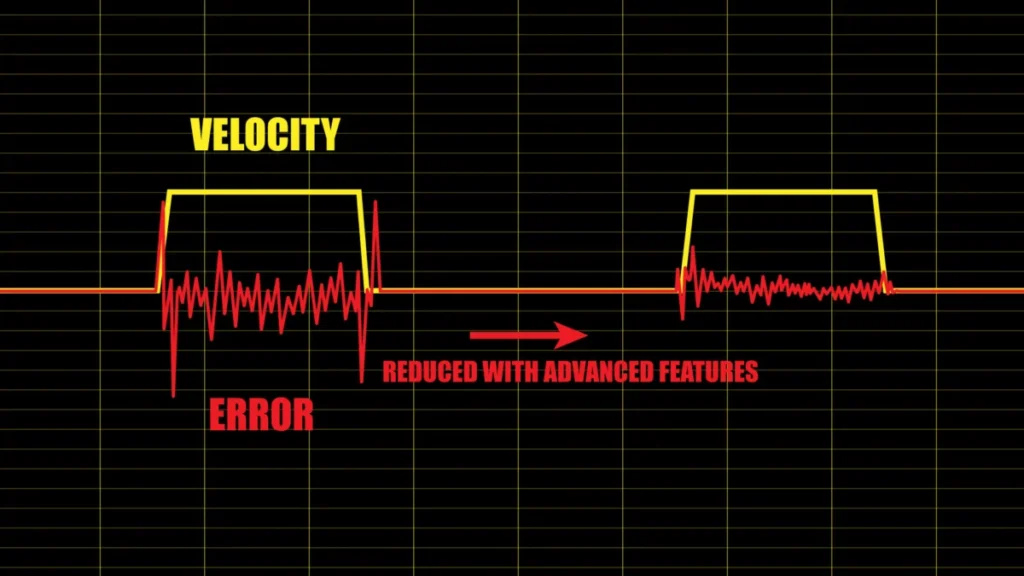
- Advanced Tuning Features with Dynamic and Adaptable Gains: Static PID (Proportional-Integral-Derivative) control often proves inadequate for systems with varying loads, changing inertia, or resonant frequencies. Advanced drives incorporate dynamic and adaptive gain scheduling, allowing control parameters to adjust in real-time based on operating conditions. This enables the system to maintain optimal performance across a wider range of scenarios, from rapid acceleration to precise holding.
- Multi-axis Synchronization: For complex multi-axis mechanics such as gantries, Cartesian robots, or robotic arms, precise coordination across multiple axes is paramount. This requires controllers capable of executing highly synchronized movements, often with nanosecond-level timing. Fieldbus communication protocols like EtherCAT, PROFINET, and SERCOS III are critical here, offering deterministic, high-speed data exchange to ensure all axes move in concert, preventing drift or misalignment that could compromise precision.
- Fast Update Rates and Processors: The responsiveness of a motion system is directly tied to the speed at which the controller can sample feedback, process control algorithms, and update motor commands. High-performance applications demand fast servo sampling and update rates (often in the kilohertz range) for tight current and voltage control. Powerful, fast processors are essential to execute complex algorithms, prevent computational lag, and ensure that commands are processed and executed without perceptible delay, which is critical for dynamic stability and precise trajectory following.
- Environmental Adaptability: Real-world industrial environments are rarely pristine. They are often characterized by electrical noise from arc-welders, mechanical vibrations from heavy machinery, and temperature fluctuations. High-performance controls must possess tools to adapt to these challenging conditions. Features such as programmable notch filters can suppress specific resonant frequencies in the mechanical system, preventing instability. Dynamic tuning parameters allow for on-the-fly adjustments to maintain performance despite environmental disturbances. Robust electrical shielding and sophisticated noise rejection algorithms are also vital to ensure signal integrity and reliable operation in electromagnetically noisy settings. A compelling example cited in the original article involved an OEM tool that performed flawlessly in an isolated lab but failed in a real-world factory environment until its controls were upgraded to incorporate such adaptive features.
Beyond the Datasheet: Critical Nuances
Several factors, often not explicitly detailed on standard datasheets, can significantly impact the success of a high-precision motion system:
- "Auto-tuning" as a Starting Point, Not a Panacea: While auto-tuning features simplify initial setup and can provide a reasonable baseline, they are rarely a silver bullet for high-performance systems. Expert manual tuning, often involving frequency response analysis and detailed system modeling, is usually required to extract the absolute maximum performance and stability, especially when dealing with complex mechanical resonances or specific dynamic requirements.
- Encoder Resolution and Compatibility: The feedback loop is only as good as its weakest link. Encoder resolution must precisely match the application’s goal and the electronics’ capabilities. An ultra-high-resolution encoder paired with a controller that cannot process its full data stream effectively is a wasted investment. Conversely, a low-resolution encoder will inherently limit the achievable precision, regardless of the drive’s sophistication. Compatibility between encoder types (e.g., incremental, absolute, serial protocols like EnDat, Hiperface) and the drive/controller input is also critical.
- Fieldbus Communication Protocols: In multi-axis or networked systems, the choice of communication protocol is paramount. For demanding speed and coordination, traditional serial or slower Ethernet-based protocols may introduce unacceptable latency or jitter. Modern industrial Ethernet protocols like EtherCAT, PROFINET IRT, or Sercos III offer deterministic, real-time communication, ensuring that commands and feedback are exchanged with precise timing, which is essential for synchronized motion and distributed control architectures.
- Software and Algorithms: The intelligence embedded within the controller’s software is a key differentiator. Advanced motion profile generation capabilities (e.g., S-curve, spline interpolation) enable smoother, faster, and more efficient movements, reducing wear and minimizing vibration. Flexible real-time multi-threaded programming allows for complex motion sequences, process control, and human-machine interface (HMI) integration. Motion optimization tools aid in fine-tuning trajectories and minimizing settling times. Furthermore, advanced algorithms like friction compensation, disturbance observers, and model-predictive control (MPC) can significantly enhance accuracy and robustness.
Industry Implications and Expert Perspectives
The growing understanding of the pivotal role of drives and controls is transforming how industries approach automation. "The shift we’ve seen is from simply ‘making a motor spin’ to ‘orchestrating precise, dynamic, and adaptive movement’," states a hypothetical Director of Engineering at a leading robotics firm. "The difference between a mediocre system and a groundbreaking one often lies in the sophistication of its control algorithms and the processing power of its drives."
This emphasis on advanced electronics has profound implications:
- Manufacturing: In advanced manufacturing, precision motion control is fundamental to Industry 4.0 initiatives, enabling high-speed pick-and-place, intricate additive manufacturing processes, and ultra-precise quality inspection systems. Optimized drives and controls reduce cycle times, minimize waste, and improve product consistency, directly impacting profitability.
- Medical Devices: In the medical field, where micron-level accuracy can be life-critical, drives and controls are indispensable for surgical robots, diagnostic imaging equipment (e.g., MRI, CT scanners), and automated drug delivery systems. The reliability and precision offered by advanced controls ensure patient safety and the efficacy of treatments.
- Semiconductor Industry: Perhaps the most demanding sector, semiconductor fabrication requires nanometer-scale precision for lithography, wafer handling, and inspection. Here, controllers must manage complex multi-axis systems, compensate for thermal expansion, and suppress minute vibrations, pushing the very limits of current technology.
- Aerospace and Defense: High-accuracy positioning is vital for optical tracking systems, antenna pointing, satellite stabilization, and precision weapon systems. The robust and adaptive nature of high-performance drives and controls ensures reliable operation in extreme environments.
The economic impact of investing in appropriate drives and controls is substantial. While initial costs for high-end systems may be higher, the long-term benefits in terms of reduced downtime, increased throughput, higher product quality, and greater operational flexibility far outweigh them. Conversely, skimping on these components can lead to chronic performance issues, costly troubleshooting, and ultimately, a failure to meet application objectives.
The Future Landscape: Integration and Intelligence
The trajectory of motion control points towards even greater integration and intelligence. Future trends include:
- AI and Machine Learning Integration: Leveraging AI and ML for predictive maintenance, adaptive control, and self-optimization of motion systems, allowing them to learn from their environment and continuously improve performance.
- Edge Computing: Bringing more computational power closer to the motor, enabling faster decision-making and reducing reliance on centralized controllers for some tasks.
- Enhanced Connectivity: Further development of standardized, high-speed industrial communication protocols to facilitate seamless integration within the broader industrial internet of things (IIoT).
- Miniaturization and Power Density: Developing smaller, more powerful drives and controllers to meet the demands of compact robotic systems and portable devices.
In conclusion, true precision in motion control is not merely about selecting the best mechanical components or motors; it is a holistic endeavor that critically hinges on the intelligent orchestration provided by advanced drives and controls. These components, far from being mere power suppliers, serve as the sophisticated brains, interpreting commands, managing feedback, and adapting to dynamic conditions to achieve specified goals that often push beyond conventional data sheet metrics. Engineers, designers, and system integrators must recognize that "the best hardware can’t overcome a dumb control loop," and a deep, interdisciplinary understanding of each layer of performance is essential for building high-precision motion systems that meet the demanding requirements of today and tomorrow.
This article is part of a comprehensive series exploring the multifaceted aspects of motion control performance. Readers are encouraged to delve into the other installments for a complete understanding:
Part 1: Layers of performance and specifications in motion control
Part 2: Layers of performance and specifications in motion control
Part 4: Layers of performance and specifications in motion control