Published: September 4th, 2026
The development of the new Ford Taurus represented the largest and most ambitious undertaking in Ford Motor Company’s history. Emerging from a period marked by significant challenges in product development, quality control, and financial performance, the Taurus was not merely a new model; it was a critical make-or-break gamble for the automotive giant. After five years of intensive research, design, and engineering, the groundbreaking Taurus was finally poised for its public unveiling.
The debut arrived at the eleventh hour, with Ford executives and members of the automotive press formally introduced to the Taurus and its sibling, the Mercury Sable, in mid-1985. This reveal occurred a mere four months before the two models were slated to enter full-scale production at Ford’s Atlanta, Georgia, assembly plant. The chosen venue for this pivotal event was none other than the legendary MGM Studios in California, a location steeped in cinematic history.
A Theatrical Unveiling Amidst Uncertainty
The presentation took place on a sound stage famously associated with the filming of "Gone With the Wind," creating a dramatic backdrop for the introduction of Ford’s futuristic vision. The theme for the unveiling was outer space, with flying saucer decorations adorning the venue and thematic food served from saucer-shaped coolers. The ambiance was further enhanced by a starry room and a space-like soundtrack, immersing attendees in an otherworldly experience. The aerodynamic designs of the Taurus and Sable were dramatically revealed, initially appearing as green outlines against the celestial backdrop before their full forms were illuminated.
As is often the case with such radically new product introductions, the initial reactions were a mixture of intrigue and apprehension. Even within Ford’s own executive leadership, there were discernible signs of doubt. Some executives expressed concerns that the Taurus’s unconventional design and innovative features might prove too avant-garde for the mainstream American car buyer, potentially leading to commercial failure.
Navigating a Competitive Landscape
Ford’s strategic timing for the Taurus’s debut was also shaped by the competitive pressures within the American automotive industry. At the time, Ford was the last of the "Big Three" domestic automakers to introduce a front-wheel-drive family car. General Motors had already completed its significant portfolio-wide downsizing and transition to front-wheel-drive across its various divisions in 1985 and 1986. Chrysler, under the leadership of Lee Iacocca, had been actively involved in the front-wheel-drive passenger car market since 1981 with its highly successful K-car derivatives.
Chrysler executives, in particular, were openly critical of the Taurus and Sable, perceiving them as overly advanced and perhaps too "foreign" in their aesthetic and engineering for domestic consumers. Chrysler was preparing to launch its own new mid-size offerings, including the Dodge Dynasty and Chrysler New Yorker (with the ultra-luxury Imperial to follow), which adhered to more traditional, boxy design principles. Iacocca’s Chrysler, known for its penchant for more ornate styling, believed that sleek, aerodynamic shapes like the Taurus and Sable, along with their modern interiors, would not resonate with their established customer base. To hedge its bets against the radical departure of the Taurus, Ford strategically chose to continue production of its more conventional, boxy LTD model for an additional year.
The Media’s Verdict: A Glimmer of Hope
The financial implications of the Taurus project were immense. Had the Taurus been a commercial failure, Ford’s considerable investment would have likely pushed the company towards bankruptcy. However, the tide began to turn once members of the automotive press gained access to pre-production models for testing.
Popular Mechanics was among the first to experience the new Taurus, describing it as an entirely new category of automobile. Motor Trend magazine also conducted prototype testing and delivered a resounding endorsement, declaring the Taurus "the shape of tomorrow." This prescient assessment proved to be remarkably accurate.
The Taurus’s launch year was marked by significant industry accolades. It was named Motor Trend‘s Car of the Year for 1986 and secured a coveted spot on Car and Driver‘s 10 Best List for the same year. These prestigious awards provided crucial validation and generated substantial positive buzz, signaling a potential turnaround for Ford.
Aerodynamic Innovation: A Design Revolution
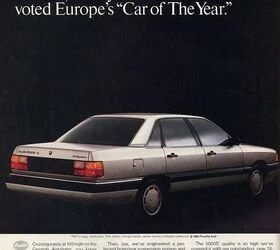
The designation of "the shape of tomorrow" by MotorTrend was an accurate reflection of the automotive industry’s trajectory. Aerodynamic sedan designs were indeed becoming the dominant trend, a movement that had begun gaining momentum in the early 1980s with vehicles like Ford’s European Sierra and the Audi 100/5000. The visual and engineering parallels between the Audi 5000 and the Ford Taurus are striking.
The C3 generation of the Audi 5000, introduced in 1983, boasted an impressive drag coefficient of just 0.30, largely attributed to its clean lines and flush glass surfaces. The Ford Taurus, with its similarly sculpted form, achieved a drag coefficient of 0.32, a remarkable feat for a mass-produced American family car of its era.
Distinctive Design Elements
The Taurus’s front fascia was characterized by large composite headlamps, a defining feature that contributed to its futuristic appearance. The traditional grille was largely absent, replaced by a blocked-off panel with a discreetly integrated small inlet for cooling, proudly displaying the Ford Blue Oval emblem. Most of the necessary airflow for engine cooling was directed from beneath the front bumper, through a split grille design. The front bumper itself featured a ribbed detail that wrapped around the front corners, incorporating the parking lamps. A thick black trim piece ran along the top edge of the bumper on base models, such as the L trim.
The hood of the Taurus was relatively smooth, featuring a modest power bulge, and flowed seamlessly into the equally smooth fenders. A single character line began at the combination indicator lamp and extended uninterrupted around the entire perimeter of the vehicle, contributing to its clean and cohesive appearance.
The exterior trim varied significantly based on the specific trim level and the production timeline of the initial Taurus models. Wagon variants, for instance, sometimes featured body-colored lower cladding on the sides, contrasting with the bumpers. Further details on these trim variations would be explored in subsequent analyses.
Subtle Details and Aerodynamic Efficiency
Lower-end Taurus models were equipped with aerodynamic wheel covers, some of which bore a resemblance to those found on Mercedes-Benz vehicles. Higher trim levels offered optional lace-style alloy wheels. All Taurus models featured a chrome trim ring around their side windows and flush-mounted black door handles, further emphasizing the car’s clean design. The side profile of the Taurus exhibited minimal ornamentation, with the primary brightwork consisting of the thin window surround and a chrome strip along the top edge of the lower cladding.
The roofline of the Taurus was notably rounded, a characteristic most evident from the rear three-quarter view. Thin D-pillars and a steeply raked rear window were integral to optimizing airflow and aerodynamic efficiency. The rear deck was slightly raised, and the trunk lid mirrored the rounded contours of the roof. The taillights were large and straightforward, featuring red lenses punctuated by segmented amber turn signals and white reverse lamps. The rear of the vehicle prominently displayed the "TAURUS" name in block lettering, with the Ford badge positioned on the right side.
A single, unassuming exhaust pipe exited discreetly beneath the driver’s side of the vehicle, lacking any prominent bumper cutout or chrome embellishment. In essence, the entire exterior design of the Taurus was a masterclass in simplicity and aerodynamic optimization, with aesthetic appeal primarily derived from its paint color and wheel selection. Future installments of this series will delve into the specifics of the Taurus wagon and the Mercury Sable, examining the exterior distinctions that might not be immediately apparent upon initial observation.
Sources: Ford, Audi, General Motors, Bring a Trailer (BaT).
Become a TTAC insider. Get the latest news, features, TTAC takes, and everything else that gets to the truth about cars first by subscribing to our newsletter.