An international research consortium, comprising scientists from École Polytechnique, Collège de France, and Helmholtz-Zentrum Dresden-Rossendorf (HZDR), has experimentally realized the first all-optical photonic time crystal (PTC). This groundbreaking material is engineered to dynamically and repeatedly alter its optical characteristics over time, a feat previously confined to theoretical physics and static, spatially-ordered photonic structures. Published in the prestigious journal Nature, this achievement marks a significant leap in controlling light-matter interactions, particularly within the challenging terahertz (THz) frequency range, and holds immense promise for the development of ultrafast optical computers, advanced telecommunications systems, and novel terahertz lasers.
The Dawn of a New Dimension: Time Crystals in Photonics
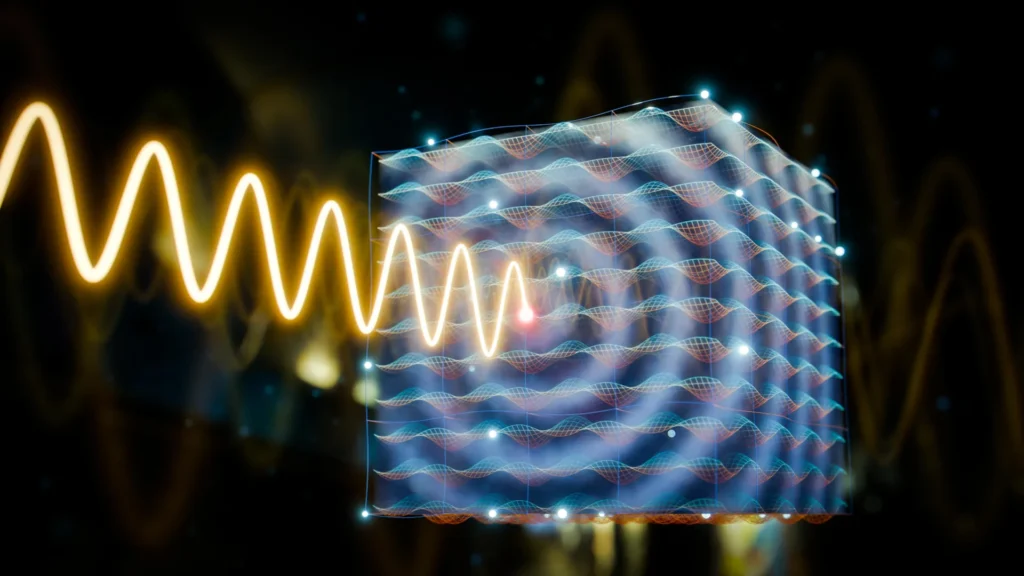
The concept of a "time crystal" represents a profound departure from traditional crystal structures. While conventional crystals exhibit a repeating pattern in space, a time crystal demonstrates a repeating pattern in time, akin to a continuously oscillating system that maintains its periodicity even in its lowest energy state. In the realm of photonics, this translates to materials whose optical properties — such as reflectivity, resonance frequency, and refractive index — can be modulated rapidly and repeatedly over time, rather than remaining fixed after fabrication. This new class of material opens up an entirely new dimension for light control, moving beyond the static spatial arrangements that have long defined photonic devices.
Dr. Tingwen Guo, a PhD student at École Polytechnique and the lead author of the publication, underscored the transformative potential: "By extending photonic crystals from space to time, we open a new dimension for light control — and a novel path toward amplification and lasing. That could be a game-changer for optical technologies at terahertz frequencies and beyond." This innovation challenges the very foundation of how we perceive and manipulate light, moving towards active, dynamic optical materials.
Navigating the Terahertz Frontier: Bridging the Gap
The breakthrough is particularly impactful due to its focus on the terahertz (THz) frequency range. Spanning frequencies from approximately 0.1 THz to 10 THz, this segment of the electromagnetic spectrum has historically been known as the "terahertz gap" due to the difficulty in generating, detecting, and manipulating THz radiation efficiently. It occupies a unique position between conventional microwave electronics and infrared photonics, possessing characteristics of both yet fully exploiting neither.
The THz range offers unique advantages. Terahertz waves can penetrate many common materials like plastics, clothing, and cardboard, making them ideal for non-invasive imaging in security screening, medical diagnostics, and industrial quality control. Furthermore, many molecules exhibit characteristic absorption "fingerprints" in the THz range, enabling highly specific spectroscopic analysis for chemical identification, drug discovery, and environmental monitoring. Most importantly for this research, THz frequencies are 1,000 to 10,000 times faster than those used in current electronic components, offering unparalleled potential for high-speed data processing and communication.
Professor Yannis Laplace, an assistant professor at École Polytechnique and a leader of the team at the Laboratory of Irradiated Solids (LSI), emphasized this frontier: "The THz range represents the frontier between electronic and photonic technologies. It is a range full of opportunities both for science and for society, yet is still under-developed technologically compared to its electrical and photonic counterparts. Creating photonic crystals could lead the way to the closing of this gap." The ability to control light in this largely untapped region promises to unlock a wealth of applications that could reshape various technological landscapes.
The Foundation: Evolution from Conventional Photonic Crystals
The journey towards photonic time crystals is built upon decades of research into conventional photonic crystals. These are nanostructured materials designed with a repeating optical pattern, similar to a lattice, that precisely dictates how photons propagate through them. By meticulously arranging materials with differing refractive indices and geometries, scientists can engineer "photonic bandgaps" — specific ranges of wavelengths that are forbidden from passing through the crystal. This allows for the exquisite control of light, enabling scientists to block, guide, or strengthen selected wavelengths. The analogy often drawn is that photonic crystals control photons much like semiconductors control electrons, forming the bedrock of modern optical technologies such as optical fibers, highly precise lasers, and a myriad of optical sensors vital in fields ranging from chemistry to biology.
However, a fundamental limitation of these conventional photonic crystals is their static nature. Once fabricated, their optical properties are fixed. While earlier experiments by Laplace’s team demonstrated that external factors like temperature and magnetic fields could induce changes in a photonic crystal’s ability to capture light, these changes were typically slow and the optical behavior remained constant once those conditions were established. The vision of truly dynamic, reconfigurable optical devices remained a distant goal, necessitating a paradigm shift from spatial periodicity to temporal periodicity.
The Breakthrough Device: A Plasmonic Metamaterial Engineered for Speed
The creation of the all-optical photonic time crystal required an extraordinarily specialized and complex device, engineered to achieve rapid, dynamic control over light. With crucial support from Thales’ Laboratoire Albert Fert and Polytechnique’s Physics of Interfaces (PICM) laboratory, the researchers constructed a sophisticated "plasmonic metamaterial." Metamaterials are artificially structured materials designed to possess properties not found in nature, often achieved by sub-wavelength patterning.
This particular metamaterial consists of micrometer-scale gold structures, precisely crenelated (notched), positioned atop an insulating layer. Beneath this layer lies a semiconductor composed of a mixture of indium and antimony (InSb). The gold structures are meticulously designed to form tiny cavities that effectively confine light between the gold and the semiconductor layers. Gold was chosen for its excellent plasmonic properties, allowing for strong interaction with light at the nanoscale. Indium antimonide, a narrow-bandgap semiconductor, is highly responsive to terahertz radiation and exhibits significant changes in its electrical properties when excited, making it an ideal candidate for active modulation.
The critical mechanism for achieving dynamic control lies in the generation of "surface plasmons." When the semiconductor surface is excited, it produces collective oscillations of electrons known as surface plasmons. These plasmons are capable of capturing light and maintaining its oscillations, creating a strong light-matter coupling. This interaction provided the researchers with an unprecedented method to manipulate the trapped photons with exceptional speed and precision, laying the groundwork for the temporal periodicity.
The Engine of Innovation: HZDR’s TELBE Source
The experimental validation of the photonic time crystal hinged on the availability of a truly unique light source: HZDR’s powerful TELBE superradiant terahertz source, part of the larger ELBE (Electron Linac for beams with high Brilliance and low Emittance) accelerator facility. The ELBE facility is a state-of-the-art research infrastructure known for generating high-brilliance electron beams, which in turn produce various forms of radiation, including intense terahertz pulses.
TELBE’s capabilities were indispensable. It generates intense terahertz laser pulses that are not only powerful but also highly tunable across a wide frequency range. Crucially, these pulses are "high-field" and "phase-stable," meaning they deliver a strong electromagnetic field with a consistent phase relationship over successive pulses. This coherence and intensity were paramount for the experiment, allowing the researchers to expose the plasmonic metamaterial device to THz radiation that could profoundly and rapidly alter its optical properties, particularly its reflectivity.
Dr. Jan-Christoph Deinert, the coordinator of the TELBE facility, confirmed the source’s vital role: "TELBE’s unique ability to generate high-field, phase-stable terahertz pulses was critical. Without this infrastructure, achieving the coherent, ultrafast modulation needed for the PTC regime would have been impossible." The ability to precisely control the excitation of the semiconductor layer with such powerful and stable THz pulses was the key to unlocking the dynamic behavior of the photonic time crystal.
Unprecedented Control: Picosecond-Scale Modulation
The experimental results were striking. The team successfully demonstrated that the material’s optical properties could be altered both strongly and rapidly. The strength of the change was significant, akin to forcing an object to emit a completely different color of light. Even more remarkably, this transformation occurred on picosecond timescales. A picosecond is one trillionth of a second (10⁻¹² seconds), an almost unfathomably short duration. To put this in perspective, light travels only about 0.3 millimeters in a picosecond. This speed is close to the timescale of light’s own oscillations, representing a new frontier in the dynamic control of light.
Achieving these two effects — strong modulation and picosecond-scale speed — simultaneously had been a major technical hurdle in the field of active photonics. Previous methods often sacrificed speed for strength, or vice-versa. The combination achieved with the photonic time crystal signifies a fundamental breakthrough, demonstrating that optical properties can be actively reconfigured at speeds relevant for future high-speed optical technologies, far surpassing the capabilities of conventional electronic switches.
Validating the Discovery: Theoretical Underpinnings
The experimental findings were not only observed but also robustly supported by a comprehensive theoretical model developed by Dr. Marco Schirò, a Research Scientist at Collège de France, and his team. This theoretical framework provided crucial insights into the intricate behavior of photons within the metamaterial device, offering a deeper understanding of the underlying physics.
The calculations performed by Schirò’s team not only accurately reproduced the experimental observations but also revealed another significant advantage of the photonic time crystal: a substantial reduction in photon dissipation. In this context, dissipation refers to the portion of photons that are not reflected by the metamaterial’s surface and are instead lost, either by absorption or transmission through the material. The theoretical model showed that by dynamically changing the material over time, photon dissipation could be cut by half. This improved efficiency is a critical factor for developing practical optical devices, as it means more light can be effectively controlled and utilized.
Dr. Schirò expressed enthusiasm for the model’s implications: "The theory not only reproduces the experiment but also provides the basis for guiding future discoveries in this system." This synergy between experimental prowess and theoretical insight is a hallmark of cutting-edge scientific research, ensuring that the findings are well-understood and providing a roadmap for future advancements.
Horizon of Possibilities: Implications and Future Directions
The successful experimental realization of an all-optical photonic time crystal marks a pivotal moment in the quest for advanced light control, with profound implications across multiple technological sectors. The researchers are already looking ahead, with immediate goals including further reducing photon dissipation and increasing the number of photons that can be held within the crystal. If they can achieve sufficiently strong amplification of light within these structures, the device could form the basis for highly adaptable and efficient new lasers.
The potential applications of this technology are far-reaching:
- Ultrafast Optical Computers: By enabling light to be manipulated on picosecond timescales, photonic time crystals could facilitate the development of optical logic gates and processing units that operate at speeds far exceeding current electronic systems. This could lead to computers capable of handling massive data volumes with unprecedented speed and energy efficiency, overcoming the fundamental speed limits imposed by electron movement in conventional circuits.
- Advanced Telecommunications: The ability to dynamically tune properties like light’s "color" (frequency) or intensity almost instantly and on demand could revolutionize telecommunications. This could translate into higher bandwidth capabilities, faster data transfer rates, more flexible and dynamic routing in optical networks, and potentially new paradigms for secure communication by rapidly changing optical carriers.
- New Terahertz Lasers: The creation of highly adaptable THz lasers is a particularly exciting prospect. Current THz sources are often bulky, expensive, and limited in tunability. A compact, dynamically controllable THz laser based on photonic time crystals could find widespread use in medical imaging (offering non-ionizing, high-resolution diagnostics), high-specificity spectroscopy for drug discovery and quality control, and advanced security screening systems capable of detecting hidden threats with greater precision.
- Fundamental Science: Beyond technological applications, this breakthrough opens new avenues for fundamental research into light-matter interactions, non-equilibrium physics, and the properties of materials driven far from their equilibrium states. It offers a new platform to explore complex quantum phenomena and push the boundaries of our understanding of light and matter.
In essence, photonic time crystals have the potential to fundamentally change how light is used in technology, particularly within the crucial and rapidly developing terahertz range. Their unprecedented ability to alter light’s properties on extremely short timescales promises to usher in an era of faster, smarter, and more adaptable optical systems, representing a significant stride towards harnessing the full potential of light for future innovation.