A team of researchers at the Massachusetts Institute of Technology (MIT) has developed an innovative system named ShiftLens, capable of fabricating a diverse range of interactive objects that dynamically alter their appearance without the need for complex, fragile electronic circuits. This breakthrough heralds a new era for adaptable warning signs resilient to harsh environmental conditions, dynamic packaging that can indicate product integrity, and streamlined rapid prototyping for artistic, architectural, and engineering applications. The technology promises to democratize the creation of interactive devices by leveraging mechanical ingenuity over delicate electronics.
The Genesis of ShiftLens: Addressing Electronic Fragility
Traditional interactive products predominantly rely on screens, sensors, and intricate electronic components to achieve dynamic visual changes. While effective in controlled environments, these electronic systems are inherently susceptible to damage from water, corrosive chemicals, extreme forces, or simple mechanical stress like squishing or twisting. This fragility severely limits their application in rugged environments, outdoor settings, or situations where durability is paramount. For instance, a smart sensor embedded in industrial machinery or an interactive display on outdoor signage faces constant threats from the elements and operational hazards, often leading to costly repairs or replacements.
Conversely, conventional non-electronic methods for altering an object’s appearance, such as static labels, stickers, or curved lenses, offer limited interactivity. These approaches typically depend on the user’s viewing angle to create different visual effects, lacking the ability to actively change their state based on an internal mechanism or user input beyond mere perspective. This stark dichotomy between fragile electronic dynamism and robust static visuals presented a significant challenge for designers and engineers seeking truly resilient interactive solutions. The market for robust, low-power interactive solutions is substantial and growing, encompassing sectors from logistics and manufacturing to public infrastructure and consumer goods, all demanding greater resilience and less maintenance than current electronic paradigms offer. The global market for smart packaging alone, for example, is projected to reach tens of billions of dollars in the coming years, underscoring the demand for innovative, durable solutions that ShiftLens could address.
It was against this backdrop that the MIT researchers, led by Yunyi Zhu, a graduate student in the MIT Department of Electrical Engineering and Computer Science (EECS), conceptualized ShiftLens. "With our system, an object can tell you whether you are using it properly, without the need for sensors or any complicated electronics. The interactive display is mechanical, so you can create a self-contained, multistate, interactive device that a user can control very intuitively," Zhu explains, highlighting the system’s core advantage of intuitive, robust interaction. The project reflects a broader trend in human-computer interaction (HCI) research towards tangible interfaces and ubiquitous computing, where digital information is seamlessly integrated into the physical world in a more durable and accessible manner.
How ShiftLens Works: A Mechanical-Optical Synergy
The ShiftLens system simplifies the process of creating dynamic, interactive objects by automatically converting a user’s design into a 3D printer-ready model. The fundamental innovation lies in its mechanically switchable surface appearance, achieved by combining two distinct optical layers on an object’s surface: a layer of specialized lenses positioned over an underlying, patterned backplane. The dynamic interaction occurs when there is relative motion between these two layers, causing the object to display different visual states.
The lens layer is composed of an array of tiny lenticular lenses. These curved lenses possess the unique property of steering light differently depending on the viewing angle of the observer. This principle is commonly seen in "3D" postcards or animated images that appear to change as you tilt them. However, ShiftLens applies this concept dynamically. The pattern layer, situated beneath the lenticular lenses, contains strips of images that represent the multiple visual appearances or states the object surface can adopt.
When a user initiates a shift in the lens layer relative to the backplane—through a simple mechanical action like turning a knob, sliding a switch, or even a built-in rotation—different parts of the underlying backplane come into view. The lenticular lenses then magnify these newly exposed parts of the backplane image, effectively changing the entire surface appearance. This elegant mechanical interplay eliminates the need for power-hungry LEDs, delicate circuit boards, or complex programming, relying instead on precise physical alignment and optical principles.
The precision required for this system is considerable. "The biggest challenge in this project was to make sure all moving parts align. We need to make sure that the optical effect, mechanical linkages, and computational graphics align with one another," Zhu elaborated, underscoring the intricate engineering behind what appears to be a straightforward mechanism. This alignment challenge necessitated a sophisticated computational design tool to translate user intent into a physically manufacturable object.
Bridging Design and Fabrication: The User-Friendly System
To make this complex technology accessible to a wider audience, the research team developed a user-friendly computational tool that automates the intricate design process. This tool operates largely "behind the scenes," simplifying the creation of ShiftLens structures for individuals without specialized knowledge in optics or mechanical engineering. Users provide a few key inputs: images representing the desired visual states for the object and the intended shape and curves of the object itself. The system then automatically generates a 3D printer-ready model incorporating the ShiftLens structure.
The development of this intuitive interface was another significant hurdle. "Another challenge is to communicate to users who are not familiar with optics or mechanical structures and let them specify and achieve what they have in mind," Zhu noted. This highlights the importance of user experience in technology adoption, ensuring that the power of ShiftLens is not confined to experts. The tool thoughtfully communicates the design limitations of ShiftLens, particularly its requirement for a shifting motion between the two layers to enable interaction. Users are guided to either integrate ShiftLens into objects that naturally possess this type of interaction—such as the rotational motion of a lipstick tube or a twist-cap bottle—or to incorporate an explicit actuation mechanism like a switch, knob, or roller. This ensures that the designed object inherently supports the mechanical interaction necessary for the visual transformation.
The research team, which includes Dingning Cao, an MIT undergraduate; Jeremy Mrzyglocki, a graduate student at the Technical University of Munich; Stefanie Mueller, an associate professor in EECS and the Department of Mechanical Engineering at MIT and a member of the Computer Science and Artificial Intelligence Laboratory (CSAIL); and Narjes Pourjafarian, a postdoc at Northeastern University, will present their findings at the upcoming ACM Symposium on User Interface Software and Technology. This presentation marks a significant milestone, introducing ShiftLens to the broader HCI and design communities and inviting further exploration and development.
Real-World Demonstrations and Practical Applications
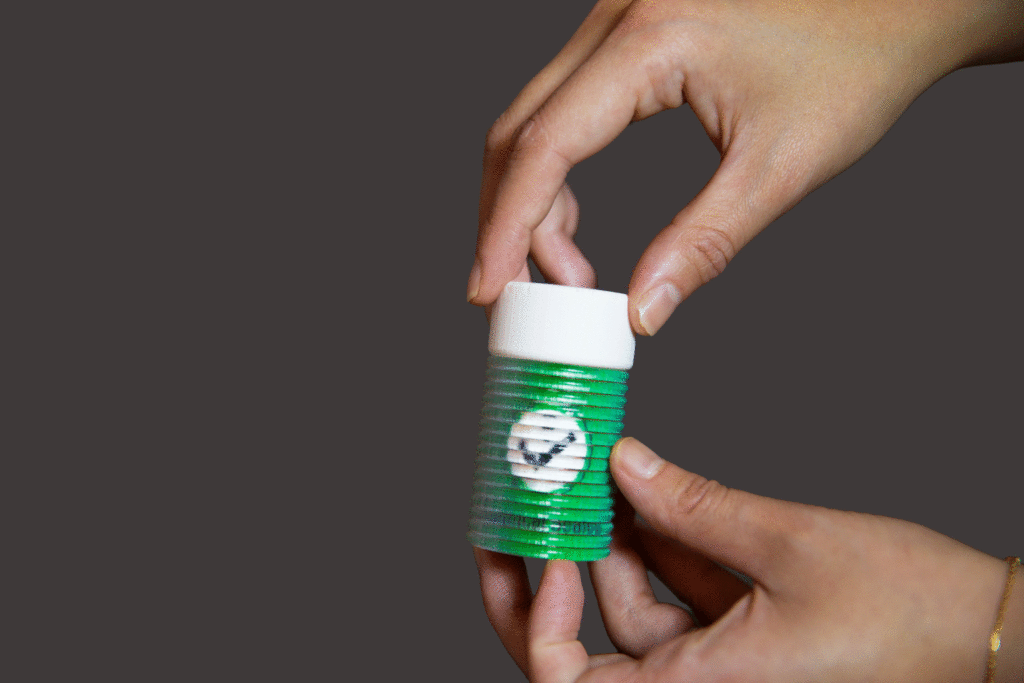
To illustrate the versatility and practical utility of ShiftLens, the researchers fabricated a series of interactive objects demonstrating its capabilities. One compelling experiment involved a chemical bottle designed to provide immediate feedback on its cap’s security. When the cap is securely tightened, the bottle’s surface visually transforms to display a green color and a prominent check mark, offering a clear, intuitive signal of proper closure. Conversely, if the cap is loose, the surface instantly switches to a red color and an exclamation mark, alerting the user to a potential spill or contamination risk without any electronic components or power source. This simple yet effective application has significant implications for safety in laboratories, industrial settings, and households, reducing the reliance on manual checks or complex sensor systems.
Another imaginative demonstration showcased a tic-tac-toe game. The squares of the game board, when manipulated by a user turning a knob, could dynamically display a red ‘X’, a blue ‘O’, or remain blank. This exemplifies how ShiftLens can be used for interactive entertainment or educational tools, providing a tangible, tactile experience that is both robust and engaging. Such applications could find homes in children’s toys, interactive museum exhibits, or even accessible gaming for individuals who prefer or require physical interaction over digital screens.
Beyond these proof-of-concept demonstrations, the potential for ShiftLens to scale up for commercial and industrial applications is vast. Zhu envisions its use in critical infrastructure, such as piping systems. "The leaking sink in my apartment would be a lot easier to fix if it could tell me where the leak was coming from," Zhu quipped, highlighting a very tangible problem. A ShiftLens-enabled pipe could change its surface appearance—perhaps from a standard color to a vivid warning hue—at a damaged connection point, visually identifying a leak without requiring continuous electronic monitoring or manual inspection. This could revolutionize maintenance protocols, reducing downtime and preventing costly damage in industrial facilities, municipal water systems, or even residential plumbing.
Beyond the Lab: Broader Implications and Market Potential
The development of ShiftLens holds profound implications across various sectors, signaling a shift towards more robust, intuitive, and sustainable interactive technologies.
Economic Impact: By eliminating the need for expensive electronic components, ShiftLens could significantly reduce the manufacturing costs of interactive objects. This cost-efficiency could open new market segments, making interactive signage, packaging, and tools more accessible to small businesses and niche industries. Furthermore, the inherent durability of mechanically driven systems could lead to lower maintenance and replacement costs over the product lifecycle, offering a compelling economic advantage.
Environmental Benefits: The reduction in electronic waste (e-waste) is a critical environmental concern. Traditional interactive displays often have short lifespans due to electronic fragility or rapid technological obsolescence. By substituting electronics with durable mechanical and optical systems, ShiftLens could contribute to a substantial decrease in e-waste. Additionally, the system’s passive nature means zero power consumption for its visual changes, leading to significant energy savings, especially in applications like outdoor signage or dynamic packaging where continuous power might be impractical or costly. This aligns with global sustainability initiatives and the growing demand for eco-friendly products.
Industrial and Safety Enhancements: The robustness of ShiftLens makes it ideal for harsh industrial environments. Adaptable warning signs that are impervious to extreme weather, chemical exposure, or physical impact could drastically improve workplace safety. Dynamic indicators on machinery could alert operators to operational states or maintenance needs without relying on easily damaged electronic displays. In logistics, smart packaging equipped with ShiftLens could visually signal tampering, temperature excursions, or product integrity issues, enhancing supply chain security and reducing waste.
Design and Artistic Freedom: For designers and artists, ShiftLens unlocks new avenues for creativity. The ability to create kinetic art or adaptable architectural elements that change appearance based on environmental factors or user interaction, without the constraints of power sources or wiring, offers unprecedented freedom. Architects could design building facades that dynamically respond to daylight or occupancy, while product designers could embed intuitive feedback directly into the physical form of an object, creating more engaging and user-friendly experiences. The rapid prototyping capabilities also mean faster iteration and innovation in these fields.
Technological Advancement: ShiftLens pushes the boundaries of several technological domains, including smart materials, advanced 3D printing, and precise mechanical engineering. The successful alignment of optical effects, mechanical linkages, and computational graphics represents a significant achievement in interdisciplinary research. It also prompts further exploration into novel materials that can enhance the durability and visual fidelity of the lenticular lenses and backplanes.
Expert Perspectives and the Vision Ahead
Stefanie Mueller, an associate professor at MIT and a member of CSAIL, whose expertise lies in human-computer interaction and novel fabrication techniques, likely views ShiftLens as a crucial step towards more pervasive and accessible interactive technologies. Her involvement underscores MIT’s commitment to pushing the boundaries of how humans interact with their environment, moving beyond screens to tangible, responsive objects. The system embodies the principles of ubiquitous computing, where intelligence is embedded seamlessly into everyday objects, making them more informative and interactive without being overtly "smart" in the electronic sense.
The research team plans to continue refining ShiftLens in future work. One key objective is to develop an algorithm capable of generating ShiftLens structures with even fewer user inputs, further simplifying the design process and broadening accessibility. They also aim to enhance the design tool to allow users to incorporate a wider variety of actuation mechanisms, moving beyond simple knobs and sliders to potentially integrate with more complex mechanical systems or even environmental triggers. This continuous development cycle is characteristic of groundbreaking research, ensuring that the initial innovation evolves to meet diverse needs and unlock its full potential.
The Future of Interaction: Robust, Intuitive, and Sustainable
The ShiftLens system from MIT represents a compelling vision for the future of interactive objects. By divorcing dynamic visual changes from fragile electronics, it offers a pathway to creating devices that are not only more robust and durable but also more intuitive to use and sustainable in their lifecycle. From crucial safety indicators in industrial settings to engaging educational toys, the applications are far-reaching and impactful. As the world increasingly seeks solutions that are resilient, energy-efficient, and user-friendly, ShiftLens stands out as a pioneering step towards a future where our physical environment is inherently more interactive and informative, without the inherent vulnerabilities of conventional electronic systems. The era of mechanically switchable surfaces has arrived, promising a future of smarter objects that can withstand the rigors of the real world.