The horological world is constantly evolving, with brands seeking to innovate and cater to the diverse preferences of watch enthusiasts. At the prestigious Geneva Watch Days, Alpina, a brand with a rich heritage in creating robust and reliable timepieces, unveiled a significant expansion of its Solarmetre line. This introduction signifies a strategic move by the Citizen Group, Alpina’s parent company, to integrate advanced solar quartz technology into more accessible and appealing watch designs. The launch introduces new solar quartz references across key Alpina collections, most notably the Startimer Pilot and a special edition Alpiner Extreme, offering consumers compelling alternatives that blend modern functionality with classic watchmaking aesthetics.
Strategic Integration of Solar Quartz Technology
The introduction of solar quartz movements, manufactured by La Joux-Perret, into familiar Alpina references represents a logical and synergistic progression for the brand. Both Alpina and La Joux-Perret are under the umbrella of the Citizen Group, a global leader renowned for its long-standing commitment to and expertise in solar quartz technology. Citizen has consistently championed this eco-friendly and convenient power source for decades, integrating it across a wide spectrum of its own watch offerings. By leveraging La Joux-Perret’s specialized movements, Alpina is able to offer the advantages of solar power within its distinct design language and at a price point that positions it above the mainstream Citizen offerings. This strategic alignment within the Citizen Group aims to broaden the appeal of solar technology, presenting it as a premium yet practical option for a discerning audience, and sparking an interesting discourse on value for collectors who may appreciate the merits of both brands.

The technical underpinnings of these new Alpina watches are rooted in the efficiency and reliability of solar quartz. The AL-140 movement, powering the new Startimer Pilot Solarmetre models, offers an impressive power reserve of up to 10 months in complete darkness. This remarkable longevity, coupled with the minimal light exposure required for modern solar movements to maintain their charge, effectively translates to a "set it and forget it" ownership experience. This "grab-and-go" convenience, a hallmark of solar-powered watches, is a significant draw for consumers seeking hassle-free timekeeping without the need for regular battery replacements or manual winding.
New Startimer Pilot Solarmetre: Enhanced Wearability and Design Evolution
The core of Alpina’s Geneva Watch Days presentation centered on a trio of new Startimer Pilot Solarmetre watches. These timepieces are essentially solar quartz powered iterations of the recently introduced Alpina pilot watch, which debuted earlier this year at Watches & Wonders. The primary value proposition of these new models lies in the inherent advantages of the La Joux-Perret quartz movement. Compared to their mechanical counterparts, the solar quartz movement allows for a more compact and refined case design.
The mechanical versions of the Startimer Pilot typically measure 40mm in diameter and a little over 10mm in thickness. In contrast, the new Solarmetre watches have been thoughtfully scaled down to a more universally wearable 38mm in width and a slim 9.3mm in height. This reduction in diameter and thickness is a meaningful difference, contributing to enhanced comfort and a more discreet presence on the wrist. This miniaturization is a direct benefit of the smaller, more efficient quartz movement, which allows for a sleeker profile without compromising on the pilot watch aesthetic.

Three distinct dial variations are available for the Startimer Pilot Solarmetre: classic black and a sophisticated blue, both housed within stainless steel cases. Complementing these, Alpina also offers a striking brown dial version encased in a PVD-coated steel case. The PVD coating is described by Alpina as a "champagne" hue, a color that evokes a sense of refined elegance. This particular shade of PVD immediately brings to mind the popular "Mojave" colorway, notably introduced by IWC in their ceramic pilot watches in recent years. While the materials differ significantly, with Alpina utilizing a more accessible PVD coating, the visual resonance and aesthetic appeal are remarkably similar, offering a modern and stylish take on a pilot watch.
The dials of all three Startimer Pilot Solarmetre models feature a prominent grain texture, adding a tactile and visual depth. They are further enhanced by oversized, lume-filled Arabic numerals, ensuring excellent legibility in all lighting conditions, a crucial characteristic for any pilot’s watch. A discreet date window is positioned at the 3:00 mark, maintaining the watch’s functional balance. The retail price for the stainless steel Startimer Pilot Solarmetre models is set at $1,495, while the PVD-coated version comes in at $1,695, positioning them as competitive offerings in the premium pilot watch segment.
Alpiner Extreme Solarmetre: A Nautical-Inspired Limited Edition
Adding to the excitement, Alpina also introduced the limited edition Alpiner Extreme Solarmetre, a timepiece designed to commemorate the brand’s sponsorship of the Route du Rhum. This renowned transatlantic sailing race, which commences in Saint-Malo, France, and concludes in Pointe-à-Pitre, Guadeloupe, is a multi-day challenge that embodies endurance and precision. The introduction of this special edition further underscores Alpina’s strategy of adapting solar technology to its diverse collections.

Similar to the Startimer Pilot line, Alpina has opted for a more compact case size for the solar-powered Alpiner Extreme compared to its mechanical counterpart. While the automatic version of the Alpiner Extreme measures 39mm, the solar-powered variant is designed to be slightly smaller, at 37.5mm. This deliberate sizing choice reflects Alpina’s understanding of how to best integrate the solar quartz movement for optimal wearability, particularly in a sports watch context.
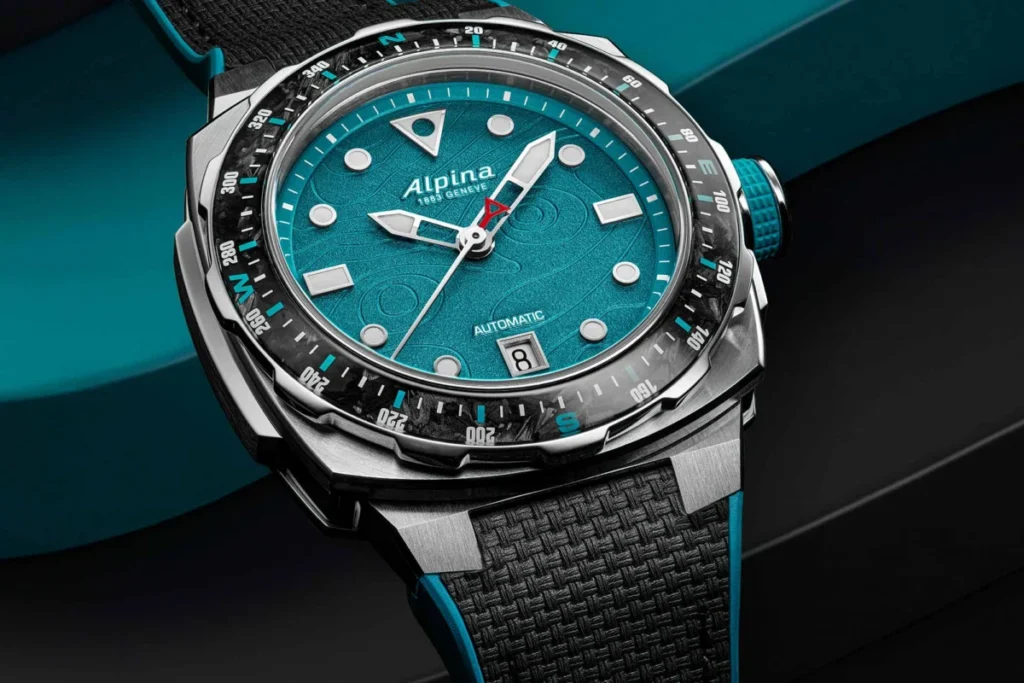
Both the Solarmetre and automatic versions of the Alpiner Extreme are aggressively styled modern divers, characterized by vibrant color accents and the strategic use of carbon fiber. The Alpiner Extreme Solarmetre features a compelling combination of a black dial, a striking turquoise chapter ring, and a carbon fiber bezel insert, creating a dynamic and eye-catching aesthetic. In contrast, the automatic version boasts a vibrant turquoise dial, adorned with a motif that artfully depicts the race route, and a functional carbon fiber compass bezel.
The limited edition Alpiner Extreme Solarmetre is priced at $1,495 and is restricted to a production run of 513 pieces, highlighting its exclusivity. The automatic version, on the other hand, is priced at $2,295 and is limited to 313 pieces, reflecting the higher cost associated with an in-house automatic movement and its even more limited production. This pricing structure and limited availability further emphasize the distinct positioning and appeal of each model within the Alpiner Extreme line.

Analysis of Value and Market Positioning
The introduction of Alpina’s Solarmetre collection naturally prompts a discussion about value proposition, particularly when juxtaposed with its sibling brand, Citizen. While both brands leverage the efficiency of solar quartz movements, the Alpina watches occupy a higher price bracket. The appeal of the Alpina Solarmetre models lies in the superior case and dial finishing, the more refined design details, and the brand’s heritage and positioning as a premium watchmaker. These subtle yet significant enhancements contribute to a more luxurious ownership experience.
However, the fundamental advantage of solar quartz technology is its inherent value in terms of convenience and cost-effectiveness, often being positioned as an accessible alternative to traditional mechanical movements. This can create a perception of an anachronism when solar-powered watches appear at higher price points. It is worth noting that Alpina is not alone in this strategy. Other esteemed brands have also embraced solar technology at elevated price tiers. TAG Heuer, for instance, utilizes La Joux-Perret solar movements in some of its timepieces, and Cartier received considerable acclaim for its solar-powered Tank watch several years ago. These examples demonstrate a growing trend of integrating advanced solar technology into luxury watchmaking, acknowledging its functional benefits and appealing to a broader consumer base.
The true innovation and interest surrounding Alpina’s Solarmetre watches, however, lie in the brand’s adept utilization of the physical advantages offered by the La Joux-Perret movements. The ability to craft slimmer, more wearable watch cases is a significant achievement. This allows Alpina to offer its distinctive designs in dimensions that will resonate with a wider audience, including those who may find traditional mechanical watches, particularly pilot and dive watches, to be overly bulky. The combination of modern solar technology, refined design, and enhanced wearability positions Alpina’s Solarmetre collection as a compelling and forward-thinking offering in the contemporary watch market. The strategic expansion of the Solarmetre line signals Alpina’s commitment to embracing technological advancements while remaining true to its brand identity and heritage.