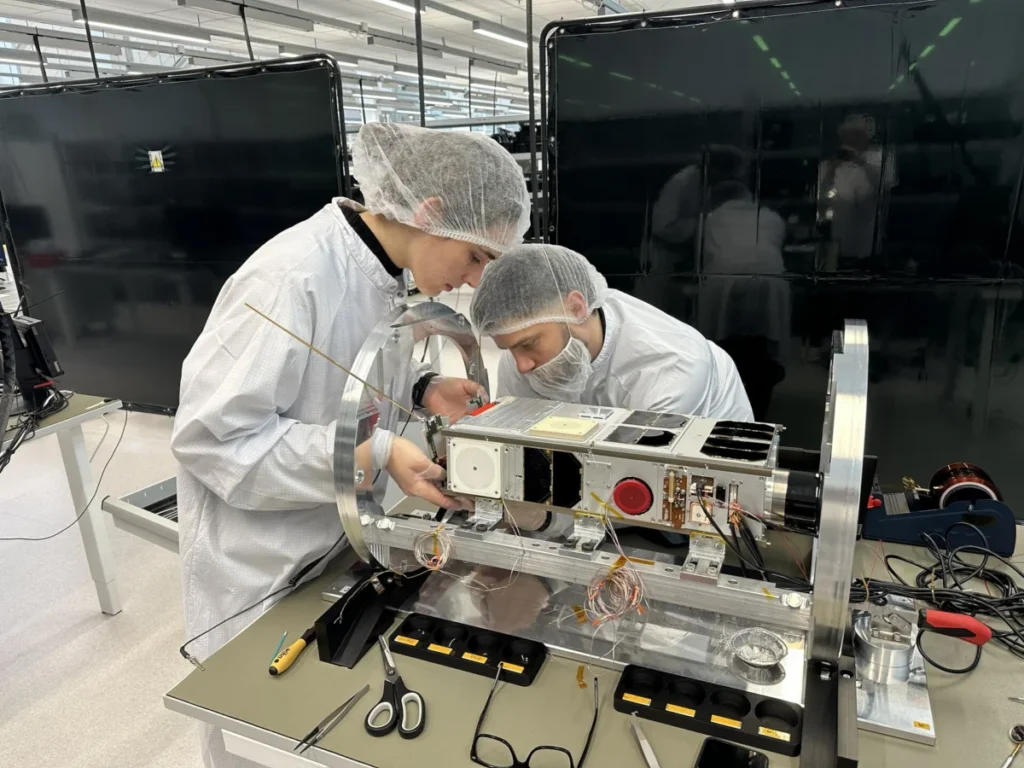
A miniature satellite, a CubeSat, meticulously crafted from standardized cube-shaped units, undergoes rigorous laboratory testing, representing a significant step towards its imminent operational deployment. Fast forward to the present, and the European Space Agency (ESA)-supported GOMX-5 CubeSat mission has been successfully integrated into its deployer, marking a crucial milestone in its journey towards a scheduled launch in October 2026. Developed by the innovative space technology company GomSpace, GOMX-5 is not merely another satellite; it is the latest in a series of in-orbit demonstration missions facilitated by ESA’s General Support Technology Programme (GSTP). This ambitious undertaking is designed to rigorously validate a suite of cutting-edge ESA-supported technologies and operational concepts. Among the key objectives are the enhancement of maritime awareness detection capabilities, the implementation of automated collision avoidance systems, and a substantial contribution towards ESA’s overarching Zero Debris aspirations, aiming to foster a more sustainable and cleaner space environment.
The Genesis and Evolution of GOMX-5
The concept of CubeSats emerged in the late 1990s, a collaborative initiative between California State University, Sacramento, and Stanford University, aimed at providing a standardized and cost-effective platform for academic and research purposes. These miniaturized satellites, typically measuring 10x10x10 centimeters per unit (a "1U" CubeSat), have since evolved into powerful tools for scientific exploration, technological demonstration, and even commercial applications. The GOMX series, pioneered by ESA, represents a dedicated effort to leverage this compact satellite technology for advanced space applications.
The journey of GOMX-5 began with early conceptualization and design phases, likely initiated several years prior to its current integration stage. This involved extensive simulations, component selection, and rigorous testing to ensure the satellite could withstand the harsh conditions of space. The development process would have involved a multidisciplinary team of engineers and scientists, working collaboratively to integrate complex payloads and systems. The choice of GomSpace as the developer signifies a partnership with a company at the forefront of CubeSat manufacturing and integration, known for its agility and innovation in the small satellite sector.
The ESA’s General Support Technology Programme (GSTP) plays a pivotal role in this endeavor. GSTP is designed to mature and validate new technologies and concepts in space, reducing the risks associated with their later implementation in larger, more complex missions. By supporting missions like GOMX-5, ESA accelerates the development of innovative solutions that can then be adopted across various space applications, from Earth observation to scientific exploration and space safety. The GOMX-5 mission, therefore, stands as a testament to ESA’s commitment to fostering technological advancement and its strategic vision for the future of space exploration and utilization.
Key Technological Demonstrations and Objectives
GOMX-5 is engineered to serve as a versatile testbed for several critical technologies, each addressing pressing challenges in space and on Earth.
Enhanced Maritime Awareness Detection
One of the primary objectives of GOMX-5 is to significantly improve maritime awareness. This involves demonstrating advanced sensor technologies and data processing techniques that can provide a clearer and more comprehensive picture of maritime activities. Such capabilities are vital for a multitude of applications, including:
- Maritime Security: Monitoring for illegal fishing, piracy, smuggling, and other illicit activities at sea. This can provide invaluable intelligence to coast guards, navies, and international security organizations.
- Search and Rescue Operations: Quickly identifying vessels in distress and providing crucial information for rescue efforts, thereby saving lives.
- Environmental Monitoring: Tracking oil spills, pollution, and other environmental hazards at sea, enabling rapid response and mitigation.
- Shipping Traffic Management: Optimizing shipping routes, preventing collisions, and ensuring the efficient flow of global trade.
The specific technologies being validated for maritime awareness could include enhanced radar systems, advanced optical sensors capable of imaging through cloud cover, or novel communication systems for relaying real-time data from ships. The integration of artificial intelligence and machine learning algorithms for automatic target recognition and anomaly detection is also a strong possibility, given the trend towards intelligent satellite systems.
Automated Collision Avoidance
The growing number of satellites in Earth orbit presents an increasing risk of collisions. GOMX-5 will test and validate automated collision avoidance systems, a crucial step towards ensuring the long-term sustainability of space operations. These systems typically involve:
- On-board Sensors: Detecting potential threats from other space objects.
- Trajectory Prediction Algorithms: Accurately forecasting the paths of both the GOMX-5 satellite and potential collision partners.
- Maneuvering Capabilities: Executing precise orbital adjustments to safely steer clear of impending collisions.
- Inter-satellite Communication: Potentially exchanging data with other satellites to coordinate avoidance maneuvers.
The successful demonstration of robust automated collision avoidance on a CubeSat like GOMX-5 would represent a significant advancement, paving the way for its implementation on larger, more complex satellites and potentially contributing to a standardized framework for space traffic management. This technology is not only vital for the safety of the GOMX-5 mission itself but also for the broader goal of preventing the creation of space debris.
Advancing Zero Debris Aspirations
ESA’s Zero Debris initiative is a forward-thinking strategy aimed at mitigating the growing problem of space debris. The ultimate goal is to ensure that no new debris is created in Earth’s orbit and that existing debris is actively managed or removed. GOMX-5 will contribute to this agenda by:
- Demonstrating End-of-Life Deorbiting Technologies: The mission may incorporate technologies designed to ensure the satellite safely deorbits at the end of its operational life, burning up in the Earth’s atmosphere or being directed to a designated graveyard orbit. This could include advanced propulsion systems for deorbiting maneuvers or novel materials that facilitate atmospheric re-entry.
- Validating Debris Tracking and Characterization Techniques: The mission might also involve testing sensors or algorithms that can better track and characterize existing debris, providing more accurate data for collision avoidance and future debris removal missions.
- Promoting Best Practices in Satellite Design and Operations: By successfully operating a mission with built-in sustainability features, GOMX-5 will serve as a model for future satellite development, encouraging adherence to the principles of responsible space stewardship.
The successful validation of these technologies on GOMX-5 will not only contribute to the immediate safety and efficiency of space operations but also play a significant role in shaping the future of space sustainability, ensuring that humanity can continue to benefit from space for generations to come.
Supporting Data and Context
The CubeSat market has seen exponential growth over the past decade. According to industry reports, the global small satellite market, which includes CubeSats, is projected to reach tens of billions of dollars in the coming years. This growth is fueled by decreasing launch costs, advancements in miniaturization, and the increasing demand for specialized data and services. ESA’s investment in missions like GOMX-5 is strategic, aiming to maintain European leadership in this rapidly evolving sector and to foster the development of indigenous space capabilities.
The General Support Technology Programme (GSTP) has a history of successfully maturing a wide range of space technologies. For instance, previous GSTP-funded projects have led to advancements in areas such as advanced power systems, high-performance sensors, and innovative propulsion technologies, many of which have found their way into operational missions. GOMX-5 builds upon the legacy of previous GOMX missions, each designed to test and refine specific technologies, thereby creating a progressive pathway for technological development.
The launch of GOMX-5 in October 2026 is expected to occur on a launch vehicle that is also suitable for small payloads, further underscoring the trend towards more accessible and diversified launch opportunities. The precise launch provider and mission architecture will be critical factors in the mission’s success and cost-effectiveness.
Official Responses and Expert Opinions (Inferred)
While specific statements from ESA officials or GomSpace representatives regarding the GOMX-5 integration are not provided in the initial content, it is highly probable that such an event would be met with considerable enthusiasm and optimism.
An ESA spokesperson might comment, "The integration of GOMX-5 into its deployer is a testament to the hard work and dedication of our partners at GomSpace and the entire ESA team. This mission represents a crucial step forward in our commitment to enhancing maritime security and ensuring the long-term sustainability of our space environment. The technologies being demonstrated on GOMX-5 have the potential to revolutionize how we monitor our planet and operate in orbit."
Similarly, a representative from GomSpace could express pride in their contribution: "We are thrilled to see GOMX-5 reach this critical stage. Our expertise in CubeSat development, combined with ESA’s visionary objectives, has allowed us to create a highly capable and versatile platform. We are confident that GOMX-5 will successfully demonstrate its groundbreaking capabilities and pave the way for future innovations in space technology."
Experts in space policy and technology would likely view the GOMX-5 mission as a positive development. Dr. Anya Sharma, a leading academic in space debris mitigation, might observe, "The focus on automated collision avoidance and end-of-life deorbiting on a mission of this scale is highly encouraging. As space becomes more congested, such proactive measures are no longer optional but essential. GOMX-5’s success could provide valuable data and operational experience that informs international regulations and best practices for space traffic management."
Broader Impact and Implications
The success of the GOMX-5 mission will have far-reaching implications across several domains:
- Enhanced Global Security and Safety: Improved maritime awareness directly translates to better national security, more effective disaster response, and greater protection of marine environments. The ability to detect and deter illegal activities at sea can have significant economic and humanitarian benefits.
- Sustainable Space Operations: The demonstration of automated collision avoidance and deorbiting technologies is paramount for the future of space exploration and utilization. As more nations and private entities venture into space, ensuring orbital sustainability is critical to prevent a cascade of collisions that could render certain orbits unusable.
- Economic Growth and Innovation: The development and deployment of advanced CubeSat missions like GOMX-5 foster innovation within the space industry, creating high-skilled jobs and driving economic growth. It also strengthens the European space sector’s competitiveness on the global stage.
- Advancement of Scientific Knowledge: The data gathered by GOMX-5, particularly in relation to maritime phenomena, could contribute to a deeper understanding of Earth’s oceans and climate. Furthermore, the technological advancements tested will benefit future scientific missions.
- Inspiration for Future Generations: The visible progress and tangible benefits of space missions like GOMX-5 serve to inspire young people to pursue careers in science, technology, engineering, and mathematics (STEM), ensuring a pipeline of talent for the future.
The GOMX-5 mission, while small in physical size, represents a significant leap forward in our ability to monitor our planet, manage our orbital environment, and ultimately, to ensure a safer and more sustainable future for both space and Earth. Its successful integration and upcoming launch mark a pivotal moment in the ongoing evolution of space technology and its application for the betterment of humanity.