A novel form of magnetism, recently conceptualized as altermagnetism, holds significant promise for advancing the capabilities of computer memory, potentially making it smaller, faster, and considerably more energy-efficient. Recent scientific investigations have now yielded compelling evidence that ruthenium dioxide (RuO2), a quantum material previously categorized as nonmagnetic in its bulk crystalline form, may indeed manifest this extraordinary magnetic behavior when precisely engineered into an ultrathin film, merely a few atomic layers in thickness. This groundbreaking finding, published in the esteemed journal Science Advances, represents a pivotal moment in materials science and the pursuit of next-generation computing technologies.
The research was spearheaded by a collaborative team of distinguished physicists, including Ming Yi from Rice University, Bharat Jalan of the University of Minnesota, and Milan Radovic from the Paul Scherrer Institute. Their collective efforts have not only provided empirical support for the existence of altermagnetism in RuO2 but have also illuminated a potential pathway for its deliberate induction and control.
"Ruthenium dioxide was among the initial materials theoretically proposed as an altermagnetic candidate," stated Dr. Ming Yi, an associate professor of physics and astronomy at Rice University, elaborating on the historical context of their work. "However, extensive studies conducted on its bulk form consistently failed to provide any definitive evidence of magnetism. Our current research compellingly demonstrates that its ultrathin form, conversely, appears to be the critical factor in unlocking its magnetic potential." This observation underscores the profound influence of material dimensionality and structural manipulation on fundamental physical properties.
The Enigma of Altermagnetism: A New Paradigm in Magnetism
To fully appreciate the significance of this discovery, it is essential to understand altermagnetism within the broader landscape of magnetic phenomena. Traditionally, magnetic materials are classified into two primary categories: ferromagnets and antiferromagnets. Ferromagnets, like iron, are characterized by electron spins that align predominantly in the same direction, resulting in a net macroscopic magnetic moment. This property makes them useful for permanent magnets and conventional data storage, but also leads to unwanted stray magnetic fields and energy dissipation during operation. Antiferromagnets, on the other hand, feature neighboring electron spins that align in opposite directions, effectively canceling each other out and resulting in no net magnetization. While this absence of stray fields is advantageous, it makes reading and writing information to antiferromagnetic materials inherently more challenging.
Altermagnetism emerges as a fascinating hybrid, blending characteristics of both ferromagnets and antiferromagnets while possessing unique attributes that set it apart. In an altermagnet, the spin arrangement exhibits an alternating pattern, much like an antiferromagnet. However, crucially, this spin alternation is coupled with a specific orbital arrangement or crystal symmetry that allows for a net spin polarization in certain directions, or distinct spin-split electronic bands. This peculiar combination means altermagnets can exhibit properties akin to ferromagnets, such as a detectable spin current, without the accompanying stray magnetic fields that plague traditional ferromagnetic devices. The potential implications are profound: faster switching speeds, reduced energy consumption, and enhanced stability for data storage and processing.
A Longstanding Debate: The Magnetic Identity of Ruthenium Dioxide
The journey to identifying altermagnetism in ruthenium dioxide is punctuated by a lengthy and often contentious scientific debate. For decades, physicists grappled with the question of whether bulk ruthenium dioxide possessed intrinsic magnetism. Its crystal structure and electronic configuration hinted at the possibility, yet experimental results consistently pointed towards a nonmagnetic state. This consensus, firmly established through numerous studies, suggested that RuO2 was an inert, diamagnetic material, at least in its macroscopic form. The new findings directly challenge this long-held understanding, demonstrating that material dimension and specific environmental conditions can fundamentally alter a material’s inherent magnetic identity. This highlights the intricate nature of quantum materials, where properties are not always fixed but can be highly dependent on external factors and structural configurations.
Unveiling Magnetism Through Electron Spin Textures
The scientific team embarked on a meticulous investigation into the magnetic state of ultrathin ruthenium dioxide films by scrutinizing their "spin texture." Spin texture refers to the intricate spatial arrangement of a material’s magnetic moments, which are fundamentally derived from the intrinsic angular momentum, or "spin," of its electrons. These intricate patterns serve as a definitive fingerprint, revealing not only whether a material is magnetic but also the precise nature of its magnetism.
To meticulously measure these elusive patterns, the researchers employed a sophisticated experimental technique known as spin-resolved angle-resolved photoemission spectroscopy (SARPES). SARPES is a powerful tool in condensed matter physics that leverages the photoelectric effect. In this technique, photons of a specific energy are directed at the material, causing electrons to be ejected. By precisely measuring the energy, momentum, and crucially, the spin polarization of these emitted electrons, scientists can reconstruct the electronic band structure of the material and map out the orientation of electron spins in different parts of the material’s electronic landscape. This provides direct insight into the spin texture and thus the magnetic order.
"Following a comprehensive analysis of our measurements, which was significantly informed and validated by detailed theoretical calculations, we observed that, under our specific experimental conditions, the ruthenium dioxide exhibited spin textures remarkably consistent with unconventional magnetism," explained Yichen Zhang, the lead author on the paper and a recent graduate from Rice University. "This striking divergence strongly suggests that bulk and ultrathin ruthenium dioxide, when subjected to the appropriate conditions, can possess distinctly different magnetic properties." The interplay between experimental observation and theoretical modeling was critical in confidently interpreting the complex SARPES data and confirming the presence of altermagnetism.
The Crucial Role of Atomic Strain: A Magnetic "Tuning Knob"
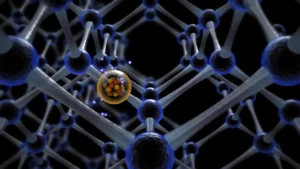
A particularly salient aspect of the research findings was the discovery that this unusual spin behavior, indicative of altermagnetism, manifested only under highly specific conditions. Foremost among these was the necessity for the electron structure of the ultrathin ruthenium dioxide to experience significant lattice strain. Lattice strain is essentially a form of mechanical stress that applies pressure on the material’s atomic lattice, causing its atoms to be slightly displaced from their equilibrium positions. This can be induced, for instance, by growing the ultrathin film on a substrate with a slightly different atomic spacing, leading to a mismatch that forces the film’s lattice to either stretch or compress.
Crucially, in the absence of such lattice strain—as is typically the case in the material’s natural, bulk form—the electron spins did not exhibit any discernible signs of altermagnetism. This direct correlation between strain and magnetism highlights a powerful mechanism for controlling the material’s properties.
"The strain-dependent nature of our observations strongly suggests that lattice strain could be effectively utilized as a ‘tuning knob’ to precisely induce or control altermagnetism," elaborated Zhang. "This capability could prove immensely valuable when conceptualizing and designing next-generation spintronics and advanced RAM architectures." The ability to manipulate magnetic behavior through mechanical means, rather than relying solely on magnetic fields or electrical currents, offers a new dimension of control in material design. This result fundamentally raises the intriguing possibility that researchers could deliberately adjust lattice strain to finely tune and control magnetic behavior in future electronic materials, opening up unprecedented avenues for innovation.
Implications for Next-Generation Computing: The Spintronics Revolution
The implications of this discovery for the future of computing are far-reaching and potentially transformative. The field of spintronics, which seeks to harness the electron’s spin in addition to its electrical charge for information processing and storage, stands to benefit immensely from the advent of altermagnetic materials.
Current computer memory technologies, such as dynamic random-access memory (DRAM) and static random-access memory (SRAM), rely on charge-based phenomena, which are inherently volatile and power-intensive. Magnetic random-access memory (MRAM), a promising non-volatile alternative, utilizes ferromagnets but faces challenges related to stray fields and write endurance. Altermagnets, with their unique combination of properties, offer a compelling solution. Their lack of stray magnetic fields eliminates interference between closely packed memory cells, enabling higher storage densities. Furthermore, the inherent symmetry of altermagnets may facilitate faster and more energy-efficient spin manipulation, leading to significantly quicker read/write speeds with lower power consumption. This could pave the way for universal memory architectures that combine the speed of RAM with the non-volatility of flash memory.
Beyond memory, altermagnetism could impact other spintronic devices, including logic gates, sensors, and quantum computing components. The ability to precisely control the magnetic state via lattice strain introduces a new paradigm for device design, potentially leading to novel functionalities and enhanced performance. For instance, strain-controlled altermagnetic transistors could offer ultra-low power switching, significantly extending battery life in portable electronics and reducing the energy footprint of data centers.
The Broader Impact on Quantum Materials Research
This work also underscores the profound complexity involved in identifying and accurately describing the behavior of quantum materials. The long-standing scientific debate surrounding the magnetic properties of bulk ruthenium dioxide serves as a stark reminder of the challenges inherent in this field. The prevailing consensus that bulk RuO2 was nonmagnetic has now been effectively overturned by the revelation that its ultrathin form, under specific strain conditions, exhibits distinct magnetic behavior.
This discovery highlights several critical aspects for the broader quantum materials research community:
- Dimensionality Matters: The properties of materials can drastically change when reduced to nanoscale dimensions, such as ultrathin films. What holds true for a bulk material may not apply at the atomic scale.
- Strain Engineering: Lattice strain is not merely a byproduct of thin-film growth but a powerful parameter that can be deliberately manipulated to tune and control fundamental material properties, including magnetism, superconductivity, and topological states.
- Advanced Characterization: The reliance on sophisticated techniques like SARPES, coupled with rigorous theoretical calculations, is indispensable for unraveling the subtle and complex phenomena occurring in quantum materials. These tools allow scientists to probe properties at the atomic and electronic levels, revealing hidden behaviors.
- Re-evaluation Potential: This finding prompts a re-evaluation of other materials previously classified as nonmagnetic or having specific properties. Many materials might harbor latent, exotic states that are only accessible under precise conditions of strain, dimensionality, or external fields.
"This work vividly illustrates the profound complexity inherent in these fundamental scientific inquiries," Dr. Yi reflected, emphasizing the meticulous nature of their research. "The exceptional quality of the material preparation and the scrupulous adherence to our measurement protocol were absolutely critical to our successful observation of the correct electron spin properties. The results necessitated an extremely careful and detailed analysis of the spin-resolved angle-resolved photoemission spectroscopy data. Through this rigorous process, we were not only able to precisely determine the magnetic state symmetries but also to identify a potential mechanism to manipulate this state in future generations of quantum materials."
Future Outlook and Challenges
While the discovery of altermagnetism in ultrathin ruthenium dioxide marks a significant scientific triumph, the path from laboratory breakthrough to widespread technological adoption is often long and fraught with challenges. Key hurdles remain, including:
- Scalability of Thin-Film Growth: Developing methods for growing large-area, defect-free ultrathin films with precise atomic layer control and uniform strain.
- Precise Strain Control: Achieving reproducible and finely tunable lattice strain across device-relevant scales.
- Integration with Existing Technologies: Incorporating these novel altermagnetic materials into current semiconductor fabrication processes and device architectures.
- Read/Write Mechanisms: Developing efficient and robust methods for reading and writing information to altermagnetic bits.
Despite these challenges, the potential rewards are immense. The ability to create computer memory that is orders of magnitude faster, consumes significantly less power, and boasts unprecedented storage density could catalyze a new era of computing, enabling advancements in artificial intelligence, big data analytics, and quantum computing. This discovery is not merely a theoretical curiosity but a tangible step towards a future where computing power is no longer limited by the constraints of conventional electronics. The scientific community will undoubtedly continue to explore altermagnetism in ruthenium dioxide and other candidate materials, driven by the promise of revolutionizing the digital landscape.
This work was made possible through the generous financial support of several key organizations, including the U.S. Department of Energy (DE-SC0026179, DE-SC0020211, DE-SC0024710), the Gordon and Betty Moore Foundation’s EPiQS Initiative (GBMF9470), and the Robert A. Welch Foundation (C-2175). These investments in fundamental research continue to push the boundaries of human knowledge and pave the way for future technological innovations.