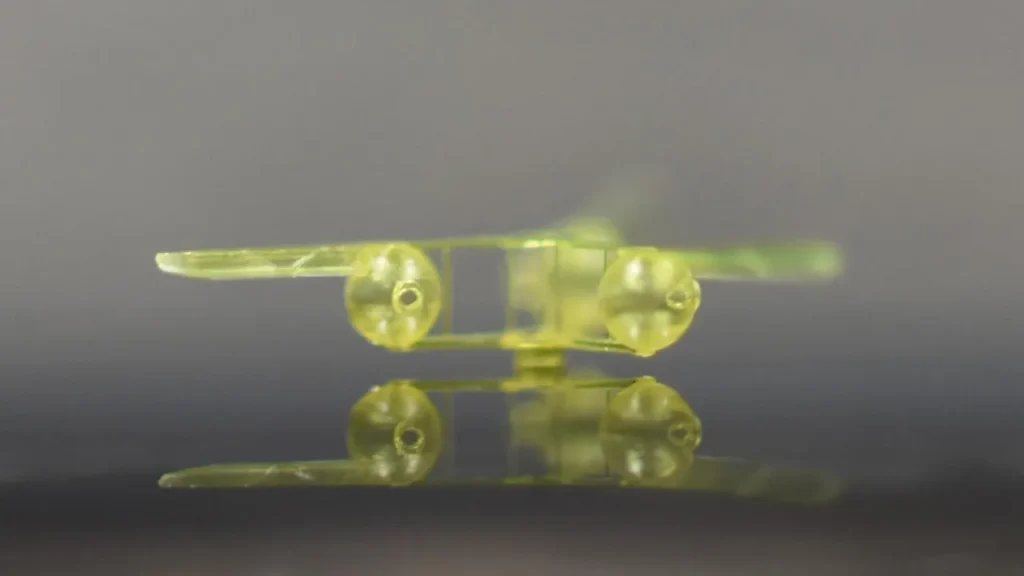
In a significant departure from conventional robotic design, a collaborative team of researchers from the Swiss Federal Institute of Technology Lausanne (EPFL) and Imperial College London has unveiled a novel class of miniature robots capable of flight, flotation, and steering, powered exclusively by sound waves rather than traditional pneumatic or electronic systems. This innovative development challenges long-held paradigms in robotics, where motors, gears, and batteries are considered indispensable components for generating movement. The research, spearheaded by Dr. Ryusuke Nomi from EPFL, introduces a transformative approach to micro-robotics, leveraging an ancient physical phenomenon to unlock unprecedented levels of miniaturization and operational versatility in challenging environments.
The Genesis of Acoustic Propulsion: Helmholtz Resonance Revisited
The fundamental principle underpinning this groundbreaking technology is Helmholtz resonance, a phenomenon first meticulously studied and documented by the eminent German polymath Hermann von Helmholtz in 1856. Helmholtz, a physician, physicist, and physiologist, made indelible contributions across numerous scientific disciplines, including optics, electrodynamics, and acoustics. His work on resonators, initially conceived to analyze complex sounds by isolating individual frequencies, demonstrated that when air within a hollow cavity vibrates at the same natural frequency as an incoming sound wave, it can generate a powerful efflux of air through an opening in the cavity. This effect, a consequence of sympathetic vibration, transforms acoustic energy into kinetic energy, creating a focused jet of air. By modulating the pressure inside the resonator, this air jet can be intensified sufficiently to produce tangible mechanical movement.
While Helmholtz’s pioneering experiments laid the theoretical groundwork over a century and a half ago, the practical application of his findings for miniature robotics remained elusive due to the sheer scale of the equipment required. The resonators of the 19th century were large and cumbersome, rendering them impractical for any form of micro-actuation. However, the dawn of the 21st century has ushered in an era of advanced manufacturing techniques, particularly in micro-fabrication, which have now made it feasible to craft extraordinarily small resonators with geometries precisely controlled at the micro- and even nanometer scales. Crucially, as the physical dimensions of these resonators are reduced, their optimal operating frequency correspondingly increases, shifting from the audible spectrum into the ultrasonic range. This transition is highly advantageous for robotic applications, as ultrasonic sound waves can be precisely focused and directed without producing dangerously loud or irritating audible noise, making them ideal for controlled manipulation in sensitive environments.
Precision Manufacturing: The Role of Two-Photon 3D Printing
The creation of these diminutive resonators, essential for the sound-powered robots, relies on an advanced additive manufacturing technique known as two-photon 3D printing, or two-photon polymerization (2PP). This sophisticated method, a form of direct laser writing, enables the fabrication of intricate 3D structures with sub-micrometer resolution – a level of precision far exceeding that of conventional 3D printing technologies. In two-photon printing, a femtosecond pulsed laser is focused into a photosensitive resin. The simultaneous absorption of two photons by the resin in a tiny focal volume triggers a localized polymerization process, solidifying the material only at that precise point. By moving the laser focus in three dimensions, complex hollow structures with extremely accurate internal and external geometries can be built layer by layer.
This unparalleled precision is critical for Helmholtz resonators, where the exact dimensions and shape of the cavity, as well as the size and geometry of the opening, directly influence the resonance frequency and the efficiency of air jet generation. The researchers utilized 2PP to manufacture these hollow structures with exquisite control, allowing for experimental testing and rigorous comparison against sophisticated computer simulations. This iterative design and validation process was instrumental in optimizing the performance of the resonators for maximum thrust and control. The ability to create such fine structures has been a game-changer, overcoming a significant hurdle that previously prevented the miniaturization of acoustic propulsion systems.
Early Demonstrations: From Aquatic Vessels to Aerial Micro-Fliers
To validate their acoustic propulsion concept, the research team initially demonstrated the technology using miniature boats, each measuring approximately 5 centimeters in length. These aquatic prototypes were equipped with multiple resonators, each meticulously tuned to different frequencies and designed to direct air jets in specific directions. By precisely controlling the pitch and frequency emitted from an external ultrasonic speaker, the researchers could orchestrate the boats’ movement, demonstrating directional control, propulsion, and steering without any onboard motors or propellers. This initial success proved the viability of using sound as both an energy source and a control signal for macroscopic movement.
Pushing the boundaries of miniaturization further, the team then scaled down their designs dramatically, creating micro-fliers as small as 1 millimeter across. These devices represent a significant leap in micro-robotics. Some of these micro-fliers generate lift by producing a direct downward air thrust through their integrated resonators, effectively acting like miniature hovercraft. Others employ a more sophisticated design, utilizing sound-driven blades that rotate in a manner analogous to miniature helicopter rotors. In these designs, the acoustic energy not only provides lift but also drives the rotational motion of the blades, showcasing the versatility of the Helmholtz resonance principle. These diverse actuation methods highlight the potential for different types of sound-powered robots, each suited to specific tasks and environments.
The Unparalleled Advantages of Motorless Design

One of the most compelling advantages of this acoustic propulsion approach is the complete absence of a conventional motor. Traditional electric motors, ubiquitous in robotics, pose significant challenges as devices shrink. Miniaturizing motors requires shrinking components such as magnets, coils, bearings, and intricate mechanical structures. As these components become infinitesimally small, maintaining sufficient magnetic force, achieving precise mechanical stability, managing heat dissipation, and ensuring durability become increasingly difficult and inefficient. The scaling laws often work against conventional motor designs at the micro-scale, where friction and surface tension effects become dominant relative to inertial forces.
In stark contrast, the resonators employed in the sound-powered robots are primarily hollow structures. Their operational principle relies on the geometry of the cavity and the interaction with sound waves, not on electromagnetic forces or mechanical rotation. This inherent simplicity in design means that their size can potentially be reduced far beyond what would be practical or even theoretically possible for a conventional electric motor. This fundamental difference in design philosophy opens up new frontiers for extreme miniaturization, allowing for the creation of robots that could operate in spaces previously inaccessible to even the smallest motor-driven devices. The elimination of moving parts also suggests potentially higher reliability and lower manufacturing complexity for the core propulsion unit, though external sound sources and control systems introduce their own complexities.
Navigating the Path to Practicality: Challenges and Opportunities
While the ingenuity of sound-powered propulsion is undeniable, the researchers acknowledge that significant work remains before these systems become practically viable for widespread application. The primary challenges revolve around control, navigation, and the integration of useful robotic functionalities. A micro-robot that can fly or float is a remarkable feat, but without onboard sensors, processing capabilities, and autonomous control systems, its utility outside of highly controlled laboratory environments is limited. A robot incapable of perceiving its surroundings, determining its own position, or executing complex tasks independently currently holds little practical value.
However, the research team and experts in the field envision a future where sophisticated micro-electronics can be seamlessly integrated into these acoustic propulsion platforms. The rapid advancements in Micro-Electro-Mechanical Systems (MEMS), low-power microcontrollers, and miniaturized sensors (such as accelerometers, gyroscopes, and even micro-cameras) suggest that such integration is within the realm of possibility. In this envisioned future, sound would continue to provide the propulsion and potentially some basic control signals, while the onboard electronics would handle sensing, complex computation, and more nuanced navigation. This synergistic approach could give rise to an entirely new family of extremely small, agile robotic devices capable of operating effectively in environments where conventional propulsion, power delivery, or communication systems face severe limitations.
Transformative Applications in Challenging Environments
The unique characteristics of sound-powered micro-robots make them particularly well-suited for a variety of challenging and previously inaccessible environments.
- Confined and Obscured Spaces: Caves, collapsed building structures, intricate pipeline networks, and the internal workings of complex machinery are often too dangerous, narrow, or dark for human inspection and too constrained for larger robots. Sound-powered micro-fliers could navigate these spaces, providing critical visual or sensor data.
- Electromagnetically Interfered Zones: Environments with significant electromagnetic interference (EMI) can severely disrupt radio-frequency communication and the operation of electrically sensitive components in conventional robots. Acoustic communication and propulsion offer a robust alternative, as sound waves are unaffected by EMI, enabling operation where other robots would fail.
- Long Tubes and Narrow Hallways: Sound propagates efficiently through these environments. An external acoustic system could not only control a small robot but potentially use the same acoustic environment to map the surroundings, providing a form of remote sensing. This could enable exploration of deep, narrow conduits, such as those found in nuclear facilities or industrial plants, without direct human entry.
- Biomedical Applications (Long-Term Vision): While highly speculative, the ultimate miniaturization potential could open avenues for non-invasive manipulation of objects within biological systems, targeted drug delivery, or micro-surgical assistance, though this would require significant advancements in biocompatibility and precision control.
- Environmental Monitoring: Deploying a swarm of tiny, sound-powered sensors to monitor air quality, detect pollutants, or track microscopic organisms in hard-to-reach ecosystems without disturbing the environment.
Broader Impact and Future Outlook
This research not only presents a novel method for robot locomotion but also fundamentally expands our understanding of how energy can be harvested and converted at the micro-scale. It reminds us that sound, traditionally perceived primarily as a carrier of information, possesses an untapped potential as a direct generator of physical movement. The ability to propel and control objects using focused acoustic energy, even without direct contact, has broader implications beyond robotics, potentially influencing fields such as microfluidics, materials science, and even acoustic levitation technologies.
The timeline for practical deployment of fully autonomous, sound-powered robots remains uncertain, likely spanning several decades. Current limitations include the need for an external sound source, which restricts the operational range, and the aforementioned lack of onboard intelligence. Researchers are actively exploring methods for miniaturizing sound generators and power sources, as well as integrating advanced sensing and processing capabilities onto these tiny platforms. The development of miniature, highly efficient ultrasonic transducers and energy harvesting mechanisms (e.g., converting ambient vibrations into electrical energy) will be crucial steps.
Nevertheless, the basic idea is remarkably clever and represents a significant scientific and engineering achievement. As engineers and scientists continue to push the boundaries of miniaturization and seek innovative solutions to the challenges of micro-robotics, acoustic propulsion stands out as a promising frontier. It offers a fresh perspective on how machines can move and interact with their environment, potentially enabling exploration, intervention, and discovery in realms where conventional motors simply cannot go. This breakthrough signals a new era for micro-robotics, one where the whispers of sound could command the next generation of incredibly small, yet profoundly impactful, machines.