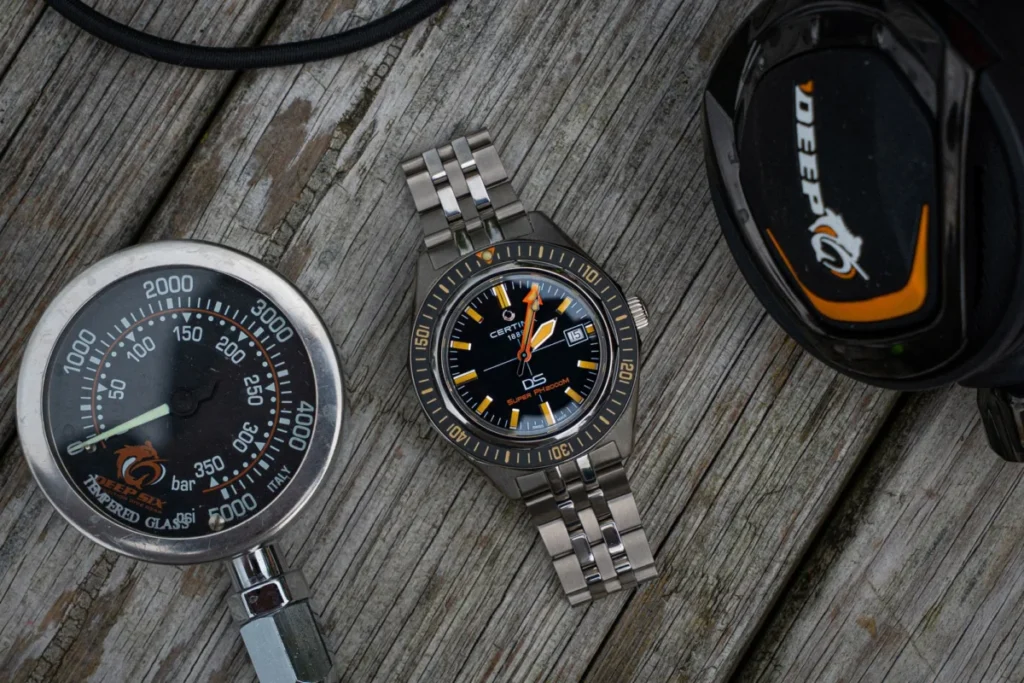
For Chris Sohl, known affectionately as Sohl, the allure of the ocean depths and the precision of a well-crafted watch have been inextricably linked since 2015. This dual fascination, ignited around the same time, has propelled him from a curious novice to a certified technical diver and a respected enthusiast who bridges communities. Sohl’s journey is a testament to how shared passions can foster deep connections, leading to adventures both underwater and within the vibrant world of horology. In this in-depth feature, we explore Sohl’s evolution as a diver, his trusted timepieces for underwater exploration, and his firsthand impressions of the robust Certina DS Super PH2000M.

From Curiosity to Technical Prowess
Sohl’s introduction to both diving and watches was serendipitous. In 2015, a glimpse of Hugh Laurie’s Hamilton Khaki King on the wrist during reruns of "House M.D." sparked his interest in mechanical watches. Simultaneously, a casual visit to a local dive shop led to an impromptu invitation to explore the world of scuba diving. These separate curiosities soon converged, revealing a shared essence of history, adventure, technical detail, and an ever-expanding realm of discovery.
"I find great joy in bringing people together over shared passions, especially watches and diving," Sohl explains. He has since embraced the moniker "Nerd Shepherd," a fitting descriptor for his efforts in organizing dives with fellow watch enthusiasts and administering online communities like The Grey NATO podcast’s TGN Crew Slack. This dedication to community building underscores his belief that shared interests forge genuine, lasting friendships, transforming digital connections into real-world road trips and unforgettable adventures.

The Rigor of Technical Diving
While Sohl began his diving journey on a traditional path—acquiring certifications in open water, advanced open water, nitrox, and rescue diving—he quickly adopted a technical mindset. This approach, characterized by a focus on redundant gear, clear communication, meticulous planning, and detailed logging, transformed recreational dives into exercises in precision and execution. "Focusing on things like redundant gear (‘two is one and one is none’), clear hand signals, detailed planning and logging gave me the satisfaction of executing the thing with excellence, rather than just being along for the ride," he notes.
His formal transition into technical diving occurred in 2025 with the completion of his AN/DP (baseline tech diving) certifications on the USS Oriskany, a sunken aircraft carrier off the coast of Pensacola, Florida. This marked the beginning of a new and challenging learning arc in his diving career. Sohl meticulously logs his dives using the MacDive application, a testament to his appreciation for data and detail. Currently, he has accumulated approximately 155 hours of bottom time across roughly 250 dives, a figure that represents a significant investment of time and effort beyond the submerged hours.

Memorable Dives and Lessons Learned
Sohl’s most memorable dive is deeply personal, tied to his family’s long-standing summer tradition at the Jersey Shore. Fulfilling a lifelong aspiration, his first dive post-open water certification was on the wreck of the Almirante, locally known as the "Flour Wreck," a few miles off Atlantic City. Despite the wreck being a jumbled mass of steel plating and boilers at 65 feet deep, the experience was profound. The North Atlantic’s challenging conditions—dark, cold (53°F), and turbid water—were overcome with the guidance of a patient divemaster. The moment his guide presented him with a small mosaic tile recovered from the wreck served as a powerful symbol of tangible history and the thrill of discovery. This dive taught him that genuine adventure is accessible to all who seek it and provided a meaningful genesis for his underwater explorations.
In stark contrast, his most challenging dive highlighted the psychological aspects of underwater safety. While on a dive with a less experienced friend, Sohl found himself managing multiple stressors: ensuring his buddy’s safety in low visibility, dealing with his own increased air consumption due to anxiety, and fumbling with the deployment of a Delayed Surface Marker Buoy (DSMB). The moment of panic intensified when he momentarily lost sight of his buddy, only to discover him calmly floating directly overhead. This near-miss served as a potent reminder that the greatest danger underwater is not the environment itself, but the onset of panic, which can escalate minor issues into significant emergencies. "The danger underwater really isn’t the shark, the wreck, the cave, or really even running out of air. It’s the panic that turns 3 or 4 little things into one big emergency because you’re no longer able to deal with them calmly and rationally," Sohl reflects.

The Enduring Appeal of Dive Watches
Sohl’s dual passion for diving and watches is amplified by the narrative power of dive watches. He likens them to portals connecting enthusiasts to the grand underwater story. Even in an era dominated by dive computers, Sohl champions the mechanical dive watch as an indispensable backup for technical diving. The pre-planned nature of technical dives, where every depth and gas mix is meticulously calculated, makes a reliable bottom timer crucial.
"I personally find it much more pleasant to use than the digital readouts on my dive computers," Sohl states. He values specific attributes in a dive watch: a sweeping seconds hand for constant reassurance of operation, a shallow dial for clear timekeeping, a grippable and fully graduated bezel for tactile control, and robust lume for visibility. These elements transform elapsed time tracking into a pleasurable experience, enhancing the overall dive.

First Impressions: The Certina DS Super PH2000M
Sohl recently had the opportunity to test the Certina DS Super PH2000M during a quarry dive. His initial impression was dominated by the watch’s surprising lightness, a characteristic attributed to its titanium construction. Despite its substantial size, the watch proved remarkably wearable. Legibility was excellent, and he particularly appreciated the purposeful design of the push-to-turn bezel and the convenience of the quick-release bracelet system, which simplifies strap changes—a feature he believes more manufacturers should adopt.
The watch’s 2,000-meter water resistance is a figure that Sohl acknowledges is far beyond practical necessity for human divers, yet it speaks to the brand’s commitment to robust engineering. "2,000 meters is over a mile. Even the commercial ‘Sat Rat’ Lords of the Abyss can’t dive half that deep," he observes, highlighting the extreme capabilities of the timepiece.

Performance Underwater and Design Philosophy
During his dive at Gilboa Quarry in northwest Ohio, a popular training ground for landlocked divers featuring an array of submerged attractions like a Sikorsky helicopter, school buses, and a private jet, Sohl found the Certina DS Super PH2000M’s bezel to be exceptionally functional. The coin-edge, decagonal design, combined with the push-to-turn mechanism, provided a secure and intuitive grip, even with gloves. "It’s very grippy. It’s coin-edge and decagonal, so that makes it really easy to grab. And since it’s push-to-turn, you’re already applying a good bit of force in the right direction," he commented. He praised Certina for creating a bezel mechanism that is both effective and straightforward, avoiding the overly complex designs that can hinder usability underwater.
The Appeal of Overbuilt Tools
The enjoyment divers and gear enthusiasts derive from "overbuilt" tools, like the Certina DS Super PH2000M, stems from a shared appreciation for capability and the boundless realm of "what if." Sohl suggests that while such extreme specifications may exceed practical dive requirements, they tap into a deeper psychological desire for confidence and exploration. "The point of the overbuiltness isn’t necessarily to physically go where you can only go with a submersible. The point is to enjoy the what-if of it all, while also resting in the confidence that it can handle whatever," he explains. This philosophy resonates with the spirit of adventure, pushing boundaries not just in physical exploration but also in imagination.

Sohl experienced the watch in three colorways: yellow, white dial, and black dial with vintage lume. He found the bright yellow dial particularly striking against the black dry suit, offering excellent visibility. While not delving to extreme depths where color perception might be significantly altered, the immediate legibility of the yellow was a distinct advantage, allowing him to easily focus on the watch face. "Man, that is a bright yellow dial in that field of black drysuit," he noted, emphasizing its purposeful and usable aesthetic.
Value and Spirit in Dive Watch Design
Comparing the Certina DS Super PH2000M to his prior experiences, Sohl believes Certina successfully conveys significant value in an overbuilt, purpose-driven diver. He highlights its broad appeal, stating, "When they see a big, chunky dive watch made out of titanium, they’re like, ‘Whoa, this thing is awesome. It has a turtle on the back. How cool is that?’" This sentiment underscores that beyond technical specifications, a dive watch’s appeal lies in its spirit and the inherent coolness it embodies. Sohl concludes that for a dive watch, being "cool and fun" is paramount.

Building a Community: The S.H.I.P.S. Society
Sohl’s passion extends to fostering a community he dubs S.H.I.P.S., or the "Subaquatic Historical Interest and Preservation Society." He describes his group of dive buddies as "nautical nerds of grace and goodwill." The society’s name itself alludes to the complex and often debated topic of shipwreck artifact salvage. In regions like the Jersey Shore, where Sohl has deep personal connections, diving is intrinsically linked to exploring and preserving the tangible history of maritime disasters through artifact recovery.
This practice, however, sparks diverse perspectives. While some enthusiasts meticulously restore and display salvaged artifacts, others, particularly in areas like the Great Lakes where shipwrecks are protected sites, emphasize preservation through non-disturbance. Sohl acknowledges this rich debate, noting that underwater history encompasses far more than just salvage, embracing fields from oceanographic exploration like Cousteau’s work and Sealab, to commercial diving and covert operations. The unifying element for S.H.I.P.S. is their shared belief in the "grand underwater story" and their collective passion for the watches that facilitate these journeys.

The interview, conducted by Kyle Snarr with photography by Jacob Van Buren, delves into the intricate connection between human endeavor, technological innovation, and the enduring allure of exploration, both beneath the waves and within the intricate world of watchmaking.