DM3D, a leading contract manufacturer and metal additive manufacturing (AM) solutions provider, is significantly accelerating production for demanding sectors like aerospace and space, notably for clients such as NASA, by leveraging its proprietary laser direct metal deposition (DMD) technology. The company’s innovative approach allows for the 3D printing of exceptionally large and intricate metal components, a capability that is transforming traditional manufacturing paradigms for low-volume, high-value applications.
From Automotive Roots to Space Exploration: The DM3D Transformation
Founded in 2013, DM3D initially established its operations in Auburn Hills, Michigan, with a primary focus on tool and die building and refurbishment, predominantly serving the automotive industry. However, the inherent challenges of the one-off nature of tool and die production, coupled with the growing trend of offshoring, began to steer the company’s strategic direction. President Bhaskar Dutta, drawing upon over two decades of experience in additive manufacturing, recognized a significant unmet need within the aerospace market. This confluence of factors, alongside a burgeoning interest in space exploration, prompted a pivotal shift in DM3D’s business model towards metal additive manufacturing.
"The traditional tool and die business, while foundational, presented limitations in terms of scalability and innovation for certain industries," explained a source close to the company, who wished to remain anonymous due to ongoing business discussions. "Mr. Dutta foresaw that the unique capabilities of metal AM could address critical bottlenecks in sectors that require highly specialized, large-scale components with rapid turnaround times. The aerospace and space industries, with their stringent quality requirements and often low-volume production needs, presented a perfect alignment for this vision."
This strategic pivot was not merely a change in focus but also involved significant investment in technological development. With a strong background in Direct Energy Deposition (DED) processes, Dutta identified an opportunity to develop in-house capabilities that could meet the scale and complexity demanded by space and aerospace clients. This led to the development of DM3D’s own DED systems and its patented Direct Metal Deposition (DMD) technology, specifically engineered for large-format additive manufacturing (LFAM) production. These advanced systems are not only integral to DM3D’s own manufacturing operations but are also offered to other additive manufacturers, positioning DM3D as both a service provider and a technology innovator.

Today, the Auburn Hills facility is a comprehensive hub for DM3D’s operations. Beyond its advanced 3D printing capabilities, the site manages all packaging and shipping logistics. Furthermore, a substantial portion of post-processing is handled in-house, utilizing a suite of advanced CNC and EDM machines. For exceptionally large components that exceed the in-house finishing capacity, DM3D strategically partners with specialized facilities to ensure a flawless final product.
The Power of Direct Metal Deposition (DMD)
At the heart of DM3D’s innovation lies its patented laser DMD technology. This advanced process is capable of printing with a wide array of metallic materials, including stainless steel, Inconel, and various alloys of aluminum, titanium, and copper. The versatility of the laser DMD system is particularly noteworthy, as it is engineered to handle the diverse material requirements of complex aerospace and space applications.
DMD is a sophisticated metal additive manufacturing process designed for the fabrication of intricate geometries. It employs a focused laser energy source to precisely melt and deposit metal powder or wire in a layer-by-layer fashion. The fundamental cycle of the DMD process involves:
- Material Feeding: Metal powder or wire is precisely delivered to the build area.
- Laser Melting: A high-power laser beam melts the delivered material.
- Deposition: The molten metal fuses with the underlying layer, building up the component.
- Layering: The process repeats, with each subsequent layer meticulously deposited to form the desired 3D structure.
This controlled deposition allows for the creation of complex internal features, optimized geometries, and consolidated parts that are often impossible to achieve through traditional subtractive manufacturing methods. The ability to precisely control the melt pool and deposition rate is crucial for achieving the high material integrity and dimensional accuracy required for critical aerospace components.
Large-Format Additive Manufacturing for Niche Industries
Industries that require low volumes of large-scale components often face significant cost and lead time challenges with conventional manufacturing techniques. Additive manufacturing, particularly LFAM, offers a compelling solution by dramatically reducing these barriers. DM3D initially targeted the space and aerospace sectors precisely because of this inherent advantage.

"The elimination of the traditional tool and die making process resulted in a substantial reduction in lead times," stated Bhaskar Dutta in a previous interview. "For low-volume production and prototyping, additive manufacturing offers a highly cost-effective approach, allowing for rapid iteration and qualification of designs that would be prohibitively expensive and time-consuming through other means."
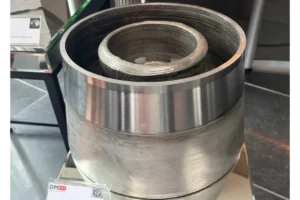
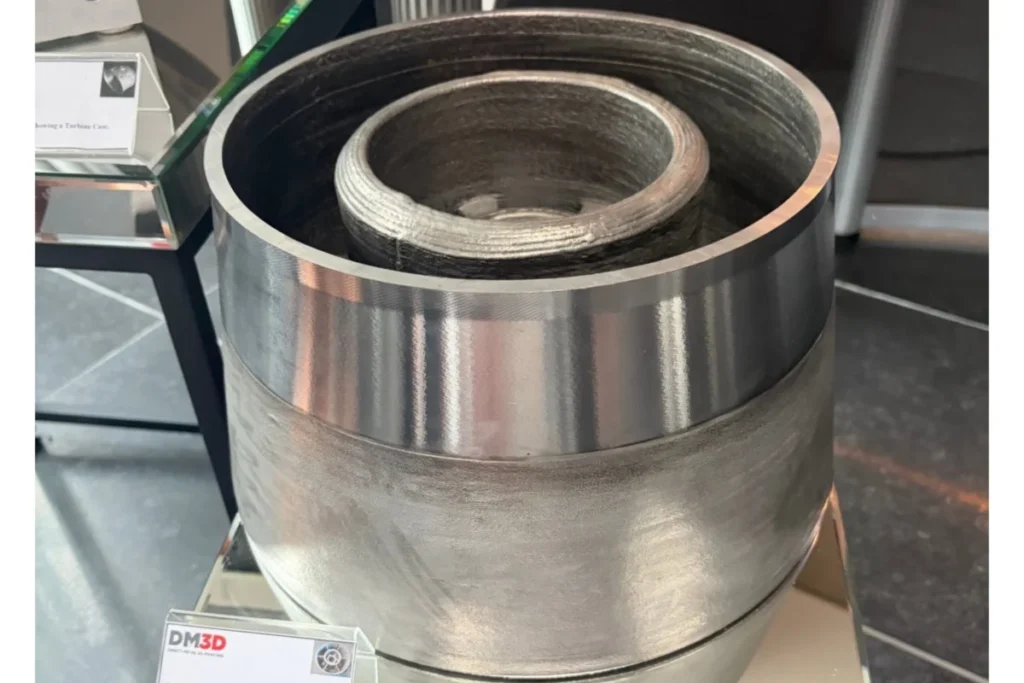
DM3D has a proven track record of producing some of the largest additively manufactured metal components for rocket engines, serving clients like NASA and other prominent private space companies. A landmark achievement in this area was the 3D printing of a candidate part for NASA’s RS-25 engine nozzle liner. This impressive component measured an astounding 111 inches in height with a 97-inch diameter base. The fabrication was accomplished using a custom-designed, multi-nozzle DMD system, a testament to DM3D’s capability in scaling its technology for extreme applications.

A nozzle jacket 3D printed from Inconel for NASA.
The production of the RS-25 engine nozzle liner involved a rigorous and collaborative process. Following the initial design phase, DM3D and NASA employed advanced simulation software, such as ANSYS, to meticulously analyze potential thermal stresses and distortions throughout the build process. This predictive modeling was critical for optimizing the print parameters and ensuring the structural integrity of the large-scale component. Once the simulation phase was complete, the liner was 3D printed using DM3D’s specialized DED technology. The finished part then underwent a comprehensive structured light geometric inspectional scan to verify its precise dimensions and form.

The impact of adopting additive manufacturing for this critical component was significant. DM3D reported a reduction of over 50% in lead time and a 25% decrease in cost compared to conventional manufacturing methods. This efficiency gain was further amplified by DM3D’s innovative multi-nozzle DMD system. By utilizing two simultaneously operating process heads, the system effectively doubled the throughput. Moreover, the modular design of the system allows for the potential addition of two more process heads, offering scalability to meet even higher production demands.
Strategic Positioning and Future Outlook
DM3D has strategically positioned itself as a comprehensive, one-stop-shop for additive manufacturing services and solutions, catering to a diverse range of industries. As a lean and agile company, DM3D prioritizes applications where its unique capabilities can deliver the most significant value, ensuring efficient resource allocation.
Looking ahead, DM3D has ambitious plans to further expand its technological repertoire and market reach. The company is actively pursuing qualification for wire-based additive manufacturing technologies, which can offer even greater deposition rates and cost efficiencies for certain applications. Furthermore, DM3D aims to qualify titanium parts for production. The increasing difficulty manufacturers face in sourcing titanium castings makes this a particularly timely and valuable capability expansion. By broadening its material and process qualifications, DM3D is poised to address an even wider spectrum of complex manufacturing challenges in critical high-technology sectors.
The company’s commitment to innovation, coupled with its advanced LFAM capabilities, positions DM3D as a pivotal player in the ongoing evolution of advanced manufacturing, particularly for industries where precision, speed, and the ability to produce large, complex metal parts are paramount. Their contributions are not only enabling faster development cycles for space missions but are also paving the way for more efficient and cost-effective production of next-generation aerospace systems.