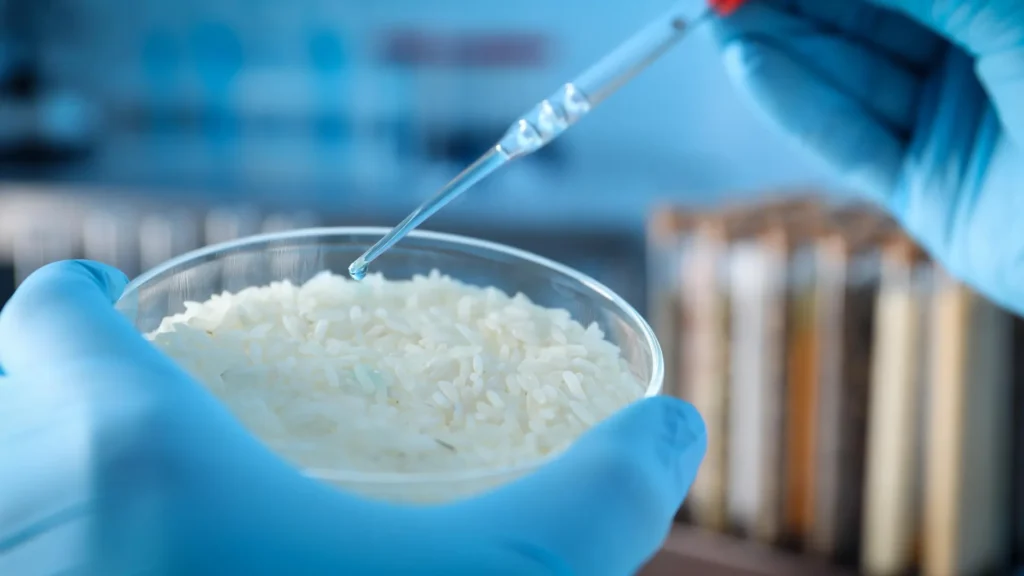
Rice, a cornerstone of global nutrition and a staple for billions, is now transcending its traditional culinary role, emerging as an unlikely inspiration for cutting-edge material science. Researchers, led by the University of Birmingham, have made a groundbreaking discovery: packed rice grains exhibit highly unusual mechanical responses to varying rates of pressure. This counter-intuitive behavior, detailed in the prestigious journal Matter, has not only shed new light on the complex physics of granular materials but has also enabled the creation of novel metamaterials capable of autonomously adjusting their stiffness and properties without the need for electronic controls or external power sources. This development heralds a significant leap forward in the design of soft robotics, adaptive protective equipment, and potentially a myriad of other applications where materials need to intelligently respond to their environment.
The Enigma of Rate Softening in Granular Systems
The core of this transformative discovery lies in the peculiar response of tightly packed rice grains to mechanical stress. When subjected to slow compression, the granular aggregate demonstrates a relatively high degree of strength and rigidity, behaving much like many conventional solid materials. However, the true surprise emerges when these same grains are compressed rapidly. Contrary to the behavior of most engineering materials, which typically stiffen or strengthen under faster loading rates—a phenomenon often termed "strain rate hardening"—the rice grains actually become weaker. This remarkable effect, scientifically termed "rate softening," is exceedingly rare in the realm of macroscopic materials and challenges many established paradigms in granular physics.
This phenomenon, while counter-intuitive, has a profound underlying mechanical explanation. The research team meticulously demonstrated that the rate softening in rice grains is primarily attributed to a sharp reduction in friction between individual grains when forces are applied rapidly. In granular systems, friction between constituent particles plays a critical role in forming robust, load-bearing networks of forces. These "force chains" distribute external loads throughout the material, contributing significantly to its overall strength and stability. When external forces are applied quickly, the instantaneous sliding and re-arrangement of grains can lead to a transient but significant decrease in these inter-particle frictional forces. This weakening of the internal force networks compromises the material’s ability to support the applied load, resulting in the observed rate softening. Understanding this intricate interplay between loading speed, friction, and force network dynamics has been a long-standing challenge in the field of granular mechanics, a domain notorious for its complexity due to the discontinuous and dissipative nature of its constituents.
Bridging Observation and Innovation: The Birth of a Self-Adapting Metamaterial
The scientific journey from observing an anomaly to engineering a solution is often a long one, but in this instance, the researchers adeptly translated a fundamental discovery into a practical design principle. Recognizing the unique implications of rate softening, the team leveraged this property to develop a new class of metamaterial. Metamaterials are artificially engineered composite structures designed to possess properties not found in naturally occurring materials. Their characteristics are derived not from the properties of the base materials themselves, but from their carefully designed structures.
To create this self-adapting material, the scientists combined rice-based granular units—which exhibit rate softening—with other granular materials, such as sand, that demonstrate the more common "rate hardening" behavior (i.e., they become stronger under rapid loading). By strategically layering and integrating these contrasting granular elements, the researchers fabricated a composite granular metamaterial. The resulting structure possesses an unprecedented ability to respond dynamically and intelligently to external stimuli. Depending on the speed at which a load is applied, the material can autonomously choose to bend, buckle, or stiffen in entirely different ways. Crucially, this sophisticated adaptive behavior occurs entirely through the material’s intrinsic mechanical properties, circumventing the need for complex electronics, external sensors, or active control systems that are typically required for adaptive materials. This inherent, passive intelligence represents a significant paradigm shift in material design.
A Deeper Dive into Granular Materials: Context and Historical Challenges
Granular materials are ubiquitous in nature and industry, ranging from sand on beaches and grains in silos to pharmaceutical powders and cosmic dust. Despite their commonality, their physical behavior has historically been one of the least understood states of matter, often referred to as a "fourth state" after solids, liquids, and gases. Unlike fluids, they can support shear stress; unlike solids, they can flow. Their behavior is profoundly influenced by factors such as particle shape, size distribution, packing density, and, most critically, inter-particle friction.
For decades, scientists have grappled with developing comprehensive theories to predict the behavior of granular systems under various conditions. Phenomena like segregation, jamming, and avalanches in granular media have captivated researchers across physics, engineering, and geology. While some granular materials like cornstarch suspensions exhibit shear thickening (increasing viscosity under shear stress), and others like certain clays show shear thinning, the rate-softening behavior observed in packed rice grains is particularly distinctive at the bulk macroscopic level. Previous research on granular materials has explored their potential in energy absorption, vibration damping, and even as components in soft robotic grippers. However, harnessing their dynamic response to create actively adaptive, "smart" materials without external controls has remained a significant challenge. This new research on rice marks a pivotal advancement in overcoming some of these long-standing hurdles, showcasing an elegant solution derived from an everyday substance.
The Research Trajectory: From Hypothesis to Publication
The journey to this discovery likely involved a meticulous and iterative research process. Initial observations of rice’s behavior under various compression rates might have sparked the researchers’ curiosity, leading to the formulation of hypotheses regarding the underlying mechanical principles. This would have necessitated the design and execution of a series of carefully controlled experiments. High-precision universal testing machines capable of applying loads at varying speeds would have been critical. The team would have needed to precisely measure parameters such as stress, strain, and deformation rates, possibly employing high-speed cameras or advanced sensor arrays to capture the subtle re-arrangements and frictional changes occurring within the packed grains.
Following extensive data collection, the researchers would have engaged in rigorous analysis, employing computational models and theoretical frameworks from granular physics to interpret their findings. This analytical phase would have been crucial in identifying the role of inter-particle friction reduction as the primary mechanism for rate softening. Once the fundamental phenomenon was understood, the engineering phase would have commenced. This involved conceptualizing and then physically fabricating the metamaterial, experimenting with different combinations of rate-softening (rice) and rate-hardening (sand) granular units, and optimizing their arrangement to achieve the desired adaptive properties. The validation of these properties, through further testing under diverse loading conditions, would have been the final step before compiling the comprehensive findings for peer review and publication in Matter. The rigorous process underscores the blend of fundamental scientific inquiry and ingenious engineering design that characterized this breakthrough.
Voices from the Forefront: Insights from the Research Team
Dr. Mingchao Liu, a pivotal figure from the University of Birmingham leading this international research, articulated the essence of the discovery and its implications. "Rice might be best known as a staple food globally, but it’s rarely associated with advanced engineering," Dr. Liu stated, underscoring the surprising nature of their findings. "Our research shows that it can form the basis of a new class of functional materials. Rather than treating this phenomenon as curiosity, we turned it into a design principle." This philosophy highlights a shift from merely observing scientific anomalies to actively leveraging them for technological advancement.
Dr. Liu further elaborated on the material’s intrinsic intelligence: "This approach enabled us to create a material that can bend, buckle, or stiffen differently under slow movements versus sudden impacts—without electronics, sensors, or active control. Instead of telling a structure how to respond, we let physics decide: fast loads trigger one behavior, slow loads another." This emphasis on passive adaptability is a key differentiator, offering robustness and simplicity compared to electronically controlled systems. While specific statements from other international collaborators were not detailed, the success of such complex research typically involves a multidisciplinary team contributing expertise in material science, experimental physics, and computational modeling, pooling resources and knowledge from diverse academic backgrounds to achieve such a profound understanding and application.
Transformative Potential: Revolutionizing Robotics and Protective Equipment
The development of this speed-sensitive granular metamaterial holds immense promise for a wide array of future technologies, particularly in the rapidly evolving fields of soft robotics and advanced protective equipment.
Soft Robotics: Traditional robots, often constructed from rigid metals and plastics, excel in precision and strength but can be heavy, potentially hazardous in human-robot interactions, and limited in their ability to adapt to complex, unstructured environments. Soft robotics, conversely, aims to create robots from compliant materials, offering inherent safety, dexterity, and adaptability. However, a major challenge in soft robotics has been the inability to dynamically control stiffness and rigidity without complex, bulky external systems. The rice-inspired metamaterial offers an elegant solution. Future soft robots could incorporate these materials to become lighter, safer, and inherently more versatile. Imagine a robotic arm that is soft and compliant for delicate handling tasks but can instantly stiffen to provide necessary support or exert force when required, all dictated by the speed of interaction. Such robots could revolutionize collaborative workspaces (cobots), perform intricate surgical procedures with unprecedented gentleness, or navigate hazardous environments, adapting their physical properties to absorb impacts or squeeze through tight spaces.
Protective Equipment: The ability of the material to respond differently to varying impact speeds makes it exceptionally well-suited for applications in protective gear. In a high-speed collision, such as a sports impact or an automotive accident, the material could rapidly soften to absorb and dissipate a large amount of kinetic energy, cushioning the impact and significantly reducing the forces transmitted to the wearer. Conversely, under slower, sustained pressure, it could maintain greater rigidity to provide structural support or resist deformation. This adaptive energy absorption could lead to a new generation of helmets, body armor, sports padding, and automotive safety components that offer superior protection compared to current static materials. The inherent lack of electronics also means these protective devices would be more reliable, require no power, and be less susceptible to environmental factors like water or extreme temperatures.
Beyond These Frontiers: The implications extend even further. Imagine civil engineering applications where building components could dynamically adjust their stiffness to dampen seismic vibrations during an earthquake, or bridge structures that stiffen under heavy, fast-moving loads but remain flexible for routine traffic. In the biomedical field, responsive implants or prosthetic limbs could adapt their mechanical properties to match varying physiological conditions or activities. Even in aerospace, structures could be designed to withstand extreme forces during launch or re-entry, while remaining lightweight and flexible for orbital maneuvers. The principle of "physics deciding" opens up a new realm of passive intelligent design across countless engineering disciplines.
Economic, Environmental, and Future Research Pathways
The economic and environmental ramifications of this discovery are also noteworthy. Rice, as a globally abundant and renewable agricultural product, presents a sustainable alternative to many synthetic materials. If scalable, materials derived from rice could offer cost-effective solutions for advanced applications, potentially democratizing access to intelligent material technologies. This research also beautifully bridges the gap between agricultural resources and high-tech engineering, fostering interdisciplinary innovation.
Looking ahead, future research will likely focus on several key areas. Optimizing the composition and geometric arrangement of the granular units will be crucial for tailoring specific adaptive responses. Investigating other granular materials, or even combinations of different types of grains, could uncover complementary or even more pronounced adaptive behaviors. Scaling up the production of these metamaterials from laboratory prototypes to industrial applications will involve significant engineering challenges. Furthermore, rigorous testing in simulated real-world conditions will be essential to validate their performance and reliability in diverse operational environments. The potential for integrating these passively intelligent materials with active control systems, where appropriate, could also lead to hybrid systems with even greater capabilities.
In conclusion, the unassuming rice grain has unveiled a profound secret, pushing the boundaries of material science and challenging our preconceived notions of how everyday substances can inspire advanced engineering. By decoding and harnessing the unique "rate softening" phenomenon, researchers have not only deepened our understanding of granular physics but have also engineered a novel class of self-adapting metamaterials. This breakthrough marks the dawn of a new era for intelligent materials, promising a future where robots are safer and more versatile, protective equipment offers unprecedented efficacy, and engineered systems possess an innate ability to respond intelligently to the dynamic world around them, all without a single circuit or sensor. The journey from the rice paddy to advanced robotics is a testament to the endless innovation hidden within nature’s simplest forms.