A groundbreaking experiment conducted at CERN’s Large Hadron Collider (LHC) has provided physicists with an unprecedentedly sharp view into the intricate behavior of gluons within atomic nuclei. This significant advance offers compelling new evidence that could help distinguish between two long-standing, competing explanations of how these fundamental particles behave at the extremely small scales governing the strong nuclear force. The findings, published in the prestigious journal Physical Review Letters, are poised to refine our understanding of the very essence of matter.
The study, a collaborative effort involving scientists from around the globe, saw University of Kansas physicist Daniel Tapia Takaki play a leading role. As a key member of the ALICE (A Large Ion Collider Experiment) collaboration at CERN, Tapia Takaki contributed to the design and analysis of the measurements, which represent the first multidimensional exploration of incoherent J/ψ (pronounced "JAY-psi") photonuclear production. This innovative approach allowed researchers to simultaneously track both interaction energy and momentum transfer, providing a level of detail previously unattainable in examining how gluons are distributed inside atomic nuclei.
The Unseen Architects of Mass: Why Gluons Matter
To fully appreciate the significance of this discovery, it is crucial to understand the role of gluons. Often described as the "glue" that binds matter together, gluons are elementary particles that mediate the strong force, one of the four fundamental forces of nature. Their primary function is to hold quarks together, forming composite particles like protons and neutrons – the building blocks of all atomic nuclei. While quarks are indeed fundamental, the vast majority of the mass of ordinary visible matter – from the atoms composing our bodies to the dense interiors of stars – does not originate from the quarks themselves. Instead, it comes from the immense energy associated with the gluons and the strong force field they generate.
"Although quarks are often described as the fundamental building blocks of matter, nearly all the mass of the visible universe – from the atoms in our bodies to the matter inside stars – actually comes from the energy carried by gluons and the strong force that binds quarks together," explained Daniel Tapia Takaki, professor of physics & astronomy at the University of Kansas and a pivotal member of the ALICE collaboration. "Understanding how gluons behave inside nuclei is therefore essential to understanding how matter itself acquires its mass and structure. This is not just a theoretical curiosity; it’s central to the fabric of reality."
The strong force is unique among the fundamental forces due to a phenomenon called "confinement," which prevents quarks and gluons from existing freely under normal conditions. This makes direct observation and study of individual gluons incredibly challenging. Furthermore, at the extremely high densities found within atomic nuclei, the behavior of large numbers of gluons together presents complex theoretical and experimental puzzles. Unraveling these dynamics is critical for a complete picture of Quantum Chromodynamics (QCD), the theory describing the strong force, particularly in its non-perturbative regime where calculations become exceedingly difficult.
Tapia Takaki’s leadership in this research was facilitated by a robust institutional partnership between the University of Kansas and the Czech Technical University in Prague, fostering exchanges of both students and researchers and highlighting the international nature of cutting-edge scientific endeavors at CERN.
CERN’s ALICE Experiment: A Microscopic Lens on the Nucleus
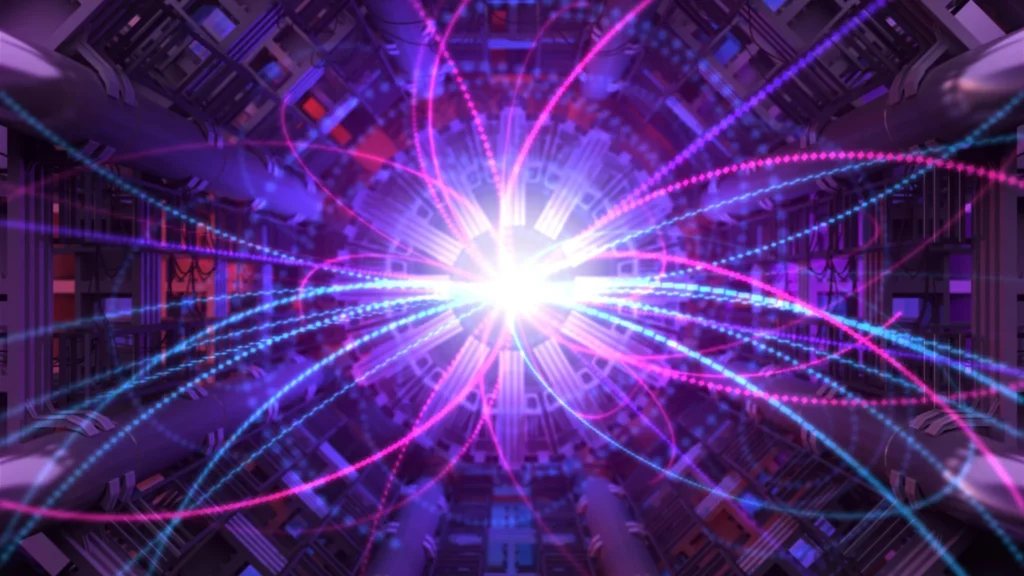
The Large Hadron Collider (LHC) at CERN, situated near Geneva on the Franco-Swiss border, is the world’s most powerful particle accelerator, a monumental feat of engineering and scientific collaboration. Operating since 2008, the LHC is designed to push the boundaries of particle physics, recreating conditions akin to those moments after the Big Bang. Among its several massive detectors, ALICE (A Large Ion Collider Experiment) is specifically configured to study the properties of matter under extreme conditions, primarily by colliding heavy ions like lead nuclei. These collisions aim to create a quark-gluon plasma, a state of matter where quarks and gluons are deconfined. However, the latest study employed a different, equally ingenious method.
The measurements central to this research were performed using data collected during Run 2 of the Large Hadron Collider, which spanned from 2015 to 2018. Instead of direct, head-on collisions, the ALICE team focused on "ultra-peripheral collisions," where fast-moving lead nuclei pass extremely close to one another without physically colliding. In these fleeting encounters, the intense electromagnetic fields surrounding the nuclei behave like highly energetic beams of photons. When one of these virtual photons strikes another nucleus, it can briefly produce a J/ψ particle.
The J/ψ particle, a meson composed of a charm quark and a charm antiquark, holds a special place in particle physics. Discovered almost simultaneously in 1974 by two independent teams (Burton Richter at SLAC and Samuel Ting at Brookhaven National Laboratory), its discovery led to the "November Revolution" and provided crucial evidence for the existence of the charm quark. Critically for this experiment, the J/ψ particle’s properties make it an exceptionally sensitive probe of the underlying gluon structure within the nucleus. Its production mechanism is largely driven by gluon interactions, meaning that by studying J/ψ production, physicists can infer information about the gluons themselves.
"The measurements were performed using data collected during Run 2 of the Large Hadron Collider, where fast-moving lead nuclei pass close to one another without directly colliding," Tapia Takaki elaborated. "In these encounters, intense electromagnetic fields surrounding the nuclei behave like beams of high-energy photons. When one of these photons strikes another nucleus, it can briefly produce a particle called the J/ψ, whose production provides a sensitive probe of the underlying gluon structure."
Peering into the Proton’s Heart: Unprecedented Resolution
A key innovation of this study lies in its ability to go beyond mere average measurements of gluon distribution. Many previous experiments effectively smeared out the gluon distribution across an entire nucleus. By contrast, the technique of incoherent J/ψ production allows researchers to resolve local changes in gluon density. This capability is akin to switching from a blurry, wide-angle photograph to a high-resolution microscopic image, making it possible to investigate structures even smaller than a single proton.
"Our experiments using incoherent production is like switching from a blurry image to a high-resolution microscope," Tapia Takaki explained. "This process allows us to see how gluons fluctuate and organize themselves inside nuclei. By varying the momentum transfer, our experiment effectively changes the focus of our microscope."
The ALICE collaboration achieved remarkable spatial resolutions, probing the nucleus at scales of 0.6, 0.3, and an astonishing 0.2 femtometers (fm). To put this into perspective, a femtometer is one quadrillionth of a meter (10^-15 m), and a proton itself has a radius of approximately 0.8 femtometers. The finest resolution achieved by ALICE in this experiment corresponds to structures only about one-quarter the size of a proton.
Tapia Takaki offered a compelling analogy to illustrate this level of precision: "If an atomic nucleus were enlarged to the size of a football stadium, the experiment’s highest resolution would be fine enough to distinguish features only a few yards wide on the field." This unprecedented detail is crucial because the powerful gluon fields inside atomic nuclei are central to the structure of nearly all visible matter, yet physicists still do not fully understand how large numbers of gluons behave collectively.
It is at these extraordinary scales, where gluons are packed tightly together, that physicists predict new collective behaviors might emerge. "At these extraordinary scales, we observe evidence that the gluons begin to behave collectively, a phenomenon known as gluon saturation," he stated.
The Core Findings: Suppression and Saturation
Daniel Tapia Takaki has been instrumental in pioneering this experimental approach and has contributed significantly to theoretical models that predict gluons could gather into localized areas of especially high density, sometimes referred to as "hot spots." In the energy-dependent hot-spot model, these dense regions are expected to change their characteristics as collision energy increases. Their unique behavior could provide scientists with distinct signatures of previously unexplored physics involving the strong interaction.
For this new work, the researchers meticulously measured incoherent J/ψ production across a broad range of photon-nucleus energies, from 20 to 633 billion electron volts (GeV). Simultaneously, they studied how this production process varied with momentum transfer. The momentum transfer is a critical parameter, as it directly determines the spatial scale being examined inside the nucleus – higher momentum transfer corresponds to finer resolution and the probing of smaller structures.
"The results revealed a striking pattern," said the KU researcher. "At the smallest spatial scales explored in the experiment, the production rate of J/ψ particles is significantly suppressed, with a statistical significance of about three standard deviations." A statistical significance of three standard deviations (often denoted as 3-sigma) indicates a high degree of confidence that the observed suppression is not merely a random fluctuation but a genuine physical effect, typically meaning there’s less than a 0.3% chance of it being random.
A Challenge to Nuclear Shadowing, Support for Gluon Saturation
This unexpected suppression of J/ψ production at the highest resolutions presents a direct challenge to a long-standing theoretical explanation known as "nuclear shadowing." For decades, nuclear shadowing has successfully accounted for earlier measurements of particle production in nuclei. In this framework, gluons within a nucleus are thought to partially overlap and obscure each other, much like layers of clouds blocking sunlight. This "shadowing" effect would reduce the effective number of gluons available to interact with an incoming photon, thereby lowering the probability of certain particle production processes, like J/ψ formation.
"In that framework, gluons inside a nucleus partially overlap and obscure each other – similar to layers of clouds blocking sunlight – reducing the probability of certain particle production processes," Tapia Takaki explained. However, the latest, high-resolution measurements suggest that conventional nuclear shadowing by itself is not sufficient to fully account for the observed pattern of suppression. The data indicates a more profound effect is at play.
Instead, the results are highly consistent with a different, more exotic phenomenon known as "gluon saturation." This concept is a fundamental prediction of Quantum Chromodynamics in a specific regime: where gluon densities become extremely high, such as in the core of large atomic nuclei or at very low momentum fractions (x). In this "saturated" regime, gluons become so densely packed that they begin interacting strongly with one another, effectively limiting how many can exist in a given region. It’s akin to a crowded highway where traffic eventually grinds to a halt due to the sheer number of vehicles.
"Instead, the observations are consistent with a different phenomenon known as ‘gluon saturation,’ predicted by the theory of quantum chromodynamics, which describes the strong force," Tapia Takaki affirmed. "In this regime, gluons become so densely packed that they begin interacting strongly with one another, limiting how many can exist in a given region." This self-limiting behavior, often described within the framework of the Color Glass Condensate (CGC) theory, fundamentally alters the dynamics of gluons and explains the observed suppression more naturally than nuclear shadowing alone.
Broader Implications and Future Directions
The implications of this research are far-reaching. By providing robust experimental evidence for gluon saturation, the ALICE collaboration has offered a critical test and validation point for Quantum Chromodynamics, especially in a regime where its predictive power has been difficult to probe directly. This work moves physicists closer to a comprehensive understanding of the strong force, which is notoriously complex due to its non-linear nature and the self-interacting properties of gluons.
The discovery also carries significant weight for future endeavors in nuclear physics. The insights gained from the ALICE experiment will be invaluable for the ongoing Run 3 of the LHC and the upcoming High-Luminosity LHC (HL-LHC), which promises even greater data volumes and precision. These future runs will allow scientists to further explore the gluon saturation regime with enhanced detail, refining measurements and potentially uncovering new nuances of gluon behavior.
Perhaps most notably, these findings provide crucial context and motivation for the Electron-Ion Collider (EIC), a next-generation facility currently under construction at Brookhaven National Laboratory in the United States. The EIC is specifically designed to act as a "gluon microscope," colliding electrons with protons and heavy nuclei to create detailed, three-dimensional images of quarks and gluons. The ALICE results underscore the importance of the EIC’s mission by highlighting the existence and significance of gluon saturation, a phenomenon that the EIC is uniquely positioned to explore with unprecedented precision.
Ultimately, by sharpening our view of gluons and the strong force, this CERN experiment deepens our understanding of how matter acquires its mass and structure. It pushes the boundaries of fundamental physics, offering new avenues for exploration into the universe’s most basic constituents and the forces that govern them, potentially opening doors to entirely new physics beyond the Standard Model. The collaborative spirit of ALICE, uniting institutions like the University of Kansas and Czech Technical University with thousands of scientists worldwide, exemplifies the global effort required to unlock the universe’s deepest secrets.