PI (Physik Instrumente), a global leader in high-precision motion control and positioning solutions, has officially launched a comprehensive low-temperature development program. This strategic initiative is exclusively focused on advancing multi-axis nanopositioning systems, specifically tailored for the burgeoning and highly demanding field of quantum applications. This program represents a significant leap forward in addressing some of the most intricate engineering challenges at the intersection of extreme cold, ultra-precision, and quantum mechanics, positioning PI at the forefront of the technological revolution currently unfolding in quantum computing, sensing, and communication.
The Quantum Imperative and the Extreme Cold Frontier
The pursuit of quantum technologies, from the development of fault-tolerant quantum computers to highly sensitive quantum sensors and secure quantum communication networks, hinges critically on the ability to precisely control and manipulate individual quantum states. This often necessitates operating at extremely low temperatures, typically below 4 Kelvin (K), and frequently down to millikelvin ranges, to minimize thermal noise and preserve fragile quantum coherence. Within these cryogenic environments, the physical arrangement and alignment of components—such as optical fibers, waveguides, photonic integrated circuits, mirrors, lenses, and superconducting qubits—demand atomic-scale precision. Traditional positioning systems falter under such conditions due to material contraction, lubrication failure, limited space within cryostats, and the generation of unwanted heat, which can disrupt the delicate quantum states.
Early cryogenic motion solutions, while functional for their time, often relied on rudimentary stacked XYZ stages. These systems, composed of multiple single-axis stages assembled in series, suffered from inherent limitations. They typically offered only three degrees of freedom (translation along X, Y, and Z axes), making complex alignment tasks cumbersome, slow, and prone to accumulated errors. Furthermore, their serial architecture meant that the errors of each stage compounded, leading to reduced overall precision and repeatability, particularly under the thermal cycling and vibrational stresses inherent to cryogenic operations. The increasing complexity of modern quantum experiments, which frequently involve intricate optical setups and multi-dimensional manipulation of quantum systems, quickly outpaced the capabilities of these simpler solutions. The demand for sophisticated 5- and 6-degree-of-freedom alignment systems became paramount, not only to achieve the necessary precision but also to support larger payloads and accommodate more complex optical configurations within the severely constrained volumes of advanced cryostats and dilution refrigerators.
PI’s Innovative Approach: Parallel Kinematics for Cryogenic Environments
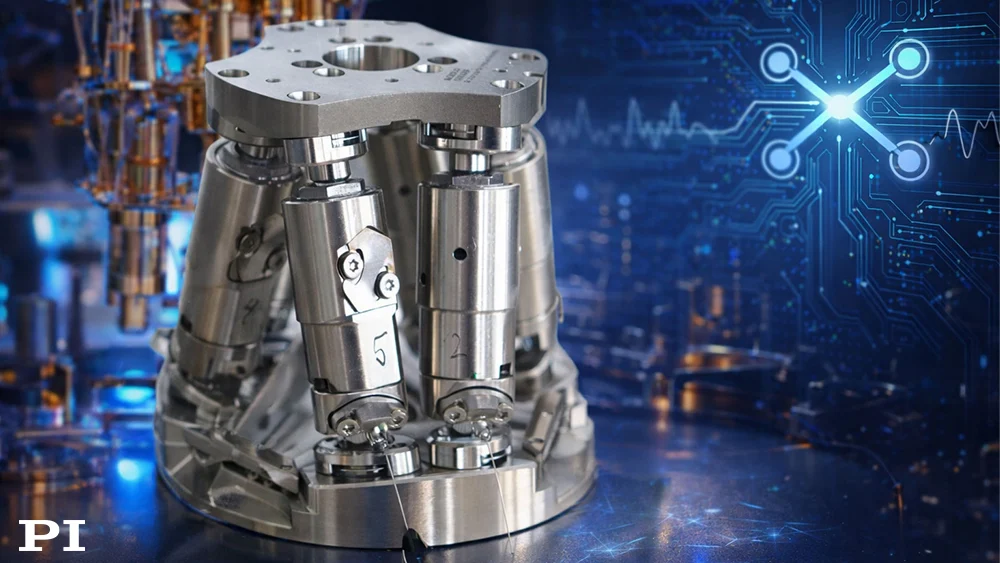
At the core of PI’s new development program is an advanced approach based on compact 6-degree-of-freedom (6DOF) parallel kinematics. This design philosophy, particularly exemplified by hexapod-type systems, offers distinct advantages over traditional serial kinematic chains. Unlike stacked stages, where each actuator moves sequentially, a hexapod employs six independent actuators connected to a single moving platform. This architecture inherently provides simultaneous control of all six degrees of freedom (three translational: X, Y, Z; and three rotational: pitch, roll, yaw), allowing for highly precise and coordinated movements.
The compact nature of parallel kinematics is particularly critical for integration within the limited space of cryostats and dilution refrigerators, where every cubic millimeter is valuable. By distributing the load and motion across multiple struts, hexapods exhibit superior stiffness and stability, crucial for maintaining picometer-level precision at extreme temperatures. This design also significantly reduces the accumulation of errors often seen in stacked systems, where the precision of the overall system is limited by the weakest link in the serial chain. Key characteristics of PI’s hexapod-type parallel kinematics include exceptionally low inertia, which translates to faster response times and reduced thermal disturbance, and significantly lower energy requirements, minimizing heat generation—a critical factor in thermally sensitive low-temperature environments. Furthermore, the programmable pivot point for rotational alignment offers unparalleled flexibility, allowing researchers to precisely align components around any arbitrary point in space, greatly simplifying complex optical and mechanical setups. The open aperture design, a hallmark of many hexapod systems, provides unobstructed optical access, which is essential for numerous quantum experiments involving laser beams, spectroscopy, and imaging.
Technical Deep Dive: Piezo-Based Architecture and Material Science

The fundamental enabling technology behind PI’s cryogenic nanopositioning systems is its sophisticated piezo-based architecture. Piezoelectric actuators, which operate on the principle of electromechanical coupling, convert electrical energy directly into mechanical displacement. This mechanism offers several distinct advantages critical for cryogenic applications. Firstly, piezo actuators generate significantly less heat compared to conventional electromagnetic motors, which is paramount in environments where even minute heat loads can disrupt sensitive quantum experiments. This inherent low heat generation is a cornerstone of maintaining millikelvin temperatures. Secondly, piezoelectric materials maintain their operational efficiency and precision even at ultra-low temperatures, unlike many other actuation technologies that struggle with lubrication or material embrittlement.
A crucial feature of PI’s piezo-based design is its ability for self-locking operation when power is switched off. This means that once a position is achieved, the system can hold that position without continuous power input, further reducing heat generation and power consumption within the cryostat. This passive stability is invaluable for long-duration quantum experiments where stable alignment over extended periods is required.
Beyond the actuation mechanism, the choice of materials is equally vital. The development program emphasizes the exclusive use of non-magnetic materials throughout the system’s construction. This is critical because magnetic fields, even subtle ones, can interfere with the operation of sensitive quantum devices such, as superconducting qubits, trapped ions, or nitrogen-vacancy (NV) centers, by altering their energy levels or coherence properties. By meticulously selecting non-magnetic alloys, ceramics, and composites, PI ensures that its nanopositioners do not introduce unwanted magnetic noise into the quantum system.
Furthermore, Ultra-High Vacuum (UHV) compatibility is a mandatory requirement. Quantum experiments often operate under UHV conditions to prevent contamination from residual gases, which can degrade device performance or introduce decoherence. PI’s systems are designed and manufactured to meet stringent UHV standards, meaning they are constructed from materials with extremely low outgassing rates and are meticulously cleaned to remove any contaminants. This ensures the integrity of the vacuum environment and the long-term stability of the quantum setup. The systems are specifically engineered to operate reliably at temperatures below 4K, supporting motion of several hundred grams over millimeter-scale travel ranges, all while maintaining sub-nanometer stability and repeatability. This combination of payload capacity, travel range, and ultra-precision at extreme cold represents a formidable engineering achievement.
Critical Optical Tasks in Quantum Systems
The precise manipulation offered by PI’s new cryogenic nanopositioning systems is indispensable for a wide array of optical tasks that form the backbone of modern quantum experiments:
- Beam Steering: Accurately directing laser beams is fundamental for addressing individual qubits, preparing quantum states, or coupling light into optical fibers or waveguides. Any drift or imprecision can lead to signal loss or erroneous qubit operations.
- Lens Aberration Correction: In complex optical paths, lenses can introduce aberrations that distort the wavefront of light. Nanopositioning allows for dynamic correction of these aberrations, ensuring the highest fidelity of light delivery to quantum devices, crucial for maintaining quantum coherence.
- Polarization Control: The polarization state of photons often encodes quantum information. Precise control over polarization is essential for manipulating qubit states, generating entangled photons, and performing quantum measurements. Nanopositioners enable fine adjustment of optical elements like waveplates to achieve exact polarization states.
- Fiber Alignment: Efficiently coupling light from free-space optics into single-mode optical fibers or photonic integrated circuits (PICs) at cryogenic temperatures is extremely challenging. Sub-micrometer alignment is often required to minimize coupling losses, which can severely impact the performance of quantum photonic circuits. PI’s systems provide the necessary precision for active and passive fiber alignment.
- Positioning of Dispersive Elements: Gratings, prisms, and other dispersive elements are used for spectral analysis, wavelength selection, or splitting light into its constituent colors. In quantum experiments, this might involve filtering specific photon frequencies for qubit readout or manipulating the spectral properties of entangled photon pairs. Precise positioning ensures accurate spectral control.
These capabilities are not merely incremental improvements; they are foundational enablers for the next generation of quantum experiments and technologies. They allow researchers to push the boundaries of quantum physics, leading to breakthroughs in quantum computing architectures, enhanced quantum sensor sensitivity, and more robust quantum communication protocols.
Strategic Expansion and Market Implications
This development program signifies a strategic expansion of PI’s already extensive work in motion technology for quantum research and cryogenic photonic systems. The company has a long-standing reputation for engineering excellence in high-precision motion, serving critical applications in scientific research, industrial automation, and semiconductor manufacturing. By specifically targeting the unique challenges of quantum environments, PI is solidifying its position as a key enabling technology provider in this rapidly accelerating field.

The technology developed under this program is poised to make a profound impact across several high-growth industries:
- Quantum Technology: This is the primary target. The market for quantum computing, sensing, and communication is projected to experience exponential growth over the coming decades. Analysts predict the global quantum computing market alone could reach tens of billions of dollars by the early 2030s, with significant investment flowing into research and commercialization. PI’s precise cryogenic nanopositioners are indispensable tools for developing and deploying these technologies, facilitating the research, prototyping, and eventual industrialization of quantum systems. They will enable more stable qubit architectures, higher-fidelity quantum operations, and more robust quantum devices.
- Photonics: Quantum photonics, a sub-field of photonics, relies heavily on the precise manipulation of light. As photonic integrated circuits become more complex and widespread in quantum applications, the need for ultra-precise alignment and control at cryogenic temperatures will only intensify. PI’s solutions will drive innovation in areas like integrated quantum optics, fiber-coupled quantum devices, and advanced spectroscopic techniques at low temperatures. Beyond quantum, these advancements could also benefit other cryogenic photonic applications in astronomy, fundamental physics research, and defense.
- Semiconductor Industries: While quantum technology is a primary driver, the semiconductor industry itself can benefit. As chip manufacturing processes push the limits of miniaturization, advanced lithography and metrology techniques often require extreme precision and, in some cases, cryogenic temperatures for characterization of next-generation devices or novel materials. Furthermore, the testing and characterization of superconducting circuits and other exotic materials relevant to future electronics often occur at low temperatures, where PI’s nanopositioning systems can offer unparalleled control and stability. The insights gained from this program could also inform the development of precision motion systems for room-temperature semiconductor processes that demand similar levels of accuracy and reliability.
Statements from Leadership and Industry Perspective
While specific statements from PI leadership regarding this new program were not included in the original brief, one can infer the strategic importance of this initiative. A hypothetical statement from a PI executive, such as Dr. Ralf Oswald, Vice President of Quantum Technologies at PI, might emphasize: "The launch of our dedicated cryogenic nanopositioning development program underscores PI’s unwavering commitment to pushing the boundaries of precision engineering for the most challenging scientific and industrial applications. Quantum technologies represent a frontier that demands unprecedented levels of control at extreme conditions. By focusing on compact 6DOF parallel kinematics and advanced piezo-based solutions, we are not just providing tools; we are enabling the fundamental research and development that will unlock the full potential of quantum computing, sensing, and communication. This program is a testament to our vision of being an essential partner in shaping the future of high technology."
Similarly, an industry analyst specializing in quantum technologies, perhaps Dr. Anya Sharma of QuantumTech Insights, might comment on the broader impact: "The bottleneck in quantum technology development isn’t just about qubit coherence; it’s also about the infrastructure to control and integrate these qubits with sufficient precision. PI’s investment in cryogenic nanopositioning is a crucial step towards addressing this bottleneck. By providing robust, ultra-precise, and low-heat solutions for multi-axis alignment at millikelvin temperatures, they are directly accelerating the transition of quantum concepts from lab-scale experiments to more scalable and reliable quantum devices. This is exactly the kind of enabling technology the quantum ecosystem needs to mature."
Conclusion
PI’s launch of its cryogenic nanopositioning development program marks a pivotal moment in the advancement of quantum technologies. By directly addressing the formidable challenges of precision motion at ultra-low temperatures and within confined spaces, PI is providing critical enabling tools for researchers and engineers worldwide. The innovative application of compact 6DOF parallel kinematics, coupled with advanced piezo-based actuation and meticulous material selection, sets a new benchmark for performance and reliability in cryogenic environments. As the quantum revolution continues to unfold, the ability to precisely manipulate and align components at the atomic scale will be paramount. PI’s commitment to this challenging frontier not only solidifies its leadership in high-precision motion but also plays a vital role in accelerating scientific discovery and fostering the commercialization of quantum computing, sensing, and communication technologies that promise to reshape our future.
For more information on PI’s innovative solutions, interested parties are encouraged to visit pi-usa.us.