The fundamental laws of physics dictate that black holes are not solely the domain of massive, dying stars or the gargantuan gravitational wells found at the centers of galaxies. While the most famous black holes possess masses millions of times that of our sun, theoretical models have long suggested that microscopic black holes could exist, provided the conditions are sufficiently extreme. Now, a collaborative team of researchers from Goethe University Frankfurt and TU Wien (Vienna) has achieved a major breakthrough in understanding how these tiny gravitational anomalies form. By utilizing an unconventional mathematical approach involving infinite dimensions, the team has derived the first exact analytical formula for "critical collapse," a process where spacetime organizes itself into a repeating, crystal-like pattern before potentially collapsing into a black hole.
This discovery provides a rigorous mathematical foundation for a phenomenon that was previously only observable through complex computer simulations. It offers a new lens through which scientists can view the early universe, potentially shedding light on the mystery of primordial black holes and the nature of spacetime itself.
The Mystery of Critical Collapse and the Spacetime Crystal
In the standard model of stellar evolution, a black hole forms when a massive star exhausts its nuclear fuel and collapses under its own gravity. However, in the early 1990s, physicists began to explore a different pathway to black hole formation known as critical collapse. This process occurs at the "tipping point" of gravitational stability. In such a state, a system is so finely balanced that the smallest imaginable addition of energy determines its ultimate fate: it will either disperse harmlessly into space or collapse into a singularity.
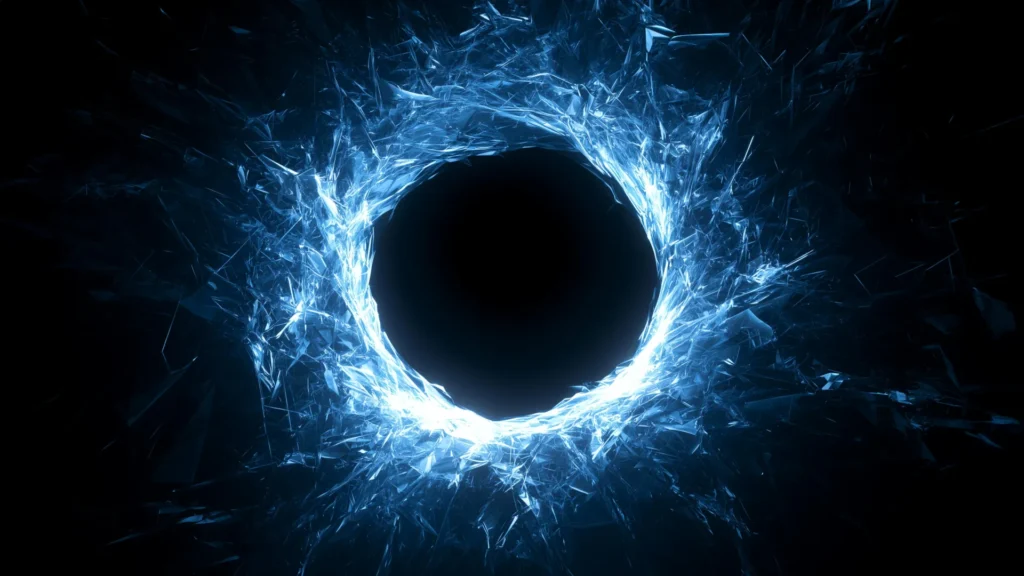
When a system reaches this critical threshold, spacetime does not behave in a linear fashion. Instead, it enters a transitional state that researchers describe as a "spacetime crystal." Unlike a traditional crystal made of atoms arranged in a spatial lattice, a spacetime crystal involves a repeating pattern in both space and time. This structure is inherently unstable, existing as a fleeting intermediate state between existence as ordinary matter and the total gravitational capture of a black hole.
Professor Daniel Grumiller from the Institute for Theoretical Physics at TU Wien compares this phenomenon to the phase transitions observed in everyday matter. "Sometimes a tiny, seemingly insignificant cause is enough to trigger a huge and dramatic change," Grumiller explains. "Take liquid water at zero degrees Celsius, for example. A very small change is enough to make the water freeze. The water molecules then spontaneously arrange themselves into a regular pattern and form an ice crystal." In the context of general relativity, matter curves spacetime, and at the critical point of collapse, this curvature adopts a self-similar, repeating geometry.
A Chronology of Discovery: From 1993 to the Present
The journey toward understanding critical collapse began in earnest in 1993. Matthew Choptuik, a physicist at the University of Texas at Austin, used what were then state-of-the-art supercomputers to simulate the collapse of scalar fields—hypothetical fields that pervade space. Choptuik discovered that as the strength of the initial gravitational wave or matter distribution approached a specific "critical" value, the resulting black holes would follow a power-law scaling.
This discovery, known as "Choptuik scaling," revealed two startling features. First, black holes could theoretically be made infinitely small, contradicting the idea that they must be massive. Second, the collapse exhibited "discrete self-similarity," meaning the structure of the collapsing field looked the same regardless of the scale at which it was observed—much like a fractal or a crystal.
For three decades, these findings remained largely within the realm of numerical relativity. While computers could simulate the process, the underlying mathematics were so complex that no one could write down a simple, exact formula to describe why the spacetime crystal formed or how the scaling worked. The equations of Albert Einstein’s General Relativity are notoriously difficult to solve because they are non-linear; the gravity produced by energy itself creates more gravity, leading to a feedback loop that usually requires massive computational power to resolve.
The recent work by the Frankfurt and Vienna teams changes this. By moving away from purely numerical models and toward an analytical "paper and pencil" solution, they have bridged a thirty-year gap in theoretical physics.
The Mathematical Shortcut: The Power of Infinite Dimensions
The primary obstacle to solving the equations of critical collapse is the four-dimensional nature of our universe—three dimensions of space and one of time. In four dimensions, the interactions of gravity and matter are intricately intertwined in ways that resist simple algebraic solutions. To bypass this, the researchers employed a technique that might seem counterintuitive: they increased the number of dimensions.
"Our universe has four dimensions," notes Christian Ecker from the Institute for Theoretical Physics at Goethe University Frankfurt. "But in principle, nothing prevents us from writing down physical equations for a larger number of dimensions—five dimensions, forty-two dimensions, or even infinitely many."
In theoretical physics, the "Large D" limit (where D represents the number of dimensions) is a powerful tool. As the number of dimensions approaches infinity, the behavior of gravity becomes more localized and simplified. The complex non-linearities that plague four-dimensional calculations begin to drop away, leaving behind a more manageable mathematical framework.
The team first solved the problem of critical collapse in this hypothetical infinite-dimensional setting. They discovered that in this limit, the "spacetime crystal" and the critical collapse process could be described by an exact formula. The crucial next step was "dimensional reduction"—translating that infinite-dimensional solution back down to the four dimensions of our reality.
The results were remarkably accurate. The formulas derived through this method closely matched the data produced by the 1993 computer simulations and subsequent numerical studies. This confirmed that the "Large D" approach was not just a mathematical curiosity, but a valid way to probe the deepest secrets of gravity.
Supporting Data and Technical Implications
The formula derived by the researchers allows for the calculation of the "critical exponent," a numerical value that describes how the mass of a black hole scales near the transition point. In Choptuik’s original 1993 work, this exponent was found to be approximately 0.37 for certain types of matter fields. The new analytical method provides a way to derive these exponents directly from the equations of motion rather than relying on trial-and-error simulations.
Furthermore, the research provides a stable framework for approximation. "Our technique turns out to be remarkably stable," says Florian Ecker from TU Wien. "Depending on the desired precision, we can systematically improve our formulas using additional approximation methods."
This analytical breakthrough has several major implications for the scientific community:
- Reduction in Computational Cost: Researchers can now predict the outcomes of certain gravitational collapses without needing weeks of supercomputer time.
- Precision Testing of General Relativity: Having an exact formula allows scientists to test Einstein’s theory in extreme "strong-field" regimes where it was previously difficult to obtain clear predictions.
- Quantum Gravity Insights: Because critical collapse involves self-similarity and universal scaling, it shares characteristics with phase transitions in quantum mechanics, potentially providing a bridge between gravity and quantum theory.
Broader Impact: Primordial Black Holes and the Early Universe
While the study of microscopic black holes may seem abstract, it has profound implications for cosmology. In the moments immediately following the Big Bang, the universe was an intensely hot, dense, and chaotic environment. Under these conditions, fluctuations in the density of matter could have triggered critical collapses, creating "primordial black holes" (PBHs).
Unlike the black holes created by stars, PBHs could be as small as a grain of sand or as massive as a planet. Scientists have long speculated that these primordial objects could account for "Dark Matter"—the invisible substance that makes up the majority of the universe’s mass but does not interact with light.
If the formulas derived by the Frankfurt and Vienna teams can accurately describe how these tiny black holes formed in the early universe, it could provide the missing link in our understanding of dark matter. By knowing the exact mathematical conditions required for a "spacetime crystal" to collapse into a primordial black hole, cosmologists can better calculate how many of these objects might still be floating through the cosmos today.
Reactions from the Scientific Community
The research has been met with significant interest among theoretical physicists and cosmologists. The ability to solve "pencil and paper" equations for a problem that was once thought to be the exclusive domain of supercomputers is being hailed as a milestone in gravitational physics.
The work also reinforces the importance of Goethe University Frankfurt and TU Wien as leading hubs for theoretical research. By combining expertise in general relativity, fluid dynamics, and high-dimensional mathematics, the researchers have demonstrated that even the most complex problems in the universe can sometimes be simplified by changing one’s perspective—or, in this case, the number of dimensions.
As the scientific community digests these findings, the next steps will likely involve applying this analytical method to more complex types of matter and energy, such as rotating systems or fields with charge. The "spacetime crystal" is no longer just a computational prediction; it is now a mathematically defined state of existence, marking a new chapter in our quest to understand the ultimate fate of matter and the fabric of the universe.