Rising Japanese watchmaker Kiwame Tokyo has once again captivated the horological community with its latest release, the Kiwame Kubo. This new timepiece, while part of a brand known for its rapid sell-out models since its debut last year, represents a significant evolution in Kiwame’s design philosophy. The Kubo, particularly the Sakura variant, marks a departure from the brand’s earlier, more familiar aesthetics, offering a distinct visual identity that speaks to a maturing design language.

Since its inception, Kiwame Tokyo has carved a niche for itself by delivering attractive, well-built watches that offer exceptional value. This has consistently led to immediate sell-out situations for their releases, often leaving enthusiasts scrambling for a chance to acquire one. While previous models, such as the Iwao and Mune, demonstrated the brand’s commitment to quality and affordability, they were often described as feeling somewhat derivative, with design distinctions limited primarily to the handset and, in some cases, the 12-hour marker. The Kubo, however, signals a conscious effort by Kiwame to imbue its creations with a unique character, setting it apart in a competitive market.
A Design Evolution: From Familiar to Distinctive
The Kiwame Kubo Sakura is not the brand’s most recent offering, with the Yane model having since been released and also achieving rapid sell-out status. However, the Kubo stands as a pivotal moment in Kiwame’s design trajectory. It offers the first tangible glimpse of the brand truly finding its own voice and developing a signature aesthetic. This is a crucial development for any emerging brand aiming for long-term recognition and success beyond mere product availability.

Having handled a considerable number of Kiwame’s timepieces, including those from its sister brand, Karl-Leimon, a consistent observation has been their robust construction and appealing visual presence, all at a commendable price point. The challenge for Kiwame has always been maintaining this balance while injecting a more profound sense of originality. The brand’s ability to sell out virtually every release, despite modest marketing efforts and designs that, until recently, lacked a strong individualistic flair, is a testament to a potent combination of perceived value and perhaps an unmet demand for accessible, well-crafted timepieces.
The Kiwame Kubo Sakura, in particular, is being hailed as the watch where the brand has finally added a discernible level of flair, enough to make it truly stand out from the crowd. This subtle yet significant shift in design is what elevates the Kubo beyond a mere functional accessory to a statement piece.

Case Design and Dimensions: A Refined Approach
The stainless steel case of the Kiwame Kubo shares a familiar silhouette with its predecessors, a testament to the brand’s consistent approach to case manufacturing. However, the Kubo introduces a more refined sizing, measuring 37mm in diameter, 10.7mm in thickness, and a 45mm lug-to-lug distance. While these dimensions might seem negligibly different from previous models, the overall wearability and visual proportion are noticeably improved, contributing to a more balanced and comfortable fit on the wrist.
The case finishing remains a strong point, with crisp transitions between brushed surfaces on the case sides and polished accents on the lugs and bezel. This meticulous attention to detail in the finishing adds a layer of perceived quality that belies the watch’s accessible price point. The pull-out crown, while perhaps not groundbreaking in its design, is appropriately sized, offering a comfortable grip for winding and time-setting operations.

A domed sapphire crystal protects the dial, a welcome feature that enhances scratch resistance and contributes to the watch’s overall premium feel. However, a notable point of discussion is the reduced water resistance of 30 meters, a step down from the 100 meters offered on models like the Iwao and Mune. While this reduction may have contributed to the slimmer case dimensions, the reviewer questions whether the slight decrease in water resistance is a justifiable trade-off for the marginal gain in case size reduction, especially considering the watch’s overall dressier aesthetic. This aspect might be a consideration for potential buyers seeking a more robust daily wear option.
Strap and Wearability: Comfort Meets Versatility
The Kiwame Kubo Sakura is presented on a soft 20mm leather strap, which complements the watch’s refined aesthetic and ensures comfortable wear. The buckle, while not particularly elaborate, is functional and aesthetically harmonious with the overall design. The 20mm lug width provides a degree of versatility, allowing enthusiasts to explore a wide range of strap combinations. While the reviewer expresses a personal preference against NATO or canvas straps for this particular model, the potential for pairing it with various unpadded leather options is evident, offering a personalized touch.

The wearability of the Kubo is a significant positive attribute. Its balanced dimensions and comfortable strap ensure that it sits unobtrusively on the wrist, making it suitable for extended wear. This focus on wearability, combined with the attractive design, contributes to the watch’s overall appeal and its ability to integrate seamlessly into various aspects of a wearer’s life, from professional settings to casual outings.
Dial Design: The Heart of the Kubo’s Charm
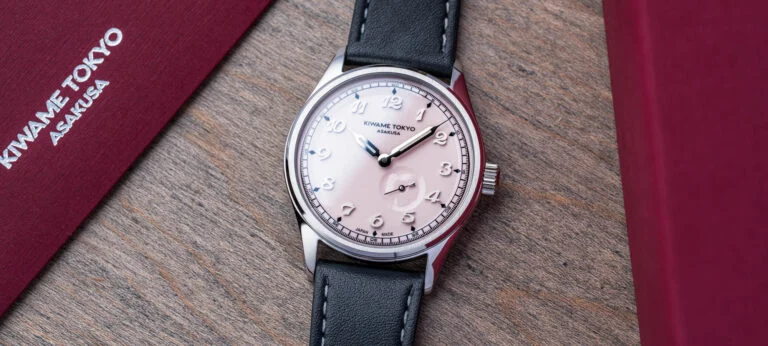
While the case and strap contribute to the watch’s overall appeal, the dial is undeniably the star of the Kiwame Kubo. The brand has opted for an offset small seconds sub-dial, a design element that consistently captures attention and adds a layer of visual intrigue. This layout immediately draws the eye, even in a quick glance during a digital scroll.

The Kubo is also the first Kiwame model to be offered in three distinct colorways, expanding the brand’s palette beyond its previous two-color offerings. Alongside the familiar creamy Usuki, the Kubo introduces a new deep blue, Tetsukon, and the delicate, cherry blossom-inspired pink of the Sakura variant. This expanded color selection allows for greater personal expression and caters to a wider range of preferences.
All dial variants share a common layout, featuring brushed, applied Breguet numerals that provide a pleasing contrast against the glossy lacquer dial. This glass-like finish of the lacquer is further enhanced by the polished and subtly stylized syringe handset. A significant departure from earlier models is the absence of a large central seconds hand. The brand’s signature counterbalance, designed to evoke the roofline of the Kaminarimon gate in Asakusa, Kiwame’s hometown, is now featured in a much smaller iteration on the small seconds hand’s counterbalance. In this reduced form, it appears more akin to a bell, lacking the distinct definition of its larger predecessor.

The small seconds sub-dial is notably recessed, a design feature that lends the model its name. "Kubo" (窪) in Japanese translates to "a hollow or recessed space," aptly describing this characteristic element of the dial.
The Sakura Dial: A Touch of Japanese Elegance
The Sakura dial, in particular, distinguishes itself with an embossed cherry blossom flower subtly rising from the center of the small seconds sub-dial. This delicate detail is not always immediately apparent, adding an element of delightful discovery when the light catches it just right. This feature, combined with the pale blush hue of the dial, imbues the Sakura variant with a distinctly Japanese elegance.

Beyond this captivating accent, the dial features a minute track and hour markers adorned with small printed black diamonds. The cardinal hours are accented with small lume plots, and the hands are also treated with lume, albeit with a color that appears secondary to the dial plots. It’s worth noting that the lume application, as observed by the reviewer, is not exceptionally bright and may be an area for potential improvement in future iterations. The brand’s commitment to lume quality across its watch lines has been a point of observation, with the suggestion that some models might benefit from its absence rather than its current execution. However, the overall design of the Kubo, particularly the Sakura, is strong enough to succeed even without a high-performance lume.
Movement and Caseback: Reliable Internals and Branding
True to its established practice, Kiwame has opted for a solid caseback on the Kubo, proudly displaying the Japanese kanji for "Kiwame," symbolizing the brand’s aspiration to push boundaries and reach its zenith. This solid caseback, while concealing the movement, serves as a strong branding element.

Beneath the caseback lies the Japanese automatic Miyota 82S5 movement. While not as commonly seen as some other Miyota calibers, it is a reliable workhorse known for its durability and accuracy. The movement operates at a frequency of 21,600 vibrations per hour (vph) and has a stated factory accuracy of -20/+40 seconds per day. Kiwame indicates that the movement is "regulated," though the extent of this regulation beyond factory standards is not specified, leading to the assumption that it adheres to the manufacturer’s specifications. This choice of movement aligns with Kiwame’s strategy of providing dependable performance at an accessible price point.
Price and Availability: A Highly Sought-After Timepiece
The Kiwame Kubo is priced at $630 USD. As is characteristic of the brand, the Kubo has been a highly sought-after model, with initial batches selling out rapidly. Kiwame has announced that another batch will be available for pre-order in October 2026, signaling continued demand and a commitment to meeting customer interest. Prospective buyers are advised to monitor the Kiwame website for official announcements regarding the next pre-order window.

Broader Implications and Market Position
The Kiwame Kubo Sakura represents more than just a new watch; it signifies a brand confidently stepping into its own design identity. The success of the Kubo, particularly its distinctive dial elements and colorways, suggests that Kiwame is resonating with a market segment that values not only affordability and build quality but also a unique aesthetic appeal.
The brand’s ability to consistently sell out its limited production runs indicates a strong understanding of its target demographic and effective product strategy. By introducing more design-forward elements, Kiwame is likely broadening its appeal and solidifying its position as a serious contender in the accessible luxury watch market. The evolution seen in the Kubo suggests that the brand is actively listening to consumer feedback and is committed to refining its offerings.

While the Yane model may represent a further leap in design, the Kubo Sakura serves as a crucial stepping stone, demonstrating a successful blend of Japanese artistry and horological engineering. It’s a watch that offers both immediate visual gratification and a deeper appreciation for the brand’s developing narrative. For enthusiasts who value distinctive design and exceptional value, the Kiwame Kubo Sakura is a compelling option, embodying the brand’s journey towards reaching its full potential.