The global water crisis remains one of the most pressing challenges of the 21st century, with the United Nations estimating that approximately 2.2 billion people—nearly one-third of the global population—currently lack access to safely managed drinking water. As climate change accelerates and traditional freshwater sources such as aquifers and glacial runoff deplete, regions ranging from the drought-stricken corridors of California to the arid landscapes of the Middle East have turned to desalination as a primary solution. However, traditional desalination methods are frequently criticized for their high energy demands and environmental degradation. In a significant breakthrough, researchers at the University of Rochester’s Institute of Optics have developed a solar-powered desalination system that not only purifies water with unprecedented efficiency but also addresses the toxic waste problem by converting salt into a harvestable resource, including the extraction of critical minerals like lithium.
The research, led by Chunlei Guo, a professor of optics and physics and a senior scientist at the University of Rochester’s Laboratory for Laser Energetics, introduces a method that bypasses the most significant hurdles of conventional water treatment. Published in the journal Light: Science & Applications, the study details a solar thermal system that requires no external power grid, no chemical pre-treatment, and produces no liquid brine—a byproduct that has long been the "Achilles’ heel" of the desalination industry.
The Limitations of Conventional Desalination Infrastructure
To understand the magnitude of the University of Rochester’s advancement, it is necessary to examine the current state of desalination technology. Today, the industry is dominated by two primary methods: reverse osmosis (RO) and thermal distillation. Reverse osmosis involves forcing seawater through semi-permeable membranes at extremely high pressure to separate salt molecules from water. While effective, RO plants are massive industrial undertakings that consume vast amounts of electricity. Furthermore, the membranes are sensitive to fouling and require extensive chemical treatment of the water before it even enters the system.
Thermal distillation, on the other hand, mimics the natural water cycle by heating seawater until it evaporates, then condensing the steam into fresh water. While simpler in concept, it is even more energy-intensive than reverse osmosis, often relying on fossil fuel-powered heat sources.
Both methods share a common environmental liability: the production of brine. For every liter of fresh water produced, these systems typically generate a liter of highly concentrated, hypersaline liquid waste. When this brine is pumped back into the ocean, it sinks to the seafloor due to its high density, depleting oxygen levels and creating "dead zones" where marine life cannot survive. According to a 2019 UN-backed study, the world’s 16,000 desalination plants produce more than 142 million cubic meters of brine daily—enough to cover the entire state of Florida in a layer of salt water 30 centimeters deep every year.
Femtosecond Laser Surface Processing: A Material Science Breakthrough
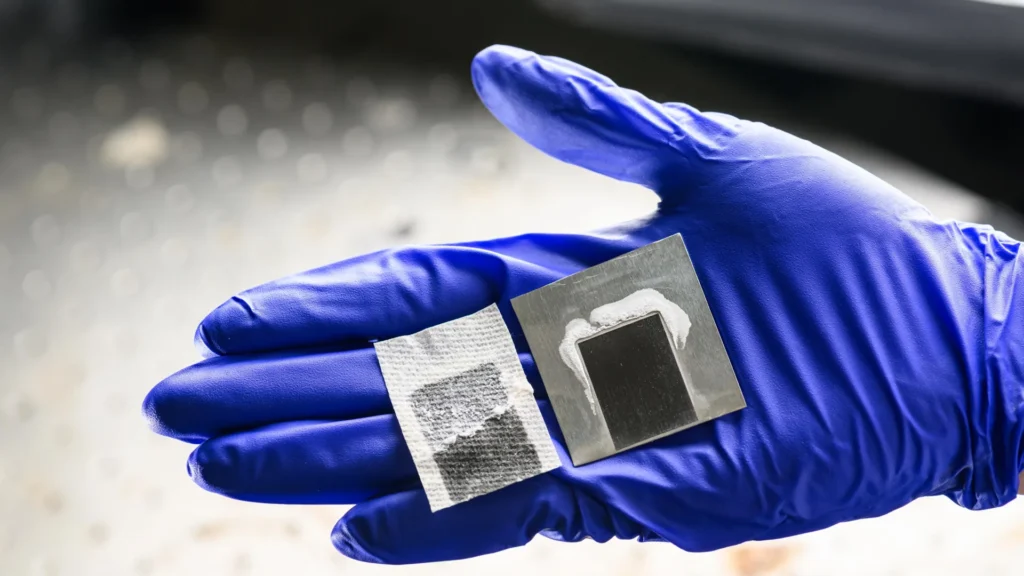
The University of Rochester team took a fundamentally different approach by focusing on material science rather than mechanical pressure or external heating. The core of their system consists of solar panels made from ordinary aluminum, which have been transformed through a process known as femtosecond laser processing.
A femtosecond is one quadrillionth of a second. When pulses of laser light at this speed strike a metal surface, they do not simply burn it; they rearrange the surface at a microscopic and nanoscopic level. This "etching" creates a complex network of micro-grooves and nano-structures that change the physical properties of the metal.
First, the laser treatment turns the naturally reflective aluminum pitch black. This allows the metal to become a near-perfect solar absorber, capturing and retaining more than 95 percent of the solar spectrum. Second, the process creates "superwicking" properties. In a standard environment, water droplets might bead up on a metal surface. On Guo’s laser-treated metal, water defies gravity, spreading instantly across the entire surface in a thin, uniform film. This maximizes the surface area of the water exposed to the sun’s heat, leading to rapid and efficient evaporation.
Overcoming the "Real Seawater" Challenge
A recurring issue in the development of solar desalination is the "salt clogging" effect. In laboratory settings, many researchers use "artificial seawater"—a simple mixture of water and sodium chloride. When this water evaporates, the sodium chloride forms porous, grainy crystals that are relatively easy to wash away.
However, Professor Guo noted that real-world applications are far more difficult. "Real seawater is far more complicated," Guo explained. In addition to sodium chloride, it contains a cocktail of magnesium, calcium, potassium, and sulfates. When these minerals evaporate, they do not form porous grains; they form "scale"—a hard, dense, and cement-like crust similar to the mineral buildup found in old plumbing or tea kettles.
In most solar stills, this scale quickly covers the absorbing surface, blocking sunlight and preventing water from wicking. This usually renders the device useless within days. To solve this, the Rochester team utilized a physical phenomenon known as the "coffee ring effect."
The Coffee Ring Effect and Self-Cleaning Mechanisms
The coffee ring effect is a common sight in daily life: when a drop of coffee dries on a table, the remaining stain is darkest at the edges. This happens because evaporation occurs more quickly at the edges of a droplet, causing a flow of liquid from the center to the perimeter. This flow carries suspended particles with it, depositing them in a ring.
By precisely engineering the microscopic grooves on the black metal surface, Guo’s team forced this effect to work in their favor. The panel is divided into an "active region" (where the sun hits and evaporation occurs) and a "passive region" (the untreated edges). As the sun evaporates the thin film of seawater in the active region, the wicking action and the coffee ring effect push the concentrating salts and minerals outward toward the passive region.
This allows the center of the panel to remain clean and efficient indefinitely. During testing with water from the Atlantic, Pacific, and Indian Oceans, the researchers found that the salt did not accumulate on the active surface. Instead, it moved to the edges where it crystallized into a solid form, leaving the solar-absorbing region clear for continuous operation.
From Waste to Resource: The Lithium Extraction Potential
Perhaps the most commercially significant aspect of the University of Rochester’s research is the transition from "Zero Liquid Discharge" to "Resource Recovery." Because the system produces solid salt rather than liquid brine, the minerals can be easily collected and processed.
In a follow-up study published in the Journal of Materials Chemistry A, Guo and his colleagues demonstrated that these panels could be modified to act as mineral extractors. By embedding nanoparticles of hydrogen titanate into the laser-etched grooves, the team created a system that could selectively pull lithium from the salt mixture.
Lithium, often called "white gold," is the cornerstone of the modern green energy transition. It is essential for the lithium-ion batteries that power everything from iPhones to Tesla Model Ys. Currently, lithium mining is an environmentally taxing process, often involving massive evaporation ponds in the "Lithium Triangle" of South America (Bolivia, Chile, and Argentina) that consume billions of gallons of local groundwater.
Using samples from the Great Salt Lake, Guo’s team was able to recover approximately 50 percent of the lithium present in the water. "Mining lithium from the earth has proven to be very taxing from an energy and environmental standpoint, so pulling lithium directly from saltwater could be a very important future route," said Guo.
Chronology of Development and Support
The development of this technology has spanned several years of iterative research at the Institute of Optics. The timeline of the project reflects a shift from basic material science to applied environmental engineering:
- Initial Discovery: Early experiments focused on the use of femtosecond lasers to create "black metal" for stealth and energy-absorption applications.
- Wicking Adaptation: Researchers discovered the superwicking properties of these surfaces, leading to the first prototypes of solar-powered water heaters.
- Desalination Trials: The team began testing the surfaces with saline solutions, identifying the "scale" problem with real seawater.
- Salt Management Innovation: The integration of the coffee ring effect and the passive/active region design solved the longevity issue.
- Mineral Recovery Expansion: The most recent phase involved the integration of hydrogen titanate nanoparticles to target lithium extraction.
The research has garnered significant institutional support, receiving funding from the National Science Foundation (NSF), the Bill & Melinda Gates Foundation, and the Worldwide Universities Network. This diverse funding pool highlights the technology’s dual potential for both high-tech mineral industrialization and humanitarian aid in developing nations.
Analysis of Broader Implications and Future Scalability
While the current prototypes are relatively small-scale laboratory devices, the implications for global water security and the energy transition are profound. The scalability of the technology relies on the industrialization of femtosecond laser processing. While once a niche laboratory tool, these lasers are increasingly used in manufacturing sectors, including automotive and medical device production, which suggests that the cost of producing these treated metal sheets could decrease significantly over time.
If scaled, this technology could be deployed in two distinct ways. First, as small, portable "point-of-use" desalination units for off-grid communities or disaster relief zones, providing clean water without the need for electricity or fuel. Second, as large-scale industrial arrays that serve a dual purpose: supplying municipal water while acting as a sustainable source of lithium and other minerals.
The removal of the brine problem removes one of the primary regulatory and environmental hurdles for new desalination projects. By turning a toxic waste stream into a revenue stream (through the sale of lithium and salt), the University of Rochester’s method could fundamentally alter the economics of water treatment.
As the global population heads toward 8 billion and the demand for battery storage grows exponentially, the intersection of water and mineral security will become the front line of climate adaptation. The work of Professor Chunlei Guo and his team at the Institute of Optics provides a rare example of a "circular economy" solution—one where the process of solving one crisis (water scarcity) provides the materials needed to solve another (the transition to renewable energy).