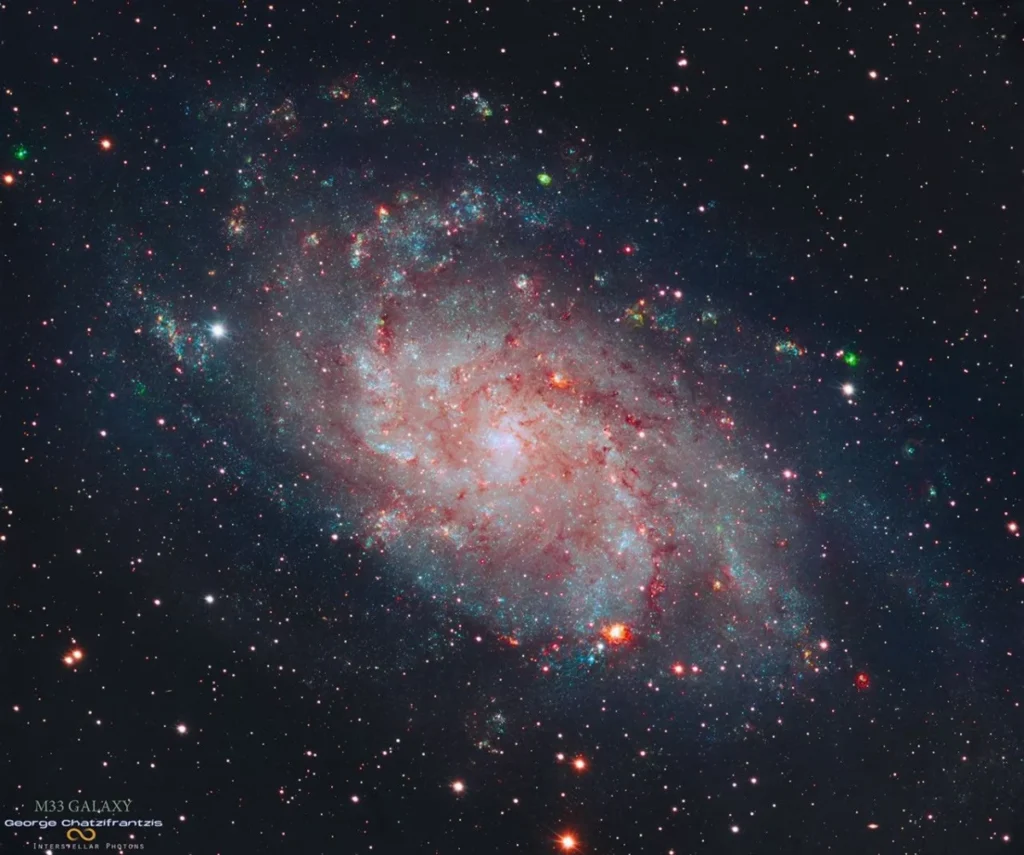
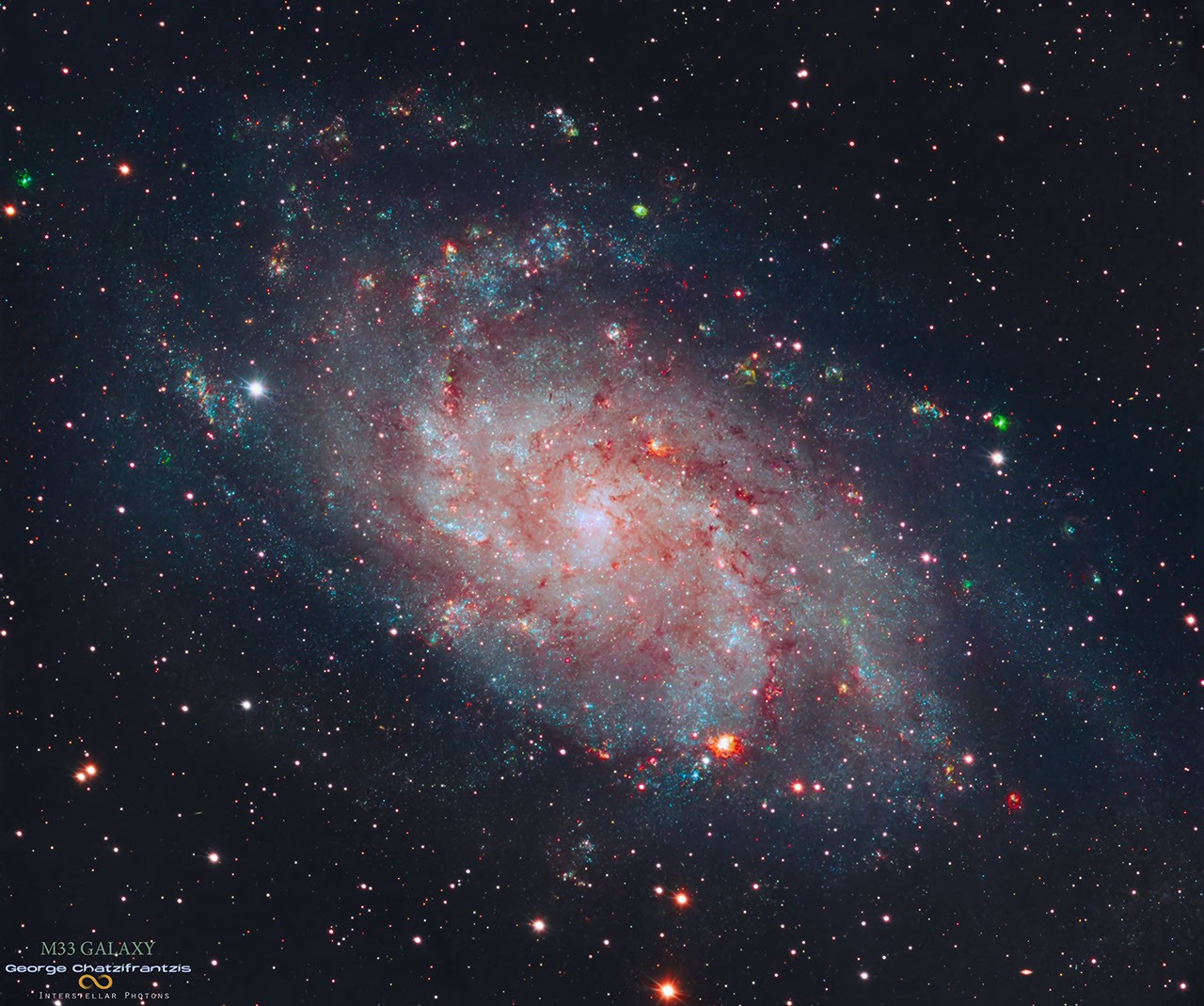
The small, northern constellation Triangulum harbors this magnificent face-on spiral galaxy, Messier 33. Its popular names include the Pinwheel Galaxy or just the Triangulum Galaxy. M33 is over 50,000 light-years in diameter, third largest in the Local Group of galaxies after the Andromeda Galaxy (M31), and our own Milky Way. About 3 million light-years from the Milky Way, M33 is itself thought to be a satellite of the Andromeda Galaxy and astronomers in these two galaxies would likely have spectacular views of each other’s grand spiral star systems. As for the view from the Milky Way, this sharp telescopic image shows off M33’s blue star clusters and pinkish star forming regions along the galaxy’s loosely wound spiral arms. In fact, the cavernous NGC 604 is the brightest star forming region, seen here at about the 5 o’clock position from the galaxy center. Like M31, M33’s population of well-measured variable stars have helped make this nearby spiral a cosmic yardstick for establishing the distance scale of the Universe.
A Glimpse into the Triangulum Galaxy’s Cosmic Neighborhood
Messier 33 (M33), also known as the Triangulum Galaxy, stands as a celestial marvel, captivating astronomers and sky-gazers alike with its elegant spiral structure and proximity to our own Milky Way galaxy. Located approximately 3 million light-years away in the constellation Triangulum, M33 is a significant member of our cosmic family, the Local Group, a collection of over 50 galaxies. It ranks as the third-largest galaxy within this group, surpassed only by the Andromeda Galaxy (M31) and our own Milky Way. This impressive size, spanning over 50,000 light-years in diameter, allows M33 to host an estimated 40 billion stars, a staggering number that underscores its cosmic significance.
The visual representation of M33 as a "face-on" spiral galaxy is crucial to understanding its structure and dynamics. This orientation means we are viewing the galaxy from a perspective directly aligned with its galactic plane, allowing us to observe its spiral arms in their full glory. These arms, characterized by their luminous blue star clusters and vibrant pinkish star-forming regions, are the cradles of new stellar birth. The image provided, a product of advanced telescopic observation, vividly showcases these features, offering an unprecedented look into the active processes occurring within M33.
Historical Context and Astronomical Significance
The journey to understanding M33 has been a long and iterative one, deeply intertwined with the history of astronomical observation and cataloging. First cataloged by French astronomer Charles Messier in 1764, M33 was initially listed as a nebula. It wasn’t until the early 20th century, with the advent of more powerful telescopes and refined observational techniques, that its true nature as a galaxy, separate from our own Milky Way, was definitively established. This pivotal realization, alongside similar discoveries concerning other spiral nebulae like Andromeda, fundamentally reshaped our understanding of the universe, moving us from a single-galaxy cosmos to a vast expanse populated by countless island universes.
The classification of M33 as a spiral galaxy places it within a broad category of galactic structures, characterized by their flattened, rotating disks with prominent spiral arms. This morphology is indicative of ongoing star formation and dynamic interactions within the galactic disk. The "loosely wound" nature of M33’s spiral arms suggests a relatively quiescent evolutionary phase, though the presence of active star-forming regions, such as the prominent NGC 604, indicates that stellar genesis is far from over.
NGC 604: A Stellar Nursery of Immense Scale
Among the many fascinating features of M33, the star-forming region NGC 604 stands out as a particularly compelling celestial object. Located at approximately the 5 o’clock position relative to the galaxy’s center, NGC 604 is an H II region, a vast cloud of ionized hydrogen gas that serves as a prolific stellar nursery. Its immense size and luminosity make it one of the brightest and largest star-forming regions in the Local Group. Within NGC 604, astronomers have identified thousands of young, massive stars, including some of the most massive stars known. The sheer scale of stellar birth occurring within this single region highlights the dynamic and energetic processes that shape galaxies. The study of such regions provides invaluable insights into the conditions required for star formation and the evolution of stellar populations.
M33 as a Cosmic Yardstick: The Cepheid Variable Connection
One of M33’s most significant contributions to astronomy lies in its role as a "cosmic yardstick." This designation stems from its rich population of Cepheid variable stars. Cepheid variables are a class of pulsating stars whose intrinsic luminosity is directly related to their pulsation period. By observing the period of a Cepheid variable, astronomers can accurately determine its absolute brightness. Comparing this absolute brightness to its apparent brightness as seen from Earth allows for a precise calculation of its distance.
The study of Cepheid variables in M33, building upon the pioneering work of astronomers like Henrietta Swan Leavitt and Edwin Hubble, was instrumental in establishing the vast distances to other galaxies and, consequently, the immense scale of the universe. M33’s relatively close proximity and clear visibility have made it a crucial calibration point for these distance measurements, helping astronomers to refine their understanding of the cosmic distance ladder. This foundational work paved the way for further discoveries, including the expansion of the universe itself.
M33’s Place in the Local Group: A Satellite of Andromeda?
The gravitational interactions and hierarchical structure of galaxy groups are fundamental to understanding galactic evolution. M33’s position within the Local Group, and its suspected satellite relationship with the Andromeda Galaxy, adds another layer of intrigue to its study. While M31 and the Milky Way are the dominant gravitational forces in the Local Group, M33 is believed to be gravitationally bound to Andromeda, orbiting it much like smaller galaxies orbit our own Milky Way.
This proposed satellite status has profound implications for the long-term evolution of both galaxies. Over billions of years, gravitational interactions, including tidal forces and potential mergers, could significantly alter the structure and star formation rates of both M33 and M31. The prospect of astronomers within M33 observing our Milky Way, and vice versa, highlights the interconnectedness of our galactic neighborhood and the dynamic cosmic ballet that unfolds over immense timescales.
Technological Advancements and Future Exploration
The stunning imagery of M33, like the one featured, is a testament to the ongoing advancements in telescope technology and astronomical imaging techniques. Modern observatories, both ground-based and space-based, are capable of capturing unprecedented detail, revealing subtle nuances in galactic structures, star-forming regions, and stellar populations. The development of advanced image processing techniques further enhances these observations, allowing astronomers to extract more scientific information from the raw data.
The image itself, with its sharp resolution and vibrant colors, serves as a powerful tool for public engagement and scientific dissemination. It ignites curiosity and wonder, encouraging a deeper appreciation for the universe we inhabit. The Astronomy Picture of the Day (APOD) initiative, which has been showcasing remarkable astronomical images and their explanations for decades, plays a vital role in this regard. The recent transition of APOD’s main NASA site to science.nasa.gov/apod signifies a continued commitment to making cutting-edge astronomical discoveries accessible to a global audience.
Broader Implications and the Ongoing Quest for Knowledge
The study of galaxies like M33 is not merely an academic pursuit; it has far-reaching implications for our understanding of the universe and our place within it. By studying the formation, evolution, and interactions of galaxies, astronomers are piecing together the grand narrative of cosmic history. The insights gained from observing M33 contribute to our understanding of fundamental astrophysical processes, such as star formation, galaxy dynamics, and the distribution of matter in the universe.
Furthermore, the ongoing exploration of nearby galaxies like M33 provides crucial context for studying more distant and enigmatic cosmic objects. As technology continues to advance, and our observational capabilities expand, we can anticipate even more profound discoveries about the Triangulum Galaxy and the vast universe it inhabits. The journey of cosmic exploration is an unending one, with each new image, each new piece of data, bringing us closer to unraveling the universe’s most profound mysteries. The Triangulum Galaxy, in its luminous splendor, remains a vital chapter in this ongoing story, a testament to the beauty and complexity of the cosmos.