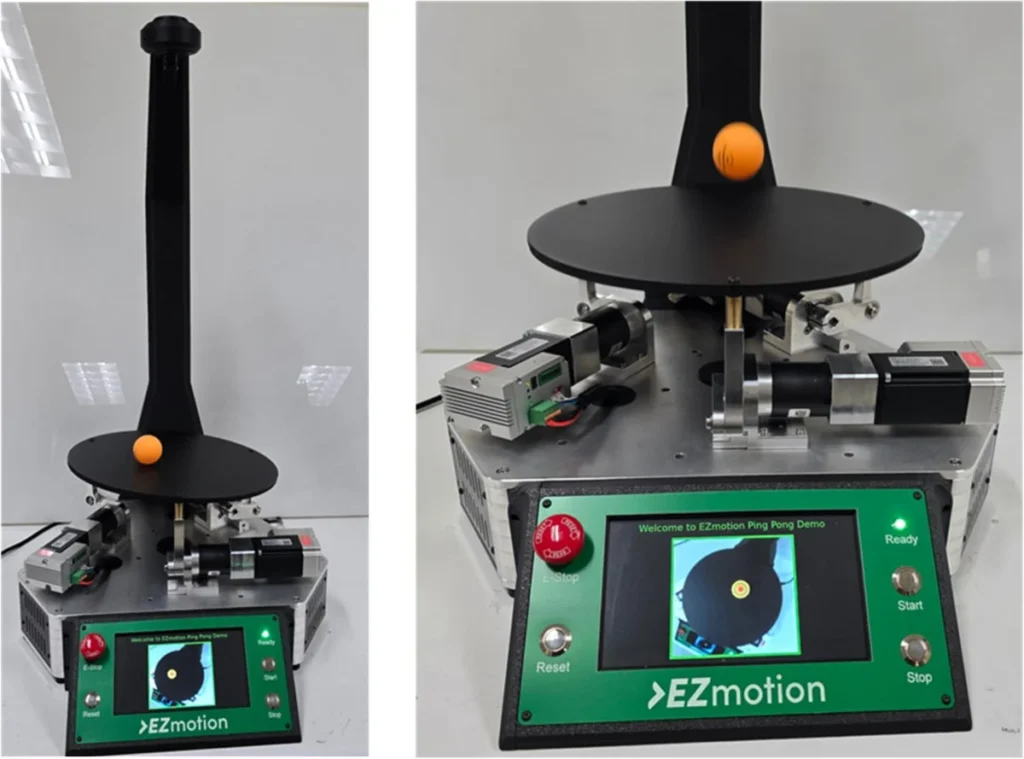
A groundbreaking demonstration platform, recently unveiled, showcases the advanced capabilities of modern servomotors in achieving real-time motion control for parallel-kinematics systems. At its core, this innovative setup meticulously manages the dynamic behavior of a lightweight ping-pong ball through synchronized servo actuation, sophisticated visual feedback, and rapid kinematic computations. This development, spearheaded by Monolithic Power Systems (MPS) and featuring EZmotion’s integrated servomotors, signifies a leap forward in precision motion control, addressing critical challenges in industries ranging from advanced manufacturing to medical robotics.
The Genesis of Precision: A Ping-Pong Ball Challenge

The primary objective behind constructing this three-axis parallel platform was to vividly illustrate the performance advantages of a specific line of servomotors, particularly their ability to execute dynamic balancing, circular swirling, and controlled bouncing of an inherently unwieldy ping-pong ball. The choice of a ping-pong ball, light and susceptible to chaotic movement from the slightest disturbance, serves as an ideal testbed for high-resolution motion, real-time responsiveness, and tight multi-axis synchronization. This seemingly simple task demands extraordinary precision and responsiveness, making it a compelling benchmark for motion control systems.
These advanced servomotors, which boast onboard drivers, integrated angle sensors, and CANopen support, are engineered to deliver unparalleled accuracy and real-time interaction. The platform specifically tackles complex engineering hurdles such as visual-feedback latency, maintaining perfect synchronization across all axes, and executing real-time inverse kinematics alongside robust proportional-integral-derivative (PID) control on embedded hardware. Charan Bhamra, a Mechatronics Engineer at Monolithic Power Systems, whose insights inform this demonstration, highlights the system’s capacity to translate visual data into precise multi-axis coordination and maintain motion accuracy instantaneously. Such capabilities are not merely academic; they are foundational for real-world applications including delta 3D printers, high-speed pick-and-place machines, delicate medical robotics, and other industrial equipment where absolute precision and dynamic control are paramount.
Architectural Blueprint: Integrating Intelligence and Actuation

The system’s architecture is a testament to intelligent design, meticulously distributing computational tasks to optimize performance. Each limb of the parallel platform is driven by an EZmotion MMS740100-24-C2-1 motor, operating in CANopen cyclic synchronous position (CSP) mode. This mode is critical for achieving the tight coordination and jitter-free motion essential for manipulating the ping-pong ball.
Central to the system’s real-time feedback loop is a camera strategically positioned above the platform. This camera captures the ball’s position at a moderate yet effective rate of 40 frames per second. The raw visual data is then fed into a Raspberry Pi 5 device, where it undergoes real-time processing using OpenCV computer vision libraries. The Raspberry Pi 5, known for its versatile computing power in embedded applications, efficiently determines the ball’s precise XY location. This crucial positional information is subsequently transmitted to a Cortex M4 microcontroller unit (MCU) via a high-speed Serial Peripheral Interface (SPI) communication link.
The Cortex M4 MCU acts as the primary initiator controller for the motors, orchestrating the platform’s core control loop and executing the complex kinematic model. Its core control logic is built upon a sophisticated PID-based algorithm. This algorithm continuously evaluates the ball’s positional error and translates it into a precise platform tilt angle. The kinematic model then converts this desired platform tilt-angle information into specific position targets for each of the three servomotors. Once these targets are calculated, the motors engage CSP mode via the CANopen protocol, ready to receive and execute the precise position setpoints. This intricate interplay ensures deterministic and synchronized motion across all three axes, allowing the platform to stabilize and react instantaneously to rapidly changing inputs from the ping-pong ball.

The Brains Behind the Ball: Visual Tracking and Image Processing
The innovative architecture deliberately separates computational roles to maximize efficiency. While the Cortex M4 MCU is dedicated to inverse kinematics, the Raspberry Pi 5 handles the demanding task of visual feedback. Running a lightweight Python script integrated with OpenCV, the Raspberry Pi processes video frames from the top-mounted USB camera at 40 frames per second. To effectively isolate the ping-pong ball, the system employs a series of image processing techniques. Gaussian blur is first applied to the frames to reduce noise, followed by a conversion to the Hue, Saturation, and Value (HSV) color space, which is more robust to lighting variations than RGB.
To facilitate accurate tracking, the ping-pong ball is marked with an orange color mask. This allows OpenCV to easily identify the ball against the background. Contour filtering is then applied to precisely delineate the ball’s boundaries. From these identified contours, the center coordinates are extracted by determining the smallest circle that completely encloses the largest detected contours. These XY coordinates provide the ball’s planar position.

Beyond 2D tracking, the system ingeniously determines the ball’s Z-position (height) by analyzing its apparent diameter. As the ping-pong ball moves closer to the camera, its detected diameter in pixel units increases proportionally. This pixel-based diameter information is then accurately translated into a real-world Z-position in millimeters, providing a complete 3D understanding of the ball’s location. For immediate operational insight, the Raspberry Pi also connects to a local display via HDMI, providing a live render of the camera feed along with the post-processed ball tracking frames. All real-time position and height data are continuously streamed to the MCU via SPI.
Mathematical Precision: The Kinematic Model in Action
The successful real-time control of the parallel platform hinges on accurate inverse kinematics. This mathematical approach computes the required motor crank angle to achieve a target platform tilt angle and Z-translation. The process begins with defining the global positions of the fixed-base joints and the local positions of the moving platform joints, which are distributed on a circle of a given radius.

Rotation matrices are then employed to precisely define how the platform moves in 3D space. Separate matrices account for rotation around the X-axis (θx), Y-axis (θy), and Z-axis (θz). These individual rotations are combined into a single rotation matrix, which describes the overall orientation of the platform’s axes relative to the base’s axes. This combined matrix is crucial for calculating the actual positions of each platform joint in global coordinates.
Once the global platform joint positions are determined, the system calculates the required length of each limb. This length is defined as the straight-line distance between the fixed-base joint and its corresponding transformed platform joint. Finally, based on these required limb lengths and the known lengths of the crank arm and connecting rod for each motor, the precise motor crank angle is computed. These calculations, though complex, are executed in real-time by the Cortex M4 MCU, enabling the platform to respond instantaneously to control commands. Visual representations, such as 3D and 2D views of the manipulator’s limbs, help illustrate how these intricate equations translate into defining platform orientation and dictating the necessary crank angles for each motor.
Dynamic Demonstration Modes: Mastering the Ball’s Trajectory

The MCU orchestrates a sophisticated PID-based control system that continuously adjusts the platform’s tilt and Z-translation to precisely control the ball’s motion in real-time. The demonstration features three distinct modes, each with its own objective and control strategy:
- Balancing: In this mode, the system aims to keep the ping-pong ball stationary at the exact center of the platform. The PID controller constantly minimizes any positional error by dynamically adjusting the platform’s tilt angles (θx and θy) to counteract the ball’s movement.
- Circular Swirling: Here, the target trajectory is a predefined circular path with a 100mm radius in the XY plane. The PID controller guides the platform to execute the necessary movements to make the ball follow this time-varying circular reference, demonstrating dynamic tracking capabilities.
- Bouncing: This is arguably the most dynamic and complex mode. The objective is to maintain the ball at a specific target height (in mm) while keeping its horizontal position centered on the platform. To initiate bouncing, the system first enters an oscillation phase, where the platform undergoes rapid vertical movements to impart sufficient energy to lift the ball off the surface. This phase is carefully designed to gradually increase the ball’s mechanical energy. Once a predefined energy threshold is met—indicating consistent bouncing—the controller seamlessly transitions into the sustained bouncing mode. In this phase, the controller applies minimal, synchronized vertical motion to maintain the bounce, prioritizing energy efficiency over driving the ball higher. The ball’s total energy (kinetic and potential) is estimated, and its velocity is computed from height differences over time steps, allowing for precise control.
The Heart of the System: Integrated Servomotors
The EZmotion MMS740100-24-C2-1 motors are the technological cornerstone of this platform. These are not merely motors but fully integrated, "smart" servomotors, compact 40mm units that encapsulate a permanent-magnet synchronous motor and a sophisticated driver module. This integration is a critical design choice, dramatically simplifying the system architecture and wiring complexity. Each motor incorporates a high-efficiency servo driver to power the windings and an embedded motion controller that runs a nested control loop, meticulously regulating current, velocity, and position in real-time.

Further enhancing their "smart" designation, these motors feature an onboard CAN transceiver, enabling direct integration into a CANopen network for robust industrial communication. A dedicated power management solution ensures stable internal voltages, guaranteeing safe and reliable operation. By consolidating all critical components—including the magnetic position sensor (offering 14-bit resolution for sub-degree accuracy), driver, controller, communication interface, and power management—into a single device, the EZmotion servomotors eliminate the need for external boards and controllers. This "plug-and-play" solution significantly reduces development time, system footprint, and potential points of failure, representing a significant advancement in motion control component design.
Synchronized Motion: The Power of CANopen CSP Mode
Achieving the precise, synchronized motion required for the parallel platform relies heavily on the Cyclic Synchronous Position (CSP) mode supported by the CANopen communication protocol. While CANopen offers other modes like Cyclic Synchronous Velocity (CSV) for velocity-driven applications and Cyclic Synchronous Torque (CST) for torque control, CSP mode is specifically tailored for deterministic, position-based multi-axis control, making it ideal for this demonstration.

In CSP mode, the Cortex M4 MCU (the initiator controller) sends precise position setpoints to each motor at a fixed, deterministic update rate. Crucially, to ensure continuity and smoothness in motion between these discrete updates, each motor internally performs linear interpolation between consecutive setpoints. This means the motor controllers do not generate their own complex trajectories; instead, they faithfully follow the continuous stream of updated position targets provided by the central initiator.
From a communication standpoint, CSP mode necessitates the initiator to send Process Data Object (PDO) messages containing these absolute target positions. These PDOs can be mapped, configured, and stored in the motor’s non-volatile memory, ensuring operational consistency. The calculated crank angle values derived from the inverse kinematics are converted into these CSP position targets and then broadcasted synchronously across the CAN bus. This robust communication strategy is what enables the system to maintain highly coordinated and jitter-free motion across all three limbs of the parallel platform, even during rapid and complex maneuvers.
Operational Sequence: A Seamless Demonstration

The system’s operation follows a carefully defined sequence to ensure reliable and repeatable performance. It begins with a torque-based homing routine for all servomotors. During this critical initialization phase, each of the three limbs retracts inward at a controlled speed until it firmly reaches its mechanical hard stop. This process establishes a precise and repeatable "zero position" for each motor. Once homing is successfully completed, the platform automatically ascends to a predefined mid-height along the Z-axis, preparing for operation. A green status LED illuminates, signaling successful initialization and indicating that the user can now place a ping-pong ball on the platform’s surface.
Upon activation, the manipulator enters its active sequence, beginning with the balancing mode to stabilize the ball. After a predetermined duration, it transitions into the circular swirl mode for 30 seconds, demonstrating dynamic tracking. This is followed by the challenging bouncing mode for another 30 seconds. This entire sequence continuously loops as long as the system remains active, providing a comprehensive demonstration of the servomotors’ capabilities. Throughout the entire demonstration, a 7-inch screen provides live visual feedback of the ball’s motion, allowing observers to appreciate the precision in real-time.
Beyond Ping Pong: Real-World Implications and Future Outlook

While the ping-pong ball demonstration is captivating, the true significance of this parallel-kinematics platform and the integrated EZmotion servomotors lies in their profound implications for real-world industrial and technological applications.
In medical robotics, architectures strikingly similar to this demonstration are critical for stabilizing delicate endoscopic instruments, precisely guiding surgical tools, and assisting in minimally invasive procedures. In such contexts, fine resolution, absolute accuracy, and jitter-free motion are not just desirable but essential for patient safety and surgical efficacy.
Within industrial automation, these integrated servomotors are ideal for imparting highly precise motion to optical alignment stages, high-speed pick-and-place heads, and micro-assembly manipulators where components must be positioned with micron-level accuracy. Furthermore, delta 3D printers and certain consumer-grade delta pick-and-place machines already leverage servo-driven parallel kinematic structures to achieve high speeds and precision over a large workspace, making these integrated motor solutions particularly suitable.

The trend towards fully integrated servomotors, like the EZmotion MMS740100-24-C2-1, addresses a growing demand for simplified system design, reduced wiring complexity, and faster deployment cycles in industrial environments. By embedding the driver, controller, and communication capabilities directly into the motor unit, manufacturers can streamline their designs, lower material costs, and improve system reliability by reducing the number of external components and interconnections.
Charan Bhamra emphasizes that this demonstration not only validates the exceptional performance of EZmotion servomotors but also provides a tangible blueprint for developers and engineers seeking to implement advanced motion control solutions. The ability to manage visual feedback latency, ensure multi-axis synchronization, and perform real-time kinematics and PID control on embedded hardware opens doors for innovative designs across various sectors. This technology points towards a future where complex robotic systems are not only more precise and responsive but also more compact, cost-effective, and easier to integrate, driving efficiency and innovation in the next generation of automation.