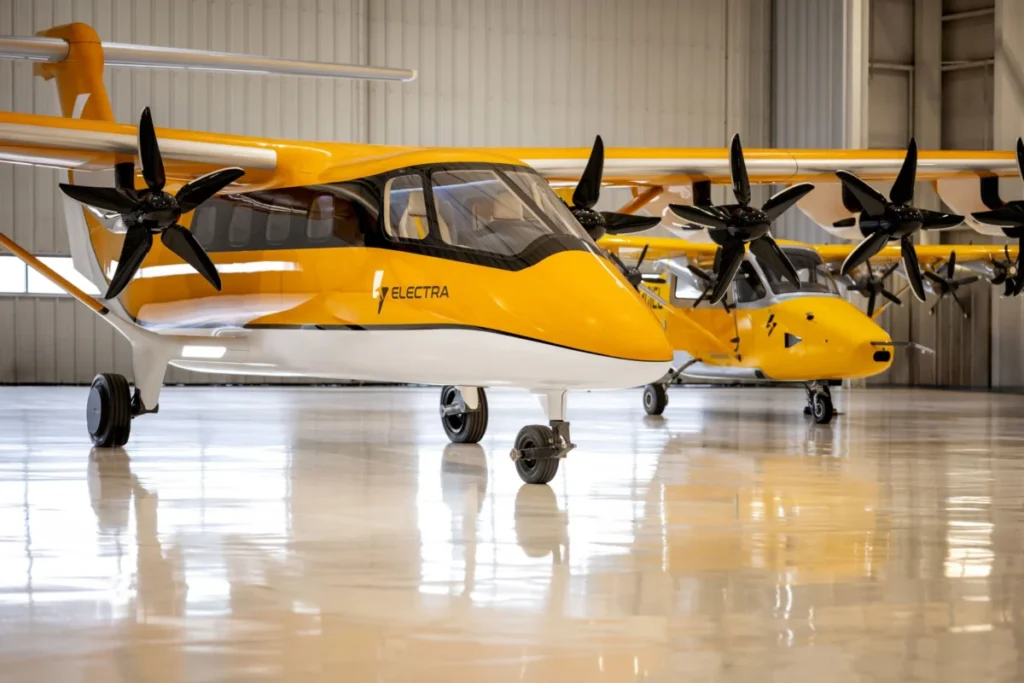
The dream of seamless, efficient travel between 50 and 250 miles is on the cusp of becoming a widespread reality, thanks to the innovative hybrid-electric aircraft developed by Electra. This burgeoning aviation company, deeply rooted in the academic and entrepreneurial ecosystem of the Massachusetts Institute of Technology (MIT), has secured a monumental $850 million investment to propel its nine-passenger aircraft from prototype to mass production. This significant financial infusion is set to transform a visionary concept into a tangible solution for travelers frustrated by the inefficiencies of current ground and air transportation, promising to create nearly 2,000 new jobs and etch a new chapter in aviation history in Ohio, the very cradle of powered flight.
Chris Courtin, Director of Technology Development at Electra, articulated the company’s core mission with striking clarity. "Helping people travel between 50 and 250 miles is the sweet spot for this technology," Courtin stated, emphasizing the potential of Electra’s aircraft to offer a superior alternative to both personal driving and commercial air travel for a significant segment of the population. He highlighted the pervasive "friction" in existing transportation systems for this range of travel, identifying a substantial unmet need that Electra aims to address. "There’s a lot of people traveling in that range and a huge amount of friction in existing ground and air transport systems. This could be a big benefit to those people," he added.
Electra’s journey from a nascent idea to a company poised for significant market impact is a testament to sustained innovation and a powerful synergy with MIT. Courtin’s personal involvement traces the evolution of the hybrid plane concept from its inception. His initial engagement was as part of a capstone class project at MIT, followed by a role as a teaching assistant, and ultimately culminating in its integration into his doctoral research. The company itself was founded by another distinguished alumnus, John Langford, who boasts an impressive academic record at MIT, including multiple master’s degrees and a Ph.D. Furthermore, Electra benefits from the foundational technical guidance of two esteemed MIT professors: Mark Drela and John Hansman, whose expertise has been instrumental in shaping the aircraft’s design and viability.
"The company has really benefited from a strong collaboration with MIT," Courtin affirmed. He elaborated on the unique environment MIT provides, which fosters a crucial blend of theoretical exploration and practical application. "One of the compelling things about MIT is it gives people space to marry the theoretical side with the practical side – to actually go build the airplane and see if people will buy it." This hands-on, problem-solving ethos has evidently been a driving force behind Electra’s progress.
From Academic Concept to Aviation Enterprise
The genesis of Electra can be traced back to a graduate seminar in 2017, MIT class 16.886, "Air Transportation Systems Architecting." At a time when electric vertical takeoff and landing (eVTOL) aircraft were capturing considerable attention, Courtin’s project group sought to evaluate alternative approaches to urban air mobility and short-haul transportation. The objective of the class was to undertake open-ended, project-based research into emerging aerospace developments.
"It was an open-ended, project-based class where you look at developments in aerospace," Courtin recalled. "My group realized short takeoff and landing aircraft had a lot of advantages over eVTOL for getting people where they wanted to go." Their insight was to leverage the advancements in lightweight electric motors, initially developed for eVTOL applications, to create a novel fixed-wing aircraft. This led to the concept of what is now termed an ultra-short takeoff and landing (eSTOL) aircraft. The core innovation lay in combining battery power with small electric motors to significantly reduce the required runway and landing space. Crucially, the design also incorporates a "blown lift" effect, achieved through strategically directed airflow, to augment lift and enable extended flight ranges beyond what electric motors alone could provide.
This foundational concept was further refined and tested through subsequent senior design classes, co-taught by Professors Drela and Hansman, with Courtin serving as a teaching assistant. During these courses, student teams collaborated to construct and rigorously test a subscale model of the aircraft. These validation efforts included empirical studies within MIT’s renowned Wright Brothers Wind Tunnel and actual flight demonstrations. Courtin’s academic journey continued with him dedicating parts of his doctoral research to advancing the underlying principles of this innovative aircraft.
The transition from academic exploration to a commercial venture solidified in 2019 when John Langford, a seasoned aviation entrepreneur who had previously led Aurora Flight Sciences before its acquisition by Boeing, became involved. This pivotal moment marked the official establishment of Electra.
The Electra EL2: A Proven Precursor
As a crucial first step in validating their technology, Electra’s team developed and successfully flew the EL2, a two-seat demonstrator aircraft. This prototype was instrumental in designing, building, and rigorously testing the core hybrid propulsion system. The EL2 commenced its flight testing program in 2023 and has since accumulated over 200 successful flights, providing invaluable real-world data and operational experience.
The hybrid propulsion system of the Electra aircraft is a key differentiator. It features a compact, gas-powered generator positioned in the nose of the aircraft, complemented by batteries located beneath the floor. During critical phases of flight, such as takeoff and landing, both the generator and the batteries supply power to the aircraft’s propellers. For cruising flight, the aircraft primarily relies on the generator, which also possesses the capability to recharge the batteries.
"The gas generator is like a traditional turbine engine used in a conventional aircraft, only instead of driving a propeller or fan it drives an electric generator," Courtin explained. "That feeds power to the eight motors on the wing. It allows you to have a smaller and more efficient engine because you can size it for cruising, not takeoff and landing conditions." This approach optimizes engine performance and efficiency by decoupling the power requirements for different flight phases.
The eight electric motors distributed across the wing are central to the aircraft’s eSTOL capabilities. They generate a "blown lift" effect, a phenomenon where a significant portion of the airflow from the propellers is directed over the wings, dramatically increasing lift at low speeds. This allows the Electra aircraft to achieve takeoff and landing within distances comparable to the length of a soccer field, a stark contrast to the extensive runways required by conventional airplanes.
Transforming Travel: Benefits for Passengers and Operators
The implications of this technology for travelers are profound, primarily centering on significant time savings. "The big benefit is you can save a lot of time," Courtin stated. "You don’t need to go to an airport, and you don’t have to go to a train station." This bypasses the often time-consuming processes associated with traditional travel hubs, such as security checks, check-in procedures, and navigating large terminals.
Furthermore, Electra’s aircraft can unlock greater utility from existing aviation infrastructure. For individuals located far from major airports, the "friction" of travel is substantial. "If you’re three hours away from the nearest major airport, there’s a lot of friction in that," Courtin observed. "With Electra, we could fly you to the nearest major airport, and you don’t need to use a runway, so it doesn’t add to congestion at these very low-capacity places." This capability allows for more efficient "last-mile" connectivity, bridging the gap between remote locations and major transportation arteries.
Beyond convenience, Electra’s aircraft are designed to be more affordable and significantly quieter than conventional aircraft. The distributed propulsion system, featuring a multitude of smaller propellers, contributes to a substantial reduction in noise pollution. "The large number of propellers means you can make them much quieter than if you only had one or two," Courtin elaborated. "That’s important because helicopters are restricted from operating in places they otherwise could because of the noise." This quieter operation opens up possibilities for service in noise-sensitive urban environments and near residential areas, expanding potential operational footprints.
Scaling Up Production: A New Era for Ohio Aviation
The recent $850 million investment marks a pivotal moment for Electra, enabling the company to scale its operations dramatically. Construction of a new 96-acre manufacturing facility in Springfield and Clark County, Ohio, is slated to commence next year. This strategic location in Ohio holds historical significance, as it was the site of the Wright brothers’ pioneering work in powered flight.
The initial phase of the Ohio facility will be equipped to produce 400 of Electra’s nine-seat aircraft annually. A subsequent expansion phase is planned to increase this production capacity to approximately 800 aircraft per year, positioning Electra as a major player in the regional aviation market.
The company envisions its aircraft playing a dual role: facilitating seamless transfers to major airports for longer journeys and, in the long term, potentially diminishing the reliance on conventional airports altogether. "If you don’t have an existing airport, that’s a very difficult thing to build these days," Courtin commented. "But finding a soccer field-sized area is not hard, especially with our noise reductions." This flexibility in operational requirements suggests a potential decentralization of air travel infrastructure.
Electra is also actively exploring diverse applications for its technology beyond passenger transport. These include significant potential in military logistics, where rapid and flexible deployment of personnel and supplies is critical; cargo transport, offering a more agile alternative for regional deliveries; and humanitarian missions, providing vital support in disaster relief and medical evacuation scenarios.
For the passenger aircraft segment, Electra’s leadership is confident that scaling production will lead to widespread accessibility. "If we can keep the fixed-wing design simplicity and make this large enough, then the per-seat cost could get to a range where a lot of people would have access to this," Courtin stated. "It wouldn’t just be a luxury product, so it could help a lot of people." This forward-looking vision suggests a democratization of air travel, making efficient, point-to-point journeys a viable option for a broad spectrum of travelers, not just an exclusive few. The company’s ambitious plans, backed by substantial investment and a strong foundation in technological innovation, signal a transformative shift in how we conceive of and undertake short-to-medium range travel.