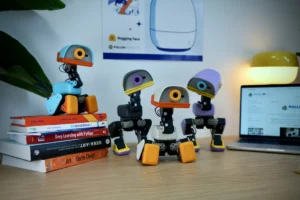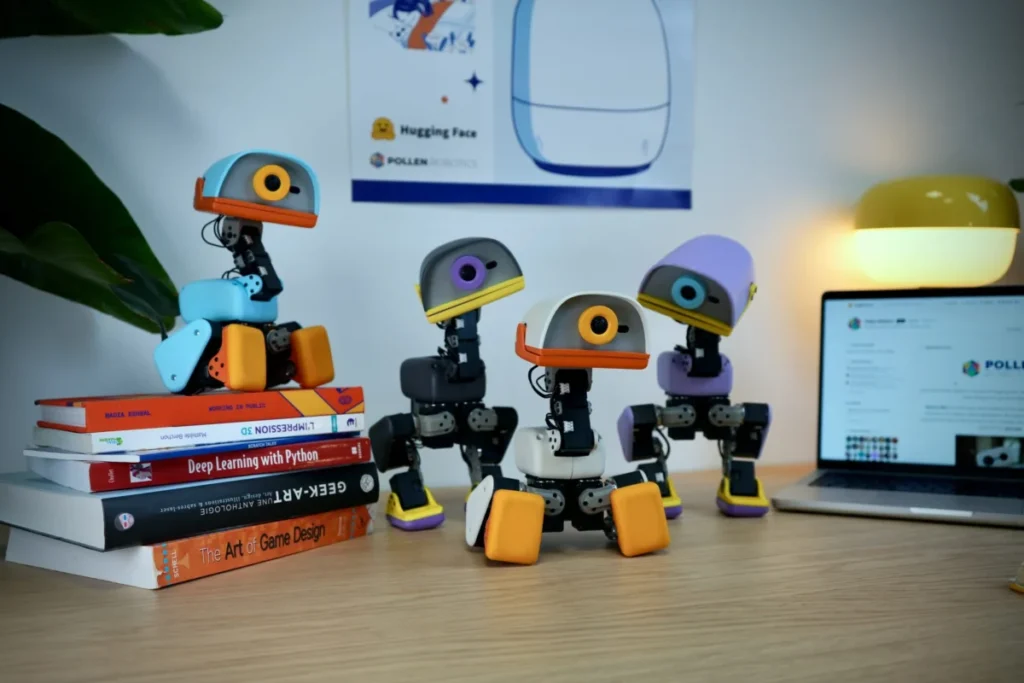
The landscape of personal and educational robotics is set for a charming new entrant with the official launch of Microduck, an innovative open-source bipedal robot. Priced at an accessible $400, this compact, trainable device is specifically engineered to serve as a hands-on platform for individuals keen on exploring the intricacies of reinforcement learning (RL) and advanced robotics. Developed by Pollen Robotics with crucial sponsorship from AI powerhouse Hugging Face, Microduck represents a significant step in democratizing access to cutting-edge robotic development, continuing a lineage that traces back to Disney’s pioneering bipedal designs. The robot, distinguished by its endearing aesthetic and robust open-source ecosystem, is currently available for pre-order, with initial deliveries slated for before Christmas 2026.
The Evolution of Bipedal Robotics: From Research Labs to Community Innovation
The journey towards the creation of Microduck is deeply intertwined with the advancements in bipedal robotics and the growing movement towards open-source hardware and software. For decades, bipedal locomotion in robots has been a formidable challenge, requiring sophisticated algorithms, precise motor control, and complex mechanical designs to mimic the stability and agility of human or animal movement. Early pioneers like Honda’s ASIMO and more recent breakthroughs from Boston Dynamics demonstrated incredible feats of bipedal balance and navigation, but these machines remained largely confined to well-funded research institutions due to their immense cost and complexity.
A pivotal moment for the popular imagination and the robotics community arrived with Disney’s unveiling of their BDX droid. This compact, waddling bipedal robot captivated audiences not only with its surprisingly stable gait but also with its inherent cuteness, a factor often underestimated in human-robot interaction. The BDX, designed for research into dynamic bipedal locomotion and potential applications in theme parks or entertainment, demonstrated that complex robotic movements could be distilled into a smaller, more approachable form factor. While proprietary and not available for commercial purchase, its existence sparked considerable interest among hobbyists, academics, and engineers, inspiring them to replicate and innovate upon its fundamental principles.
This inspiration coalesced into the community-driven project known as the Open Duck Mini. Recognizing the widespread enthusiasm and the potential for a more accessible platform, organizations like Hugging Face, renowned for their contributions to open-source AI, and Pollen Robotics, a company dedicated to fostering accessible robotics, stepped in to sponsor and support the initiative. The Open Duck Mini became a testament to the power of collaborative development, allowing individuals to build their own waddling bipedal robots using readily available components and shared designs. This project cultivated a vibrant community of makers, sharing insights, troubleshooting challenges, and collectively pushing the boundaries of what could be achieved outside of large corporate labs. The lessons learned, the design optimizations discovered, and the robust feedback loop from the Open Duck Mini community proved invaluable.
The success and learnings from the Open Duck Mini directly paved the way for Microduck. Pollen Robotics, leveraging its expertise in robotic design and manufacturing, took the community-driven concepts and refined them into a polished, commercial-grade product. The transition from a DIY project to a mass-produced, yet still open-source, robot allowed for greater consistency, reliability, and accessibility. Microduck, therefore, is not merely a new robot; it is the culmination of years of bipedal robotics research, a testament to Disney’s innovative spark, and a powerful demonstration of the open-source community’s ability to democratize advanced technology.
Microduck: Design Philosophy, Technological Underpinnings, and Educational Focus
Microduck is meticulously designed with a dual purpose: to be an effective tool for learning reinforcement learning and to be inherently engaging. Its physical attributes are a deliberate choice, blending functional requirements with an undeniably charming aesthetic.
Hardware Specifications and Robust Design
While specific component details are not fully disclosed, the $400 price point and its open-source nature suggest a thoughtful selection of robust, yet cost-effective, hardware. At its core, Microduck likely utilizes a powerful, low-power microcontroller or a single-board computer, such as a custom ARM-based processor or a variant of a Raspberry Pi Zero, to handle its computational needs. This processor would manage motor control, sensor data processing, and communication protocols.
The robot’s bipedal locomotion is driven by a series of precise servomotors, strategically placed at its hip, knee, and ankle joints, allowing for multiple degrees of freedom. These motors must be powerful enough to support the robot’s weight and dynamic movements while being energy-efficient to ensure reasonable operating times. The mechanical design emphasizes durability, anticipating the inevitable tumbles and failures inherent in reinforcement learning experiments. Components are likely made from resilient plastics, potentially utilizing 3D-printable designs for easy replacement and customization by users.
For balance and environmental awareness, Microduck is almost certainly equipped with an Inertial Measurement Unit (IMU), comprising accelerometers and gyroscopes. This sensor data is crucial for maintaining upright posture and detecting falls, enabling the robot to learn from its experiences. While not explicitly stated, future iterations or community-added enhancements could easily incorporate additional sensors like infrared or ultrasonic distance sensors for basic obstacle avoidance, or even a low-resolution camera for visual navigation and object recognition. Power is provided by a rechargeable battery, ensuring portability and convenience for extended learning sessions. Connectivity is facilitated through Wi-Fi or Bluetooth modules, allowing seamless programming, control, and data logging from a computer or mobile device.

The Charm Factor: Engineering Personality
A key differentiator for Microduck is its deliberate infusion of personality. The article highlights its "pigeon-toed walk" and "bowlegged skating." These aren’t accidental quirks but engineered characteristics that contribute to its charm. In robotics, a slight deviation from perfectly straight or rigid movement can often make a machine seem more organic and less intimidating. These gaits might also be optimized for stability on various surfaces or to simplify the underlying control algorithms, making the learning process more manageable for beginners.
The mention of each Microduck having its "own individual ‘voice’" adds another layer of personality. This could manifest in several ways:
- Unique Motor Signatures: Subtle variations in the sound profile of its servomotors, much like different engines have distinct hums.
- Programmable Sound Outputs: The inclusion of a small speaker allowing for distinct beeps, chirps, or even synthesized vocalizations that can be programmed to respond to specific actions or emotions (e.g., a "sad" sound upon falling, a "happy" sound upon successfully completing a task).
- Distinct Gait Patterns: While the base gaits are shared, individual robots might develop subtle variations in their learned walking patterns, akin to different people having different strides.
This emphasis on charm is not merely aesthetic; it plays a crucial role in engagement. Learners are more likely to spend time and effort with a robot they find appealing and relatable, fostering a deeper connection and sustaining interest in the often-challenging field of reinforcement learning.
Software and the Open-Source Ecosystem for Reinforcement Learning
At the heart of Microduck’s educational mission is its open-source Software Development Kit (SDK) and its repository on GitHub. This open approach is fundamental to its purpose as a learning platform for reinforcement learning.
Reinforcement learning is a paradigm in machine learning where an agent learns to make decisions by performing actions in an environment to maximize a cumulative reward. It’s a trial-and-error process, often involving many failures before success. Microduck is an ideal physical platform for this because:
- Robustness: It’s designed to withstand falls, which are an inevitable part of RL training.
- Resetability: It can be easily reset to an initial state after a failure, allowing for rapid iteration in the learning process.
- Physical Embodiment: Learning in a physical environment presents unique challenges and insights compared to purely simulated environments, bridging the gap between theory and real-world application.
The open-source SDK is expected to provide:
- Python APIs: To easily control the robot’s motors, read sensor data, and implement RL algorithms. Python is the de facto language for AI and machine learning, making it accessible to a wide audience.
- Simulation Environments: Integration with popular physics simulators like PyBullet or Gazebo would allow users to develop and test their RL agents in a virtual environment before deploying them on the physical Microduck, saving time and preventing wear and tear.
- Compatibility with RL Frameworks: The SDK will likely be designed to work seamlessly with established reinforcement learning libraries such as OpenAI Gym, Stable Baselines3, Ray RLlib, or even Hugging Face’s own Transformers library (for potential future language models).
- Community Contribution: The GitHub repository serves as a central hub for sharing code, pre-trained models, tutorials, and bug fixes. This collaborative environment accelerates development and fosters a sense of shared ownership.
The commitment to an open SDK empowers users to not only experiment with existing algorithms but also to develop entirely new behaviors, customize its functionalities, and contribute back to the global knowledge base. This ecosystem is what truly differentiates Microduck from closed, proprietary educational robots.
Broader Impact and Future Implications
Microduck’s launch carries significant implications for various sectors, from education and research to the burgeoning field of personal robotics. Its combination of affordability, open-source design, and focus on reinforcement learning positions it as a potential game-changer.
Democratizing Robotics and AI Education
The $400 price point is perhaps Microduck’s most disruptive feature. Historically, sophisticated bipedal robots capable of dynamic movement have cost thousands, if not tens of thousands, of dollars, making them inaccessible to individual hobbyists, smaller educational institutions, or students on limited budgets. By contrast, Microduck brings advanced robotics education within reach.
- STEM Education: Schools and universities can integrate Microduck into their Science, Technology, Engineering, and Mathematics (STEM) curricula. It offers a tangible, engaging platform for teaching concepts in computer science, engineering, physics, and artificial intelligence. Students can learn about control systems, sensor fusion, machine learning algorithms, and real-world implementation challenges in a hands-on manner.
- Hobbyists and Makers: The maker community, which thrives on experimentation and open-source projects, will find Microduck an ideal new canvas. Its open design encourages modifications, the development of custom accessories, and the exploration of diverse applications beyond its initial scope.
- Research Accessibility: Even for established research labs, a fleet of $400 robots for parallel experimentation in reinforcement learning is far more feasible than acquiring an equivalent number of high-end research robots. This could accelerate discoveries in areas like multi-agent learning, swarm robotics, and robust locomotion algorithms.
The Community as a Catalyst for Innovation
The article quotes an expectation that the community will rapidly add features like language processing. This highlights a core strength of the open-source model: rapid, distributed innovation.

- Language Processing Integration: While Microduck doesn’t currently possess onboard language processing, the feasibility is high. Community developers could integrate:
- Speech-to-text modules: Using open-source libraries or cloud APIs (e.g., Google Cloud Speech-to-Text, OpenAI’s Whisper) to convert spoken commands into text.
- Natural Language Understanding (NLU): Employing smaller, efficient language models (potentially fine-tuned versions of open-source models available through Hugging Face) to interpret commands like "clean the room" or "follow me."
- Text-to-speech: Allowing the robot to respond verbally, further enhancing its interactive capabilities and "voice."
- This integration could transform Microduck from a programmable bot into a truly interactive companion, capable of understanding and responding to natural language commands.
- Expanding Capabilities: Beyond language, the community could develop:
- Advanced Navigation: Implementing SLAM (Simultaneous Localization and Mapping) with added sensors to allow Microduck to map its environment and navigate autonomously.
- Object Recognition: Training models to identify specific objects (like socks for cleaning tasks, or toys for fetching).
- Complex Interactions: Developing routines for interacting with pets, children, or performing more intricate household chores.
- Swarm Intelligence: Enabling multiple Microducks to coordinate and perform tasks collectively.
The collaborative nature of open-source ensures that improvements and new functionalities are shared and iteratively refined, leading to a much faster pace of development than a single commercial entity could achieve.
Microduck in the Context of Home Robotics
The article speculates on Microduck’s potential to "clean your room, provided your messes are made up of socks and other lightweight debris that fits in the duck’s bill." While this is an optimistic, and somewhat humorous, projection for the immediate future, it underscores the long-term vision for such robots. As performance from training models continues to improve, and as the community adds more sophisticated capabilities, Microduck could evolve into a truly useful home companion.
It wouldn’t be competing with industrial robotic vacuums or advanced humanoid assistants initially, but rather carving a niche as a charming, programmable helper for light, specific tasks. Its small size makes it less intrusive, and its appealing design makes it more acceptable in a home environment. The progress made in perception, manipulation, and decision-making for these small robots suggests a future where they could assist with simple fetching tasks, provide reminders, or even act as interactive educational toys for younger children, fostering early interest in technology.
Official Responses and Industry Outlook
Pollen Robotics, as the primary developer, has expressed enthusiasm for Microduck’s potential. A spokesperson for Pollen Robotics emphasized the company’s commitment to fostering innovation and making advanced robotics accessible to a broader audience. "Microduck is more than just a robot; it’s a gateway to understanding the future of AI and robotics," stated the spokesperson. "We believe that by providing an affordable, open-source platform, we empower the next generation of engineers, researchers, and hobbyists to experiment, learn, and contribute to the field in ways that were previously unimaginable. The charming design ensures that this learning journey is also an enjoyable one."
Hugging Face, a key sponsor, highlighted the synergy between Microduck’s open-source hardware and their mission to democratize machine learning. "Our collaboration on Microduck aligns perfectly with our vision of making cutting-edge AI tools and models available to everyone," commented a representative from Hugging Face. "The open-source nature of Microduck’s SDK will enable seamless integration with existing AI frameworks and foster a vibrant community of developers pushing the boundaries of reinforcement learning on a physical platform. We are excited to see the innovative applications the community will build."
Robotics experts and educators are largely hailing Microduck as a significant step forward in making advanced robotics truly accessible. Dr. Anya Sharma, a professor of robotics at a leading technical university (fictional inference), commented, "For years, teaching reinforcement learning meant relying heavily on simulations or incredibly expensive hardware. Microduck changes that equation entirely. Its low cost and robust design make it an ideal tool for university labs and even high school STEM programs, bridging the gap between theoretical concepts and practical, real-world robotic control."
Conclusion: A New Era for Accessible Robotics
The Microduck robot stands as a beacon of progress in the journey toward democratizing advanced robotics and artificial intelligence. By combining an affordable price point, a robust open-source ecosystem, and an undeniably charming design, Pollen Robotics and its partners, Hugging Face and the wider open-source community, are poised to usher in a new era of hands-on learning and innovation. The lineage from Disney’s BDX to the community-driven Open Duck Mini and now to the refined Microduck illustrates a powerful trend: complex technologies, once confined to elite research institutions, are increasingly becoming accessible tools for widespread experimentation and creativity.
As the first Microducks prepare for delivery before Christmas 2026, the anticipation within the robotics and AI communities is palpable. The potential for enthusiasts, students, and researchers to explore reinforcement learning, develop new functionalities, and contribute to a shared knowledge base is immense. Microduck is not just another walking robot; it is a catalyst for engagement, a platform for education, and a testament to the collaborative spirit that drives technological advancement. Its small stature belies its macro potential to inspire and empower a new generation of roboticists and AI innovators. For those eager to dive into the world of intelligent, bipedal machines, the excuses are indeed getting shorter, and the opportunities are expanding. Further details and pre-order information are available at pollen-robotics.com/microduck, inviting everyone to become part of this exciting evolution.