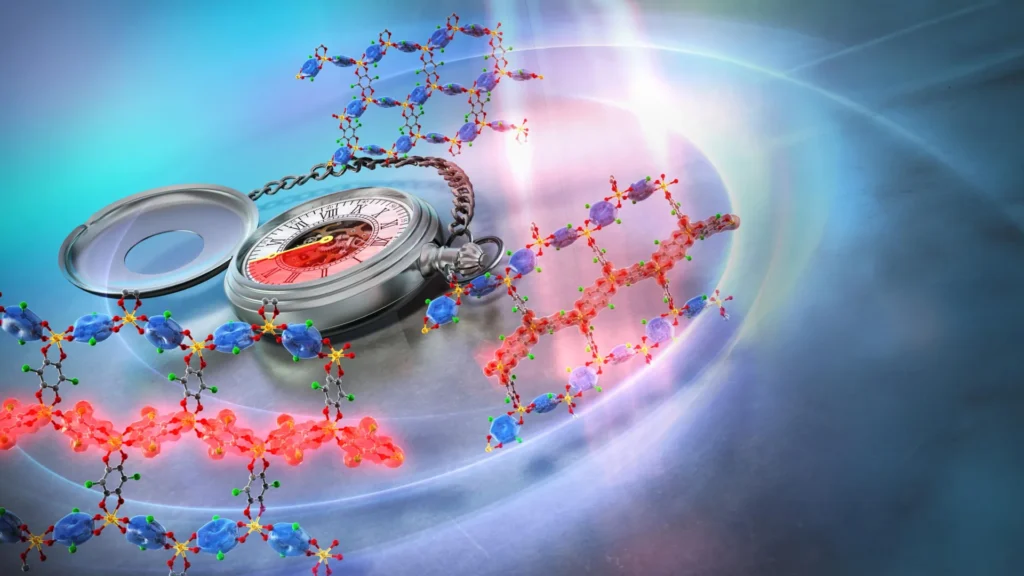
In a landmark achievement for the field of condensed matter physics and materials science, a collaborative research team in Japan has successfully observed the near-instantaneous birth of a "hidden" electronic state within a metal-organic framework (MOF). By utilizing state-of-the-art laser technology capable of emitting pulses lasting only six femtoseconds, the scientists captured a transformation that occurs in less than 30 femtoseconds—a duration so brief it represents a millionth of a billionth of a second. This discovery, spearheaded by researchers from the Institute of Science Tokyo (Science Tokyo), Tohoku University, and the Nagoya Institute of Technology, provides the first clear glimpse into the fleeting intermediate stages that govern how light can fundamentally alter the properties of complex materials.
The study, recently published in the prestigious journal Physical Review Letters, marks a significant leap forward in our understanding of photoinduced phase transitions. While scientists have long known that light can be used to "switch" materials between different states—altering their conductivity, magnetism, or transparency—the exact mechanics of these transitions have remained largely speculative due to the extreme speeds at which they occur. By identifying a previously unknown intermediate "bond-order wave" state, the Japanese team has provided a roadmap for the future design of ultra-high-speed optoelectronic devices and light-controlled quantum materials.
The Frontier of Ultrafast Material Science
The quest to control matter with light is one of the most ambitious goals in modern physics. Traditionally, the properties of a material are changed through "equilibrium" methods, such as adjusting temperature, applying physical pressure, or changing chemical composition. However, these methods are relatively slow and limited by the laws of thermodynamics. Photoinduced states offer a radical alternative: by hitting a material with a precise burst of laser light, researchers can kick it into a "non-equilibrium" or "hidden" state that does not exist under normal conditions.
Metal-organic frameworks (MOFs) have emerged as the ideal laboratory for these experiments. MOFs are porous, crystalline materials composed of metal ions or clusters linked together by organic "ligand" molecules. Their highly organized, cage-like structures make them incredibly versatile; they are currently used in applications ranging from carbon capture and gas storage to drug delivery and catalysis. Because their properties are determined by the delicate interaction between the metal centers and the organic bridges, they are highly sensitive to external stimuli, making them prime candidates for light-induced transformations.
Despite their potential, the "black box" of the transformation process has hindered progress. When a photon hits a MOF, the resulting change usually happens so fast that researchers only see the "before" and "after" states. The "in-between" moments—where the actual physics of the change resides—have been invisible until now.
Methodology: The Precision of Six-Femtosecond Pulses
To break through this temporal barrier, the research team, led by Assistant Professor Tadahiko Ishikawa of Science Tokyo’s Department of Chemistry, employed a technique known as time-resolved reflectance spectroscopy. This method operates on a "pump-probe" principle: a first laser pulse (the pump) excites the material, and a second, weaker pulse (the probe) measures how the material’s reflectivity changes over time.
The key to the team’s success was the duration of the laser pulses. While standard ultrafast lasers operate in the 50 to 100-femtosecond range, the team utilized pulses lasting a mere six femtoseconds. To put this into perspective, a femtosecond is to a second what a second is to roughly 32 million years. At this scale, the researchers were able to "freeze" the motion of electrons within the MOF.
The experiments focused on a specific MOF known for its complex electronic interactions. By measuring the reflectance spectrum immediately after the laser hit the sample, the team observed a dramatic shift in the material’s optical absorption bands within 30 femtoseconds. These shifts served as the "fingerprint" of a new, hidden state emerging from the darkness of the sub-picosecond realm.
Decoding the Bond-Order Wave: The Intermediate Discovery
The experimental data alone revealed that something was happening, but it took advanced theoretical calculations to interpret what that "something" was. Collaborating with experts from Tohoku University and the Nagoya Institute of Technology, the team used quantum mechanical modeling to reconstruct the sequence of events.
The analysis revealed that the transformation occurs in two distinct stages. Immediately upon absorbing the light, the material enters an intermediate electronic state characterized by a "bond-order wave." In this state, the electronic bonds between the metal ions and the organic molecules begin to oscillate, creating a repeating pattern of stronger and weaker connections across the crystal lattice.
Crucially, this bond-order wave is purely electronic; it occurs before the atoms themselves have had time to move. It is a state of pure energy redistribution. Only after this electronic precursor is established do the heavier atomic nuclei begin to shift their positions. These slight structural adjustments then "lock" the material into the final photoinduced hidden state.
"We found that the photoinduced hidden state forms within 30 fs through a previously unknown intermediate electronic state," Assistant Professor Ishikawa noted. "This sequence—where electronic reorganization precedes structural change—is fundamental to understanding how we might one day bypass the speed limits of current electronic switching."
Implications for Future Technology
The discovery of this intermediate state has profound implications for the future of "light-driven" technology. One of the most exciting findings from the theoretical calculations is that the resulting hidden state may be polar. In a polar state, the distribution of electrical charges is uneven, creating a permanent electric dipole.
If researchers can reliably induce and control these polar states with light, it opens the door to several revolutionary applications:
- Ultrafast Optical Memory: Current hard drives and flash memory rely on magnetic or electrical signals to write data, which is limited by the speed of physical circuits. Light-induced switching could allow for data storage devices that operate at terahertz speeds, thousands of times faster than current technology.
- Optoelectronics and Photonic Computing: By using light to toggle the conductivity of a MOF between "on" and "off" states in 30 femtoseconds, scientists could develop transistors that process information using photons rather than electrons, drastically reducing heat and increasing processing power.
- Smart Materials: This research provides a blueprint for designing materials that change their physical properties—such as color, transparency, or mechanical strength—on demand with the flick of a laser switch.
A New Paradigm in Material Design
The success of the Science Tokyo team demonstrates that the combination of ultrafast spectroscopy and theoretical modeling is a powerful tool for peeling back the layers of material behavior. By revealing the "invisible" steps of a transformation, scientists can move away from trial-and-error experimentation and toward "rational design."
"By revealing intermediate states, our method could help design materials that can be efficiently controlled using light," Ishikawa explained. The goal is to identify which molecular structures favor the formation of these beneficial intermediate states, allowing for the creation of MOFs tailored for specific high-speed tasks.
The broader scientific community has reacted to the findings with significant interest. Dr. Samiran Banu, a key contributor to the study and currently a Special Postdoctoral Researcher at RIKEN, emphasized that this approach isn’t limited to MOFs. The same methodology can be applied to other complex systems, such as high-temperature superconductors and organic conductors, where hidden states are suspected to play a role in exotic physical phenomena.
Conclusion and Chronology of the Breakthrough
The journey to this discovery began with the development of the 6-femtosecond laser system, a feat of engineering that required precise control over light phase and intensity. Following the experimental phase at Science Tokyo, the data was cross-referenced with computational models developed over several months by the Tohoku and Nagoya teams.
The chronology of the 30-femtosecond transformation can be summarized as follows:
- 0–6 Femtoseconds: The MOF is struck by the pump laser pulse, absorbing photons.
- 6–15 Femtoseconds: The material enters the "bond-order wave" state. Electrons rearrange into alternating patterns of bond strength, but the atomic structure remains momentarily static.
- 15–30 Femtoseconds: Atomic nuclei begin to move in response to the new electronic environment.
- 30 Femtoseconds and beyond: The "hidden state" is fully established, exhibiting new optical and potentially polar properties that differ from the material’s ground state.
As the research moves forward, the team plans to explore how different wavelengths of light and different metal ions within the MOF framework affect the stability and duration of these hidden states. Their work brings the world one step closer to an era where the speed of light is the only limit to how we control the world around us.
By capturing the fleeting "bond-order wave," Ishikawa and his colleagues have not only solved a mystery of subatomic timing but have also provided the foundational knowledge necessary to build the next generation of light-responsive technology. The invisible has been made visible, and the implications for the future of science are as bright as the laser pulses that made the discovery possible.