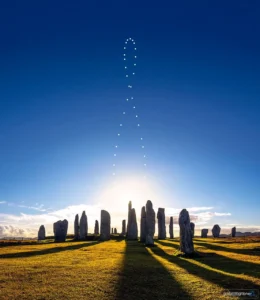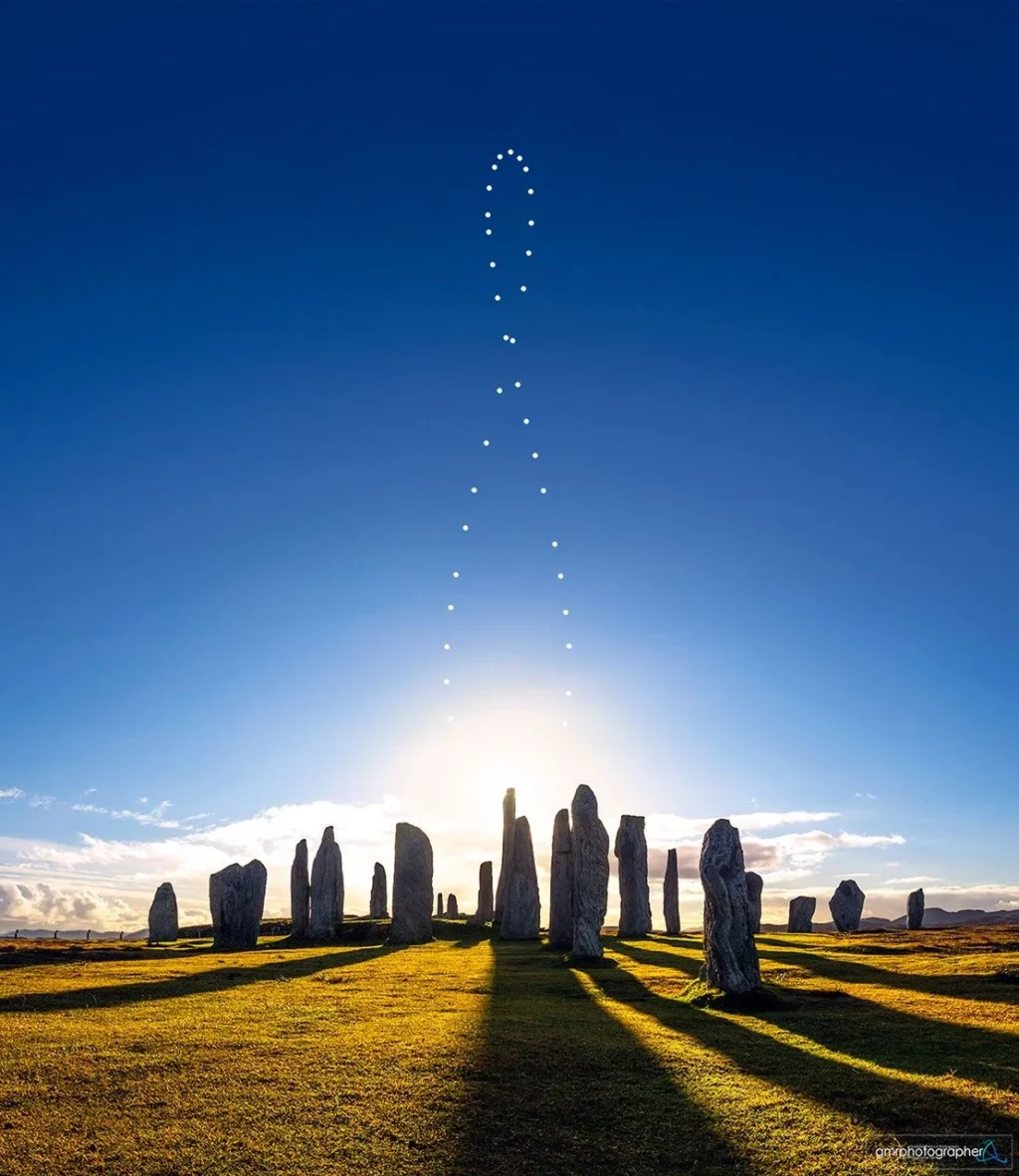
The celestial ballet of our planet’s journey around the Sun, combined with its axial tilt, has been captured in a breathtaking composite image showcasing an analemma over the ancient Callanish Stones in Scotland. This striking visual, presented as the Astronomy Picture of the Day (APOD) on September 20, 2026, offers a profound glimpse into the Earth’s orbital mechanics and its historical connection to human observation and monumental architecture. The photograph, a meticulous compilation of images taken at noon every few days over a year, reveals the Sun’s apparent path through the sky as a distinctive figure-eight shape, a phenomenon known as an analemma.
Understanding the Analemma: A Year-Long Solar Symphony
An analemma is not a direct observation of a single day, but rather a composite image that reveals the Sun’s precise position in the sky at the same time and from the same location over an extended period, typically a full year. In this particular featured image, the composite was constructed from photographs taken near the village of Callanish in the Outer Hebrides of Scotland, a region steeped in history and known for its prehistoric stone circles. The midday Sun, meticulously tracked, traces out a characteristic figure-eight pattern.
The creation of an analemma is a testament to the consistent, yet subtly changing, relationship between the Earth and its star. The distinct shape arises from two fundamental astronomical facts: the tilt of the Earth’s axis and the elliptical nature of Earth’s orbit around the Sun.
- Earth’s Axial Tilt: Our planet is not upright as it orbits the Sun; it is tilted at an angle of approximately 23.5 degrees. This tilt is the primary driver of our seasons. As the Earth orbits, different hemispheres are tilted towards or away from the Sun, leading to variations in the amount of direct sunlight received. This tilt causes the Sun’s apparent position in the sky to shift both north and south throughout the year, contributing to the vertical extent of the analemma.
- Earth’s Elliptical Orbit: The Earth’s orbit is not a perfect circle but an ellipse. This means that at certain times of the year, the Earth is closer to the Sun (perihelion, typically around January 3rd), and at other times, it is farther away (aphelion, typically around July 4th). While the distance variation is relatively small (about 3%), it affects the Earth’s orbital speed. According to Kepler’s laws of planetary motion, the Earth moves faster when it is closer to the Sun and slower when it is farther away. This variation in speed, coupled with the axial tilt, causes the Sun’s apparent position at noon to drift slightly east and west over the course of the year, creating the horizontal loops of the figure-eight.
The analemma’s apexes, the top and bottom points of the figure-eight, correspond to the solstices. The summer solstice, the longest day of the year, sees the Sun reach its highest point in the analemma, while the winter solstice, the shortest day, marks its lowest point. The points where the analemma crosses itself represent the equinoxes – the spring (vernal) and autumnal equinoxes – when day and night are of roughly equal length across the globe. It is important to note that the equinox points are not the intersection point itself but rather the mid-points of the analemma’s vertical path.
The featured analemma was captured near the December solstice, explaining why the Sun appears at the lower part of the figure-eight in the photograph. This celestial phenomenon is a constant, observable for any observer willing to dedicate the time and effort to meticulously track the Sun’s position.
A Glimpse into Prehistory: The Callanish Stones
The backdrop for this astronomical display is equally significant: the Callanish Stones. This ancient stone circle, located on the west coast of the Isle of Lewis in the Outer Hebrides, Scotland, is a remarkable archaeological site. Radiocarbon dating suggests that the stones were erected around 2700 BC, placing their construction firmly within the Bronze Age, a period of significant technological and societal development in human history.
The Callanish Stones are comprised of a central standing stone, surrounded by a ring of twelve stones, with a further eleven stones forming a cross-like avenue leading away from the circle. The exact purpose and meaning behind the construction of these megalithic structures remain a subject of scholarly debate and fascination. While their alignment with celestial events, particularly the solstices and the Moon’s cycles, has been a focal point of research, definitive proof of astronomical intent for all aspects of their placement is elusive.
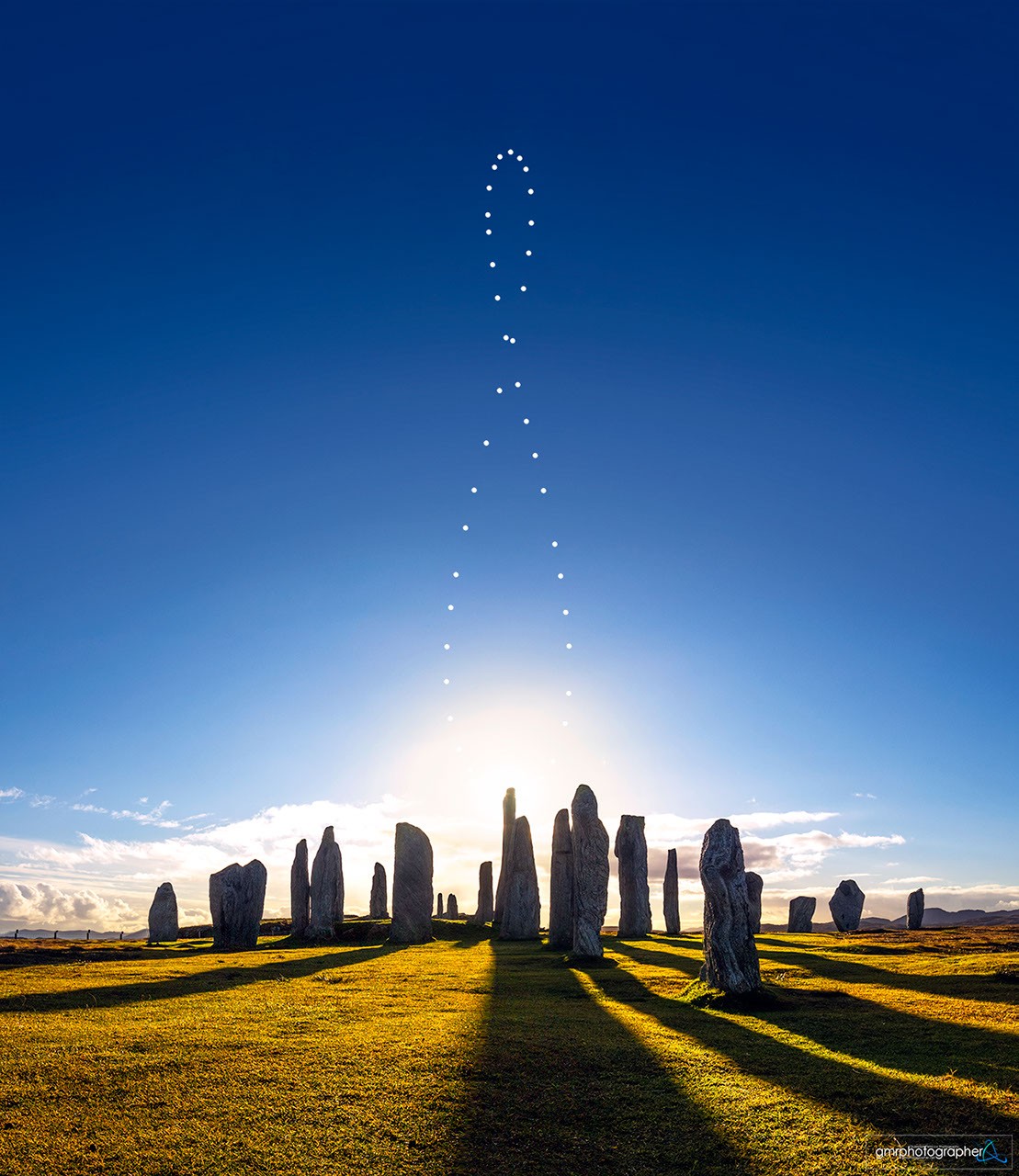
The juxtaposition of the analemma, a phenomenon dictated by the fundamental mechanics of our solar system, with the Callanish Stones, a testament to early human ingenuity and their potential observation of the cosmos, creates a powerful dialogue between ancient wisdom and modern scientific understanding. It prompts reflection on how early civilizations perceived and interacted with the celestial sphere, and whether their monumental constructions served as markers of cosmic events, calendars, or perhaps held deeper, spiritual significance yet to be fully understood.
The Role of APOD: Illuminating the Universe Daily
The Astronomy Picture of the Day (APOD) initiative, a project of NASA, has been instrumental in bringing the wonders of the universe to the public for decades. Each day, a different image or photograph of our fascinating universe is featured, accompanied by a brief explanation crafted by professional astronomers. This daily dissemination of astronomical knowledge fosters public interest and understanding of science.
APOD’s main NASA site is undergoing a transition, moving from its long-standing address at apod.nasa.gov to the more centralized science portal at science.nasa.gov/apod. This migration signifies an ongoing effort to consolidate and streamline NASA’s vast array of scientific outreach resources.
The featured analemma image was captured by Giuseppe Petricca, a photographer who has contributed to the APOD archive, and the accompanying explanation was authored by Robert Nemiroff, Jerry Bonnell, Cecilia Chirenti, and Keighley Rockcliffe, a dedicated team of editors and scientists. Their collective efforts ensure that complex astronomical concepts are made accessible to a broad audience.
Broader Implications and Future Reflections
The image of the analemma over the Callanish Stones serves as a potent reminder of humanity’s enduring connection to the cosmos. It highlights how the same celestial mechanics that guided ancient peoples in their understanding of time and seasons continue to shape our world today. The scientific analysis of the analemma, rooted in precise measurements and mathematical principles, allows us to deconstruct and appreciate the intricate workings of our solar system.
This image also underscores the importance of preserving ancient sites like the Callanish Stones. These structures are not merely relics of the past; they are physical manifestations of human curiosity and our earliest attempts to comprehend our place in the universe. Their presence, particularly in conjunction with phenomena like the analemma, encourages us to bridge the gap between historical observation and contemporary scientific inquiry.
As we move forward, the ongoing exploration of space and the continued refinement of our understanding of celestial mechanics will undoubtedly unveil further layers of complexity and beauty in the universe. The analemma, a seemingly simple yet profound representation of Earth’s orbital dance, stands as a timeless symbol of this ongoing journey of discovery, connecting us to both the ancient past and the boundless future of astronomical exploration. The fact that this image was taken near the December solstice, a time when the Sun is at its lowest point in the analemma, also serves as a poignant reminder of the cyclical nature of time and the changing seasons, a rhythm that has governed life on Earth since its inception. The upcoming equinox, just two days after the publication of this APOD, further emphasizes this theme of seasonal transition and the balanced interplay of day and night across the planet. This celestial event, celebrated by cultures worldwide, marks another significant point in Earth’s journey around the Sun, reinforcing the universal significance of these astronomical cycles.