The European Space Agency’s (ESA) ambitious terrestrial planet hunter, Plato, has successfully navigated a critical phase of its pre-launch preparations, demonstrating the robust functionality of its electronic systems within the specialized Maxwell Test Chamber at ESA’s ESTEC facility. This milestone signifies a significant step forward for the mission, ensuring that Plato’s intricate instrumentation is shielded from electromagnetic interference and capable of operating reliably in the unforgiving environment of space. The completion of these tests marks the final major hurdle for the spacecraft before it can officially “graduate” for its scheduled March 2027 launch aboard an Ariane 6 rocket.
Rigorous Testing in an Electromagnetic Sanctuary
The Maxwell Test Chamber, located at ESTEC, the European Space Research and Technology Centre, is no ordinary testing facility. It is a marvel of engineering designed to simulate the extreme electromagnetic conditions that a spacecraft will encounter beyond Earth’s protective atmosphere. The chamber itself is a shielded enclosure, meticulously constructed with conducting metal walls, floor, and ceiling, effectively creating a Faraday cage. This design is paramount for screening out all external electromagnetic interference, which could otherwise contaminate sensitive measurements or disrupt the delicate operation of onboard electronics.
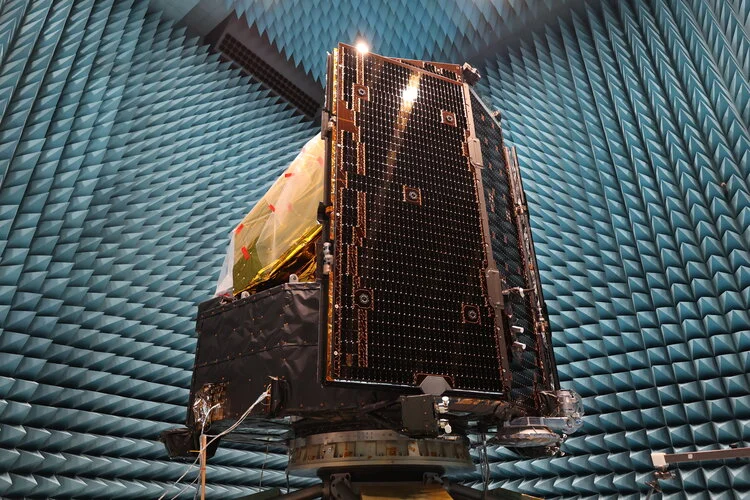
Within this sanctuary of silence, the 9-meter-high interior is further enhanced by an array of foam spikes lining every surface from floor to ceiling. These specially designed spikes are engineered to absorb electrical signals and sounds, thereby mimicking the near-perfect vacuum and lack of ambient electromagnetic noise found in space. It is within this meticulously controlled environment that Plato’s complex electronic heart was put to the ultimate test.
Engineers, operating remotely, initiated and commanded Plato’s electronic equipment once the chamber was sealed. The tests involved activating a comprehensive suite of instruments and modules, systematically observing their interactions. The primary objective was to verify that no single component or system would interfere with another, and crucially, that they would not disrupt the mission’s essential communication systems. This meticulous process is designed to prevent unwanted “crosstalk,” a phenomenon where signals from one electronic device bleed into another, potentially corrupting data or causing malfunctions.
The Critical Importance of Electromagnetic Compatibility in Space
The decision to conduct such rigorous electromagnetic compatibility (EMC) testing is rooted in the fundamental differences between operating electronics in a controlled laboratory setting on Earth and in the harsh vacuum of space. On Earth, the atmosphere and Earth’s magnetic field provide a degree of natural shielding. However, in space, without these protective layers, a spacecraft’s electronics can behave unpredictably. The absence of air means that heat dissipation mechanisms differ, and the lack of atmospheric interference allows for the amplification of any generated electromagnetic fields.
Without thorough EMC testing, the consequences of electromagnetic interference in space can be severe. They can range from subtle data corruption that could compromise the scientific integrity of a mission, to catastrophic failures that could render entire systems inoperable, jeopardizing the mission’s objectives and potentially leading to the loss of the spacecraft. For a mission as scientifically significant as Plato, which is designed to discover and characterize exoplanets, ensuring the flawless operation of its sensitive instruments is paramount.
The successful verification that Plato’s numerous electronic systems can coexist and function harmoniously in space, free from detrimental interference, is a testament to the meticulous design and engineering that has gone into the spacecraft. This electromagnetic compatibility is not merely a technical requirement; it is a foundational element for mission success.
A Phased Approach to Readiness: From Vibration to the Void
The electromagnetic compatibility testing is the culmination of a series of demanding examinations that Plato has undergone throughout the year, designed to ensure its readiness for the rigors of spaceflight and its operational life. These rigorous tests are often colloquially referred to as “exams” within the space agency, highlighting their critical nature in assessing the spacecraft’s preparedness.
The gauntlet of tests began in January of the current year with vibration and acoustic testing. These simulations replicate the intense forces and sounds experienced during a rocket launch. The sheer power of a launch vehicle, such as the Ariane 6 that will carry Plato into orbit, generates vibrations that can be incredibly destructive. Acoustic testing further assesses the spacecraft’s resilience to the deafening roar of engines. Passing these tests indicates that Plato’s structure and internal components are robust enough to withstand the violent ascent into space without structural damage or the loosening of critical parts.
Following the vibration and acoustic assessments, Plato spent a month immersed in the simulated conditions of space within the Large Space Simulator (LSS). This colossal facility is designed to replicate the extreme thermal and vacuum conditions of space. The LSS is capable of creating a high vacuum, mirroring the near-emptiness of space, and can precisely control temperature, simulating the intense heat of direct sunlight and the frigid cold of shadow. Plato’s performance in the LSS was particularly impressive, with the spacecraft acing a demanding set of tests that demonstrated its ability to withstand the harsh thermal cycles and vacuum of its operational environment. This ensured that its thermal control systems and materials are fit for purpose.
The recent completion of the Maxwell Test Chamber’s EMC tests represents the final major hurdle in this comprehensive suite of examinations. With compatibility confirmed, Plato has now successfully passed all the essential "exams" that qualify it for launch.
Plato’s Mission: Unveiling Earth-like Worlds
Plato, which stands for PLAnetary Transits and Oscillations of stars, is a cornerstone of ESA’s Science Programme. Its primary objective is to discover and study exoplanets orbiting stars in our solar neighborhood, with a particular focus on identifying planets that are similar in size to Earth and reside within their star’s habitable zone. The habitable zone is the region around a star where conditions might be right for liquid water to exist on a planet’s surface, a key ingredient for life as we know it.
The spacecraft will employ the transit method, observing the slight dimming of a star’s light as a planet passes in front of it. However, Plato’s innovative approach goes beyond simple transit detection. It will also utilize the asteroseismology technique, studying the oscillations (or "starquakes") of stars. These oscillations provide valuable information about a star’s internal structure, mass, and radius, which in turn allows for a more precise determination of the properties of any transiting exoplanets. This dual approach is expected to yield an unprecedented sample of rocky, Earth-like exoplanets, some of which could potentially harbor life.
The mission is designed to observe up to 1,000 stars, targeting brighter, Sun-like stars at relatively close distances, typically within 300 light-years. This proximity and brightness are crucial for detailed follow-up studies by ground-based telescopes and future space missions, allowing scientists to characterize the atmospheres of potentially habitable exoplanets.
A Promising Future on Ariane 6
Plato’s journey to its launch pad will be aboard an Ariane 6 rocket, a testament to the continued collaboration between ESA and its industrial partners. The launch is scheduled by Arianespace for March 2027. The Ariane 6, Europe’s next-generation launch vehicle, is designed to provide flexible and cost-effective access to space for a wide range of missions. Its successful deployment of Plato will mark a significant achievement for the European space sector.
The image accompanying this report depicts Plato within the cavernous Maxwell Test Chamber. The spacecraft, partially clad in reflective gold-colored insulating foil and a translucent protective sheet, stands at the center of the chamber, dwarfed by the surrounding walls covered in dense rows of blue foam spikes. These spikes are not merely decorative; they are essential components of the chamber’s sound and signal absorption capabilities, creating the sterile electromagnetic environment required for such critical testing. The stowed solar panels, a prominent feature on the right side of the spacecraft, are a reminder of its future energy source once it begins its long voyage through space.
With its electromagnetic compatibility assured and all major pre-launch tests successfully completed, Plato is now poised to embark on its groundbreaking mission. The successful navigation of these rigorous testing phases underscores ESA’s commitment to scientific exploration and its dedication to ensuring the reliability and success of its most ambitious missions. The scientific community eagerly awaits the data Plato will provide, as it promises to revolutionize our understanding of exoplanets and the potential for life beyond Earth.