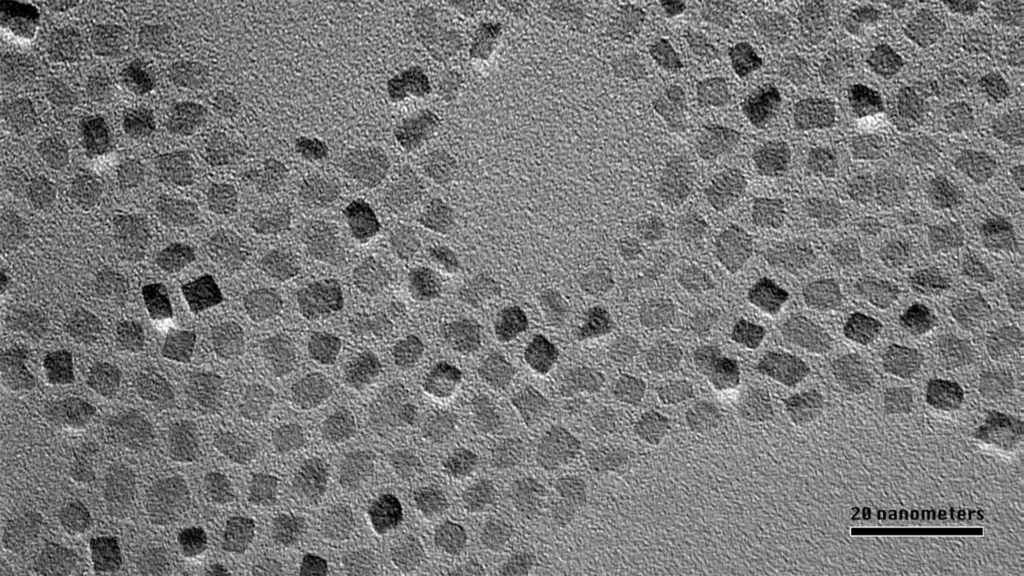
Nanocrystals have become an important part of modern materials science, with quantum dots helping inspire the 2023 Nobel Prize in Chemistry. Yet despite their enormous potential, researchers have only been able to produce these microscopic crystals from a relatively narrow range of materials. Now, chemists at the University of Chicago and Argonne National Laboratory have developed a method for creating nanocrystals from metal nitrides, a technologically important group of materials that had resisted conventional nanocrystal synthesis. The study, published in Nature, could expand the possibilities for electronics and other applications, including flexible lighting and medical implants.
"We were able to show how to make a series of nearly a dozen materials that could not be synthesized by traditional methods," said Ruiming Lin, a graduate student at UChicago and first author on the new paper. This groundbreaking achievement addresses a significant bottleneck in materials science, potentially paving the way for a new generation of advanced materials with unprecedented properties.
The Unlocking of Metal Nitride Nanocrystals
Metal nitrides are a class of chemical compounds formed by the union of a metal element with nitrogen. These materials are already deeply embedded in our technological landscape, underpinning many of the devices we rely on daily. Gallium nitride (GaN), for instance, is a cornerstone of modern lighting technology, powering everything from energy-efficient LED bulbs that illuminate our homes and cities to the vibrant displays on our laptops and smartphones. Its remarkable properties, including high brightness, durability, and energy efficiency, have made it indispensable.
Beyond lighting, metal nitrides boast a diverse range of applications. Titanium nitride (TiN) is widely used in medical implants due to its biocompatibility and wear resistance, often found in orthopedic devices and dental prosthetics. Niobium nitride (NbN) is a crucial component in superconducting magnets and sensitive detectors, vital for advanced scientific research and medical imaging technologies like MRI machines. Molybdenum nitride (MoN) serves as a potent catalyst in various industrial chemical processes, enhancing reaction rates and efficiency.
The inherent strength, stability, biocompatibility, and resistance to heat and corrosion that make these metal nitrides so valuable also present a formidable challenge when it comes to manipulating them at the nanoscale. Conventional methods for creating nanocrystals, which involve carefully controlling the assembly of atoms and molecules into tiny, precisely structured crystals, have historically failed to yield usable metal nitride nanocrystals. This limitation meant that the unique quantum mechanical properties exhibited by materials at the nanoscale—properties that can lead to enhanced light emission, improved catalytic activity, or novel electronic behaviors—remained largely inaccessible for this important class of compounds.
The inability to produce metal nitride nanocrystals meant that their potential applications were largely confined to rigid films and bulk materials. Imagine the limitations: instead of being able to integrate these advanced materials seamlessly into flexible electronics, embed them within innovative textiles, or utilize them in advanced biomedical devices, their use was restricted. This new research, however, shatters those limitations, opening up a universe of possibilities.
"This expands the boundaries of the field beyond what were previously fundamental constraints, and lays the foundation for the use of nitrides as nanomaterials," stated Dmitri Talapin, the Ernest DeWitt Burton Distinguished Service Professor of Chemistry and Molecular Engineering at UChicago and a scientist at Argonne, who served as the senior author on the paper. His statement underscores the profound impact this discovery could have on materials science and related industries.
The Profound Utility of Nanocrystals
Nanocrystals, at their core, are miniscule crystalline structures, so small that billions of them could fit onto the surface of a single fingernail. Their diminutive size is not merely a matter of scale; it fundamentally alters their material properties. At this nanoscale, materials can exhibit extraordinary behaviors that are not observed in their bulk counterparts. This phenomenon is driven by quantum mechanical effects, where electrons are confined to tiny spaces, leading to altered energy levels and unique optical and electronic characteristics.
For example, quantum dots, a well-known type of nanocrystal, are celebrated for their tunable light-emitting properties. The color of light they emit can be precisely controlled by adjusting their size, a discovery that was recognized with the 2023 Nobel Prize in Chemistry. This tunability has revolutionized display technologies, enabling brighter, more energy-efficient screens. Similarly, nanocrystals can exhibit dramatically enhanced catalytic activity, meaning they can accelerate chemical reactions far more effectively than larger particles. This is crucial for developing more efficient industrial processes and cleaner energy technologies.
In principle, the vast array of elements and compounds that make up our material world should be capable of forming nanocrystals. However, the practical reality has been far more constrained. The delicate balance of forces and the precise atomic arrangements required for nanocrystal formation are difficult to achieve for many substances. The inherent chemical bonds, the thermodynamics of crystal growth, and the kinetics of atomic rearrangement all play critical roles. For some materials, these factors conspire to make conventional synthesis methods either inefficient, impossible, or prone to producing flawed, non-crystalline structures.
It was this very challenge that motivated Lin and his colleagues in Talapin’s laboratory. Their research was driven by a desire to push past these existing barriers and unlock the potential of materials that had previously eluded nanoscale manipulation.
Their focus gravitated towards metal nitrides. As a class, these compounds possess a compelling combination of desirable traits: exceptional strength, proven biocompatibility for medical applications, and remarkable resistance to both high temperatures and corrosive environments. These properties make them highly sought after for a wide spectrum of technological applications, from high-performance coatings to advanced electronics and biomedical devices. Yet, it is precisely the robustness of the chemical bonds within these materials that makes them so notoriously difficult to break down and reform into the precise, ordered structures of nanocrystals.
The Formidable Challenge of Strong Bonds
The process of crystal formation, particularly at the nanoscale, requires a delicate dance of atoms. During the growth phase, the constituent ions or atoms within a material must possess sufficient mobility to rearrange themselves into the specific, ordered lattice structure that defines a crystal. This dynamic process can be conceptually likened to partners in a square dance momentarily stepping out of formation to change partners before settling back into a new arrangement.
In the case of metal nitrides, the chemical bonds between the metal and nitrogen atoms are exceptionally strong. This inherent strength significantly restricts the freedom of movement for these ions. They are far less willing to break their existing bonds and reconfigure themselves into the desired crystalline architecture.
"If bonds cannot break during this process, that’s a death sentence for nanocrystals," explained Talapin, highlighting the critical nature of this challenge. "Once you make an incorrect bond, everything goes south." The inability for the atomic structure to properly organize during formation leads to defects, amorphous structures, or simply the failure to form any crystalline material at all.
Overcoming this fundamental hurdle required a paradigm shift in thinking and a series of innovative solutions. The researchers at UChicago and Argonne attribute their success to two key advancements that together circumvented the issue of strong nitride bonds.
Firstly, the team built upon a prior discovery within Talapin’s laboratory. This earlier work had established that employing molten salts as the liquid medium during nanocrystal synthesis could be a crucial factor in stabilizing the nascent nanocrystals as they formed. Molten salts, at elevated temperatures, provide a unique chemical environment that can influence the surface chemistry and aggregation behavior of growing nanocrystals, preventing them from clumping together or degrading.
However, the molten salt approach alone was not sufficient to overcome the inherent bond strength of metal nitrides. The researchers then embarked on an extensive period of experimentation, meticulously testing a wide range of conditions. This painstaking process involved systematically varying parameters such as temperature and the pressure of ammonia (a key precursor in nitride synthesis). Their persistent efforts led them to identify a critical "sweet spot." Within this specific window of temperature and ammonia pressure, the otherwise recalcitrant bonds between metal and nitrogen atoms were coaxed into a state where they could break and reform more readily. This delicate balance allowed the crystal structure to organize itself properly, leading to the successful formation of ordered metal nitride nanocrystals.
"This process is very unusual—it goes against every bit of common sense in the field," admitted Talapin, underscoring the counterintuitive nature of their breakthrough. "We had to entirely rethink the approach." This required moving beyond established methodologies and embracing a novel understanding of the chemical dynamics at play.
A Cascade of Nearly a Dozen New Nanocrystal Materials
The significance of this breakthrough is amplified by its broad applicability. The developed method proved effective not just for gallium nitride, but for a spectrum of related nitride materials. This expansion is a testament to the robustness and generalizability of the newly discovered synthesis strategy.
Among the successful syntheses were titanium nitride (TiN) nanocrystals, which are already in use in demanding applications such as medical implants due to their biocompatibility and resistance to wear and corrosion. The ability to produce TiN in nanocrystal form could lead to enhanced performance and new integration possibilities for these implants, potentially improving patient outcomes and enabling more sophisticated designs.
Niobium nitride (NbN) nanocrystals were also successfully synthesized. NbN is an indispensable material in high-technology fields, particularly as an industrial superconductor. Superconductors are materials that can conduct electricity with zero resistance, a property crucial for advanced technologies like particle accelerators, magnetic resonance imaging (MRI) machines, and next-generation computing. Producing NbN in nanocrystal form could unlock new avenues for creating more efficient and compact superconducting devices.
Furthermore, the team achieved the synthesis of molybdenum nitride (MoN) nanocrystals. MoN is commonly employed as a catalyst in a variety of chemical reactions, playing a vital role in industries ranging from petrochemicals to pharmaceuticals. Nanocrystal catalysts often exhibit significantly higher surface areas and unique electronic properties compared to their bulk counterparts, leading to enhanced catalytic efficiency and selectivity. This could translate to more sustainable and cost-effective chemical manufacturing processes.
The successful synthesis of these diverse metal nitride nanocrystals is not just a scientific achievement; it represents a significant expansion of the toolkit available to materials scientists and engineers. These materials are not only technologically important but also relatively abundant and cost-effective, making their transition into nanocrystal form particularly promising for widespread adoption.
Researchers are optimistic that by transforming these established materials into nanocrystals, it will become possible to leverage their unique properties in an even wider array of cutting-edge technologies. This could include their incorporation into flexible electronic circuits, advanced sensors, novel energy storage devices, and enhanced catalytic converters, among many other possibilities.
"I remember the first time I looked through the electron microscope and saw those crystals," shared Lin, recalling the pivotal moment of discovery. "You always hope something you discovered will wind up in applications. I think there will be many uses." This sentiment reflects the deep satisfaction of translating fundamental scientific research into tangible technological advancements that can benefit society.
Broader Implications and Future Directions
The implications of this breakthrough extend far beyond the immediate scientific community. The ability to synthesize nanocrystals from a previously inaccessible class of materials like metal nitrides opens up a wealth of new possibilities for innovation across numerous sectors.
In the realm of electronics, metal nitride nanocrystals could pave the way for more flexible, durable, and energy-efficient devices. Imagine wearable electronics that are seamlessly integrated into clothing, or advanced displays that can be rolled up or folded. The inherent stability and conductivity of nitrides, when harnessed at the nanoscale, could revolutionize battery technology, enabling faster charging and longer-lasting power sources.
The medical field stands to gain considerably as well. The biocompatibility of materials like titanium nitride, coupled with the unique properties of nanocrystals, could lead to the development of next-generation medical implants with improved integration into the human body and enhanced functionality. Furthermore, metal nitride nanocrystals might find applications in targeted drug delivery systems or advanced diagnostic tools, offering new hope for treating diseases and improving patient care.
The lighting industry, already transformed by quantum dots, could see further innovation with the incorporation of metal nitride nanocrystals. Their potential for efficient light emission, combined with their durability, might lead to even more robust and versatile lighting solutions, including specialized applications for agriculture, horticulture, and advanced scientific instrumentation.
Beyond these specific areas, the discovery has broader implications for materials science education and research. It challenges existing assumptions about the limitations of nanocrystal synthesis and encourages a re-evaluation of other material classes that may have been previously overlooked due to perceived synthetic difficulties. This could spur further research into analogous challenges and lead to a cascade of new discoveries.
The collaborative nature of this research, involving both the University of Chicago and Argonne National Laboratory, highlights the power of interdisciplinary partnerships in driving scientific progress. The access to state-of-the-art facilities and the expertise of researchers from both institutions were instrumental in achieving this complex synthesis.
The list of contributing authors from the University of Chicago underscores the depth of talent and dedication involved in this project: Ningxin Jiang, Wooje Cho, Zirui Zhou, Di Wang, Justin Ondry, Zehan Mi, James Cassidy, Alex Hinckle, Alexander Filatov, and John S. Anderson. Their collective efforts, under the guidance of Professor Talapin, have yielded a discovery with the potential to reshape technological landscapes.
The scientists utilized critical resources at the UChicago-based National Science Foundation Materials Research Science and Engineering Center, the UChicago Soft Matter Characterization Facility, and Argonne’s Center for Nanoscale Materials. These advanced facilities provided the essential infrastructure for characterization, analysis, and experimentation, proving indispensable for the success of the research.
The funding for this groundbreaking work was provided by esteemed organizations, including the U.S. Department of Energy, the Samsung QD Cluster Collaboration, the National Science Foundation, and the Air Force Office of Scientific Research. This support signifies the national importance and broad potential impact of the research, aligning with strategic goals in energy, advanced materials, and national security.
As this new method for producing metal nitride nanocrystals matures, it is poised to unlock a new era of material innovation, promising significant advancements across a wide spectrum of technological applications and scientific endeavors. The journey from fundamental discovery to widespread application is often long, but this breakthrough represents a crucial and exciting first step.