In the suburban classrooms of Edina, Minnesota, the traditional boundaries between creative writing and technical programming are beginning to blur, signaling a transformative shift in how foundational digital skills are delivered to the next generation. At Highlands Elementary, fifth-grade teacher Allison Knoph has reimagined her creative writing station not as a place of silent introspection, but as a vibrant hub of collaborative engineering. By integrating "Experience CS"—a standards-aligned computer science curriculum designed for students aged 8 to 14—Knoph is demonstrating that the logic of coding and the art of storytelling are two sides of the same cognitive coin. This approach comes at a critical juncture for Minnesota, a state currently grappling with some of the lowest rates of computer science access in the United States, and highlights a growing national movement to embed computational thinking into the core of primary education.
The Evolution of the Creative Writing Station
The implementation of computer science (CS) within a fifth-grade classroom typically suggests a dedicated lab or a specialized "tech hour." However, Knoph’s model integrates these skills into the existing Language Arts framework. During the month of October, her creative writing station becomes the most animated part of the room. Students use computers not merely for word processing, but for building interactive projects where they program characters, script dialogue, and test comedic timing through code.
The curriculum used, Experience CS, is developed to be modular and adaptable. It allows students to engage with computing through the lens of subjects they are already studying, such as math, science, and art. In Knoph’s classroom, the integration is seamless. Students are tasked with building narratives that require them to understand the sequence of events—a fundamental concept in both literary plot development and algorithmic logic. When a student writes a joke for a character they have programmed, they must ensure the "trigger" for the punchline is correctly sequenced within the code. The resulting laughter in the classroom is, as Knoph describes it, "a good problem to have," serving as an audible indicator of high student engagement and successful logic execution.
Comparative Curriculum Analysis: The Me Project and Ecosystems
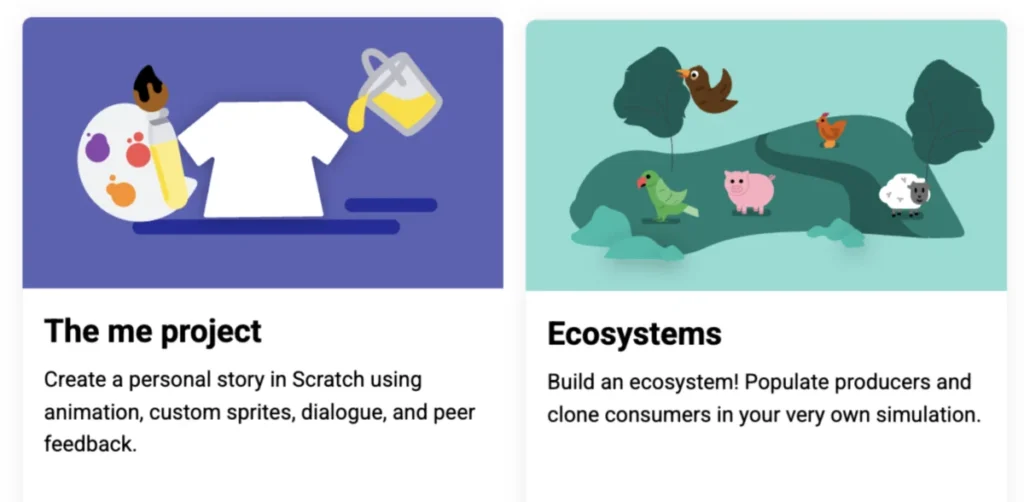
To understand the efficacy of integrated CS, it is necessary to examine the specific units deployed in the classroom. Knoph has utilized two distinct modules: "The Me Project" and "Ecosystems."
"The Me Project," designed for children aged 9 to 10, focuses on identity and storytelling. This unit proved to be an exceptional fit for the fifth-grade level because it mirrors the personal narrative work common in upper elementary language arts. The structure of the project provides "signposts"—specific technical or thematic goals—while leaving the internal creative content entirely to the student. This flexibility allows for natural differentiation in the classroom. One student might complete the basic requirements of the project, while another might spend weeks developing a multi-scene digital odyssey complete with custom sound effects and complex branching paths.
In contrast, the "Ecosystems" unit, designed for a slightly older demographic (ages 12 to 13), presented a more significant challenge. While students who were particularly motivated by technical challenges thrived, the unit required a higher level of abstract reasoning and scientific application. This disparity underscores a vital lesson for educators: the successful integration of computer science depends heavily on "placement." For CS to feel like a natural extension of learning rather than an intrusive add-on, it must align with the cognitive development and existing subject matter of the grade level.
Breaking Academic Hierarchies through Peer Support
One of the most significant observations from the Edina classroom is the way computer science levels the academic playing field. Knoph noted that students who often struggle with traditional curriculum components, such as reading comprehension or standardized testing, frequently emerge as leaders during CS modules.
In one instance, a student with significant reading difficulties demonstrated an intuitive grasp of program sequencing. While they might have struggled to parse a complex paragraph, they could visualize the logical flow of a script with ease. Within a week of starting the Experience CS unit, this student became a classroom resource. Other students, including those who typically excelled in traditional subjects, began seeking help from their peer.
This "peer support model" is a natural byproduct of the trial-and-error nature of coding. Because the teacher is not positioned as the sole arbiter of "correct" code, students feel empowered to collaborate and problem-solve amongst themselves. This shift in classroom dynamics builds a culture of "we can figure it out," a mindset that Knoph observes transferring into other subjects like mathematics and social studies.
The Minnesota Context: A Statistical Outlier in Tech Education
The urgency of Knoph’s work is framed by Minnesota’s standing in the national landscape of tech education. Despite being home to a robust "Medical Alley" and numerous Fortune 500 tech and manufacturing companies, Minnesota has historically lagged in providing foundational computer science education.
According to the most recent "State of Computer Science Education" reports, Minnesota ranks near the bottom of the country for high school CS access. Only 34 percent of its public high schools offer a foundational computer science course, significantly lower than the national average of 60 percent. This gap creates a "pipeline" issue where students from other states arrive at universities or the workforce with a decade more exposure to computational thinking than their Minnesota-raised counterparts.
In response to these figures, the Minnesota legislature recently passed the 2023 Computer Science Education Act (HF 2497), which aims to develop a long-term strategy for state-wide CS integration. However, as the state works to build its high school infrastructure, educators like Knoph argue that the introduction must happen much earlier. By embedding these skills in the fifth grade, schools can ensure that every student—regardless of their future high school electives—has a basic level of digital literacy.
Computational Thinking in the Age of Generative AI
The debate over the necessity of coding often centers on the rise of Artificial Intelligence (AI). Critics argue that if AI can generate code, humans no longer need to learn the syntax. However, Knoph’s experience, corroborated by the Raspberry Pi Foundation’s 2025 position paper, suggests the opposite.
As AI tools make it easier to generate blocks of code, the ability to read, judge, and debug that code becomes more valuable, not less. Knoph illustrated this through her son’s experience on a robotics team. Students who merely "dropped in" AI-generated code were helpless when the robot performed unexpectedly during a competition. Conversely, the students who understood the underlying logic—the "computational thinking"—were able to adapt and fix the errors.
Computational thinking involves several key components that are applicable far beyond a computer screen:
- Decomposition: Breaking a complex problem into smaller, manageable parts.
- Pattern Recognition: Identifying similarities between problems.
- Abstraction: Focusing on the important information while ignoring irrelevant details.
- Algorithms: Developing a step-by-step solution to the problem.
These are the same skills used in writing a persuasive essay or solving a multi-step word problem in math. By teaching coding as a form of "structured writing," Knoph is preparing students to be critical consumers of technology rather than just passive users.
Addressing the Barriers for Elementary Educators
If the benefits of early CS integration are so clear, why isn’t every classroom following suit? Knoph is candid about the barriers facing her colleagues. Elementary teachers are often generalists who are already stretched thin by shifting literacy and math standards. The three primary hurdles are time, cost, and the "fear of the unknown."
The "Experience CS" model addresses these concerns directly:
- Cost: The curriculum is provided free of charge, removing the budgetary constraints that often stall tech initiatives in public schools.
- Time: Because the units are designed to meet existing standards in math and science, they do not require "finding more time" in the day; they simply change how existing time is used.
- Expertise: The curriculum is designed with "little direct instruction" required. Teachers do not need to be master programmers; they need to be facilitators who are comfortable saying, "I don’t know, let’s figure it out together."
Conclusion: The Long-Term Impact of "Figure it Out"
The long-term goal of programs like Experience CS is not necessarily to turn every child into a professional software engineer. Rather, it is to provide them with a toolkit for the modern world. In a state like Minnesota, where the digital divide remains a significant hurdle to economic equity, early exposure to computer science is a matter of social justice as much as it is a matter of education.
When Allison Knoph’s students leave her classroom at the end of the year, they carry with them more than just a few finished coding projects. They carry a newfound confidence in their ability to navigate complex, logic-based systems. They have learned that failure is simply a "bug" that needs to be "debugged," and that persistence is the most important skill in any field.
As the state moves toward a more comprehensive plan for computer science education, the grassroots success in Edina serves as a blueprint. It proves that with the right resources and a willingness to embrace the "loudness" of creative problem-solving, even the youngest students can become masters of the digital world. The shift from "I can’t do this" to "we can figure it out" is the ultimate output of the program—a result that is as valuable in a creative writing station as it is in the global tech economy.