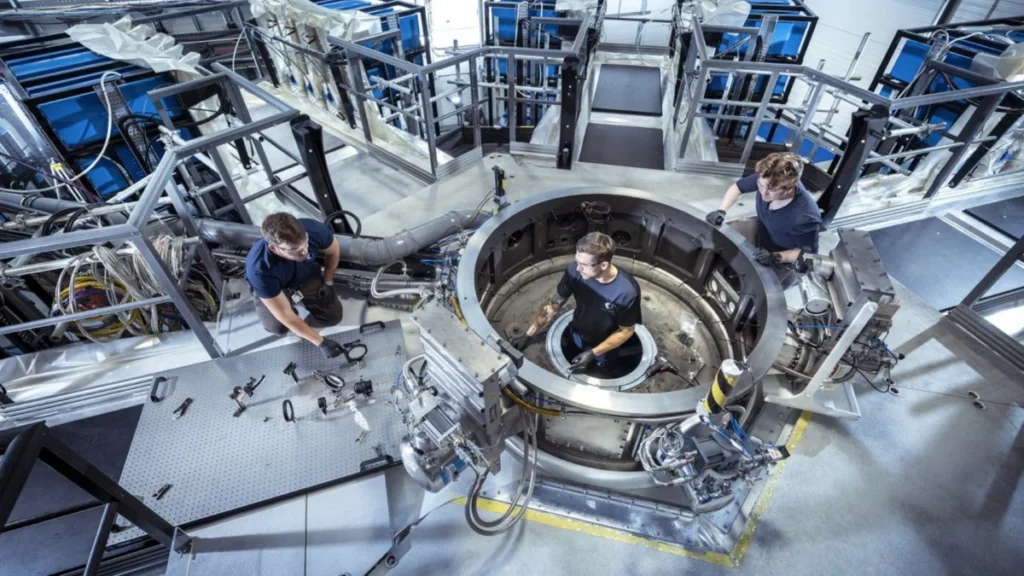
A significant milestone has been achieved in the pursuit of commercially viable fusion energy, with British company First Light Fusion successfully demonstrating the fundamental fuel compression principle that underpins its proprietary FLARE (Fusion Line Assembled Reactor) approach to inertial fusion. This pivotal validation took place during a series of experiments conducted on M3, the company’s advanced in-house pulsed power facility. This breakthrough represents a crucial step in de-risking the path toward affordable and scalable fusion power, a long-sought solution to global energy demands.
The Innovative FLARE Approach: Separating Compression and Ignition
First Light Fusion’s FLARE system distinguishes itself from conventional inertial confinement fusion (ICF) methods by intelligently separating the two primary steps required for fusion: first, compressing the fuel to extreme densities, and subsequently, rapidly igniting it. This sequential approach mirrors the operational principle of an internal combustion engine, which first compresses fuel before a spark plug initiates ignition. In the context of FLARE, the system first assembles the fusion fuel to a high-density state, followed by a distinct, rapid burst of energy designed to trigger the fusion reaction itself. The recent experiments on the M3 facility were specifically engineered to validate the efficacy of this crucial initial stage – the compression of fuel to high densities utilizing a comparatively simpler, lower-power driver.
"This experiment validates a central principle of FLARE: that we can simplify the machine by putting more functionality into the target," stated Mark Thomas, Chief Executive Officer at First Light Fusion. His remarks underscore the strategic shift in complexity from the driving apparatus to the fusion target itself, a design philosophy central to the company’s vision. "Demonstrating controlled compression on M3 is an important step in reducing risk on our path towards commercially viable fusion energy." This statement highlights the modular de-risking strategy employed by First Light Fusion, tackling the complex challenges of fusion one fundamental principle at a time.
Addressing Fusion’s Central Challenge: Cost and Complexity
One of the most formidable obstacles impeding the commercialization of fusion energy has historically been the immense cost associated with the necessary machinery and infrastructure. Traditional fusion devices, particularly those employing inertial confinement, demand drivers capable of delivering colossal bursts of energy with almost inconceivable precision. The repetitive nature of this process places extraordinary stress on system components, leading to increased operational and capital expenditures due to the heightened risk of component failure, stringent maintenance requirements, and inevitable downtime. These factors collectively contribute to the prohibitive cost estimates often associated with large-scale fusion projects.
FLARE proposes a radical departure from this paradigm. Its innovative multi-shell target is meticulously engineered to internalize and manage a significant portion of the compression process. This ingenious design transforms a relatively straightforward electrical pulse from the driver into a precisely timed sequence of shock waves. These shock waves progressively compress the fusion fuel to the requisite high densities without prematurely heating it, a critical factor for efficient fusion. By mitigating premature heating, the FLARE approach substantially reduces the peak power and overall complexity demanded from the external driver. This fundamental re-allocation of functional complexity from the machine to the target is a cornerstone of First Light Fusion’s strategy for making fusion economically viable.
Professor Jeremy Chittenden, Chair of First Light Fusion’s Science Advisory Board and Professor of Plasma Physics and Director of the Centre for Inertial Fusion at Imperial College, affirmed the significance of this achievement: "First Light Fusion’s demonstration of the compression of materials to very high pressures, using multi-shell liners on a low voltage generator, represents a significant step on the path to validating the science behind the FLARE fusion concept." His expert endorsement lends considerable weight to the technical veracity and future potential of the FLARE system.
By embedding more functionality directly within the target, FLARE aims to enable the use of a simpler, more robust driver. This simplification is projected to significantly reduce component stress, diminish maintenance requirements, and minimize operational downtime. The reduction in the power, complexity, and ultimately, the cost of the driver is central to First Light Fusion’s ambitious goal of achieving commercially viable fusion. The company estimates that the FLARE compression driver could ultimately cost an order of magnitude less than comparable inertial fusion systems, a projection that, if realized, would be transformative for the economics of fusion power.
The M3 Facility and the Technical Milestone
The M3 facility, First Light Fusion’s in-house pulsed power machine, is central to these experimental validations. Pulsed power technology involves the storage of electrical energy over a relatively long period and its rapid discharge in a very short pulse to generate extreme conditions. M3 is designed to deliver precisely controlled energy pulses, making it an ideal platform for isolating and testing specific physics principles, such as fuel compression, without the full complexity of an integrated fusion system. The successful execution of these experiments on M3 represents a major technical milestone for the company, following a substantial £25 million fundraise earlier in the year. This funding infusion provided the necessary capital to advance their experimental program and validate key aspects of their technology.
The experiments were deliberately not designed to achieve ignition or demonstrate fusion gain – which refers to the ratio of fusion energy produced to the energy input required to initiate the reaction. Instead, their primary objective was to isolate and rigorously test the core compression principle, a foundational element of the FLARE concept. This methodical, step-by-step validation strategy is crucial in high-stakes scientific endeavors like fusion, where each component of the overall system must be proven independently before integration.
A Broader Look at Fusion Energy: The Holy Grail of Power
Fusion energy, often referred to as the "holy grail" of power generation, promises an almost limitless supply of clean energy by harnessing the same process that powers the sun and stars. It involves fusing light atomic nuclei, such as isotopes of hydrogen (deuterium and tritium), under extreme conditions of temperature and pressure, releasing vast amounts of energy in the process. Unlike nuclear fission, which powers conventional nuclear reactors, fusion produces virtually no long-lived radioactive waste and carries no risk of meltdown. Its fuel sources, primarily deuterium from seawater and tritium bred from lithium, are abundant.
The global pursuit of fusion energy broadly encompasses two main approaches: magnetic confinement fusion (MCF) and inertial confinement fusion (ICF). MCF typically uses powerful magnetic fields to confine superheated plasma in devices like tokamaks and stellarators. Projects like ITER (International Thermonuclear Experimental Reactor) in France, a multinational collaboration, represent the pinnacle of MCF research, aiming to demonstrate net energy gain on a large scale.
ICF, the category under which FLARE falls, involves using high-power lasers or pulsed power systems to compress and heat a small pellet of fusion fuel to ignition temperatures. The National Ignition Facility (NIF) in the United States is a prominent example of an ICF facility, primarily used for national security applications but also contributing significantly to fusion energy research. NIF achieved a landmark "net energy gain" in December 2022, albeit for a very brief moment, marking a scientific breakthrough by producing more energy from the fusion reaction than was delivered by the lasers to the target. However, this did not account for the total energy input required to operate the laser system, highlighting the vast gap between scientific ignition and practical, commercially viable energy production.
First Light Fusion’s approach, while rooted in ICF principles, seeks to overcome the challenges of existing ICF methods, particularly the complexity and cost of the driver systems. By shifting functionality into the target, FLARE aims for a more robust and economically viable pathway.
Economic Implications and the Path to Commercial Viability
The economic implications of First Light Fusion’s validated compression principle are substantial. The company’s estimate that the FLARE compression driver could cost an order of magnitude less than comparable inertial fusion systems is a game-changer if proven at scale. The capital expenditure (CAPEX) for fusion power plants has always been a significant hurdle. Reducing the cost and complexity of the core driver system directly impacts the overall CAPEX, making fusion power plants potentially more competitive with existing energy sources.
Moreover, a simpler, more robust driver translates to lower operational expenditure (OPEX) due to reduced maintenance requirements and less downtime. This combination of lower CAPEX and OPEX is crucial for attracting the massive private investment needed to transition fusion from a scientific endeavor to a commercial industry. The ability to repeat fusion reactions rapidly and reliably, with components that can withstand the intense stresses, is paramount for a power plant, and FLARE’s design philosophy directly addresses these concerns.
The global energy transition away from fossil fuels necessitates a portfolio of clean energy solutions. While renewables like solar and wind are rapidly expanding, their intermittency requires robust baseload power alternatives. Fusion energy, with its potential for continuous, carbon-free, and safe operation, could provide that baseload, complementing renewables and forming a resilient energy grid. Companies like First Light Fusion, along with others in the private fusion sector (e.g., Commonwealth Fusion Systems, Helion Energy, TAE Technologies), are accelerating the timeline for fusion power, often with novel approaches that challenge the traditional large-scale government-led projects.
Next Steps and Future Outlook
With the successful validation of the core compression principle, First Light Fusion is now poised to embark on the next critical phases of its development roadmap. The immediate future will involve building upon this validated compression platform to advance towards fusion-relevant fuel conditions. This means achieving not only high densities but also temperatures and confinement times closer to what is needed for a sustained fusion reaction.
Following this, the company plans to move towards integrated experiments, which will combine the validated compression process with the rapid heating mechanism needed to trigger the fusion reaction. This will be the ultimate test of the FLARE concept, demonstrating whether the separated steps can synergistically achieve ignition and, eventually, net energy gain.
The journey to commercial fusion power remains challenging, requiring continued scientific innovation, engineering prowess, and significant investment. However, each successful experimental validation, such as First Light Fusion’s recent achievement, brings the world incrementally closer to unlocking a clean, virtually limitless energy source. The focus on cost reduction and simplification inherent in the FLARE approach offers a compelling vision for how fusion energy could not only be scientifically proven but also economically viable, potentially transforming the global energy landscape in the decades to come. The implications for energy security, climate change mitigation, and sustainable development are profound, marking these incremental steps as vital progress toward humanity’s energy future.