When three companies join forces to address an ongoing challenge with new technology, good things can happen. This was the case when K-Rain, a leading manufacturer of irrigation products, collaborated with Zero Tolerance LLC, Xact Metal, and Reaction Plastics Solutions to find an innovative solution to a persistent cooling issue in one of its critical molds. The successful implementation of 3D-printed conformal cooling inserts not only resolved K-Rain’s production bottleneck but also underscored the transformative potential of additive manufacturing in the moldmaking industry, setting a new benchmark for efficiency and part quality.
The genesis of this collaborative effort lies in a common demand within the manufacturing sector: the relentless pursuit of faster cycle times. K-Rain approached Steve Michon, the founder of Zero Tolerance LLC, with a specific challenge. Their existing mold design relied on traditional thermal pins, but these were clustered in a particular area, leading to inefficient and uneven cooling. This localized hot spot was impeding the overall production speed, resulting in longer cycle times, undesirable part warpage, and surface defects. "Everywhere else in the mold was fine, but this section wasn’t cooling efficiently," Michon explained, highlighting the precise nature of the problem. Traditional methods were proving inadequate for this critical zone, necessitating a departure from conventional approaches.
Recognizing the limitations of existing technology, Michon turned his attention to a burgeoning solution: 3D-printed conformal cooling inserts. This innovative approach promised to deliver cooling channels that precisely followed the complex geometries of the mold, ensuring uniform temperature distribution and significantly enhanced heat dissipation. The concept was appealing, but bringing it to fruition required specialized expertise and cutting-edge equipment.
K-Rain Manufacturing: The Challenge and the 3D-Printed Solution
The Problem: K-Rain’s manufacturing process was hampered by an inability of traditional cooling pins to effectively reach a critical area within their mold. This led to persistent hot spots, which in turn caused slow cycle times, unacceptable part warpage, and visible surface defects. The existing cooling system was no longer meeting the demands of modern production efficiency and quality standards.

The Solution: The collaborative team opted for a revolutionary approach: 3D-printed cooling channels crafted from high-performance stainless steel. These inserts were meticulously designed to distribute heat evenly, even in tight and complex spaces where conventional cooling methods were impossible to implement effectively. This custom-engineered solution directly addressed the core issue of localized overheating.
The Results: The impact of the 3D-printed conformal cooling inserts was immediate and substantial. K-Rain experienced a significant reduction in cycle time, dropping from 54 seconds to 44 seconds per cycle – an impressive 20% improvement. Furthermore, the implementation of conformal cooling eliminated the previously problematic warpage and sink marks, ensuring a higher quality and more consistent final product. The success of this project has paved the way for the repeatable adoption of this technology in K-Rain’s future mold designs.
Embracing Additive Manufacturing: From Fascination to In-House Capability
Steve Michon’s interest in metal additive manufacturing was not new. He had long been fascinated by the possibilities offered by metal 3D printing but had found the cost and complexity of the machinery to be a significant barrier to entry for his company. "I’ve always been fascinated by metal additive, but the machines were just out of reach for a long time," Michon admitted. The advent of Xact Metal’s compact and more accessible metal 3D printers presented a timely opportunity to bring this advanced capability in-house. This strategic decision allowed Zero Tolerance LLC to not only undertake ambitious projects like the one with K-Rain but also to expand its service offerings and remain at the forefront of manufacturing innovation.
The project with K-Rain represented a calculated leap of faith. "This project with K-Rain was unique because we started without knowing for sure that conformal cooling would make a difference, but based on past experience and the experience of Scott Kraemer, senior sales manager at Xact Metal, we decided to go for it," Michon stated. This collaborative spirit and willingness to explore new frontiers were instrumental in the project’s success.
The Intricate Cooling Challenge: Precision Engineering for a Hot Spot
The specific cooling challenge presented by K-Rain’s mold was nuanced. While the outer sections of the mold benefited from conventional cooling channels and inserts, providing adequate thermal management around the perimeter and top of the molded part, the core tip presented a significant hurdle. This area, characterized by a thin cross-section, offered limited space for traditional cooling solutions. The team’s initial attempt with thermal pins proved insufficient to effectively manage the intense heat concentrated in this critical zone.

With the expert guidance of Scott Kraemer from Xact Metal, Steve Michon and his team embarked on the design of a set of conformally-cooled inserts. The material of choice was Uddeholm’s Corrax stainless steel, a high-performance alloy known for its excellent hardenability, polishability, weldability, and corrosion resistance – properties that would be crucial for the demanding environment of the K-Rain facility in the Dominican Republic, which is susceptible to corrosive salty air.
The design strategy was elegant in its simplicity: maintain the existing mold structure while replacing the problematic core cap with a 3D-printed insert. This insert would feature intricate conformal cooling channels engineered to perfectly match the mold’s geometry, thereby maximizing cooling efficiency within the confined hot zone without compromising the structural integrity of the steel. This approach allowed for a targeted and highly effective solution to the cooling problem.
From Digital Design to Physical Reality: The Additive Manufacturing Process
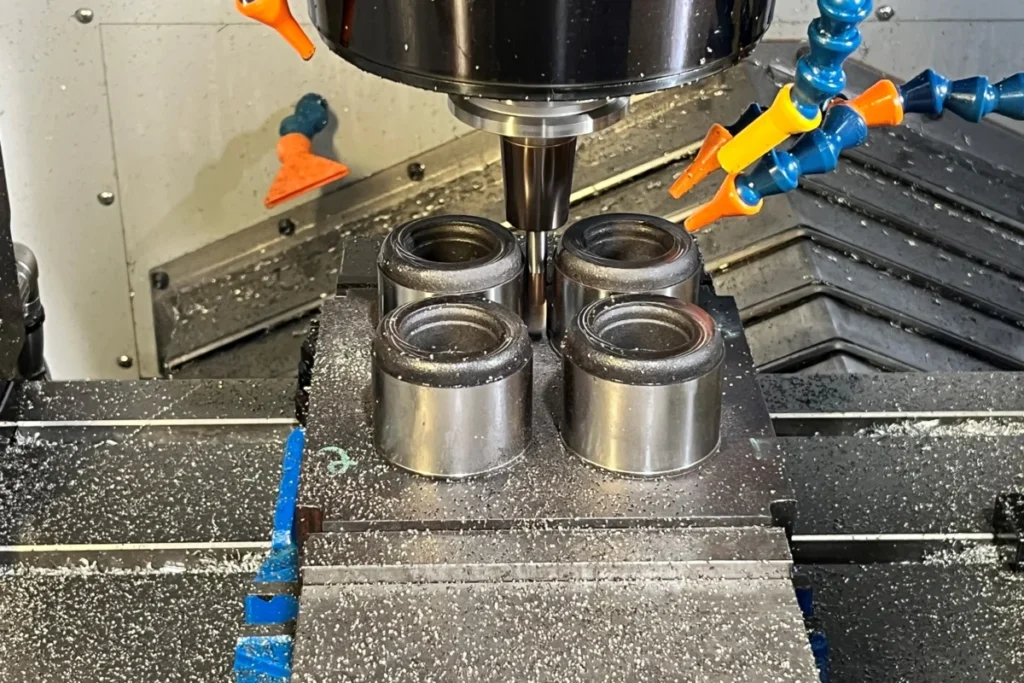
The production of the conformal cooling inserts commenced with the 3D printing process, where the complex geometries were built layer by layer directly on the metal additive build plate. This direct printing method is a hallmark of additive manufacturing, enabling the creation of intricate internal structures that are impossible with traditional subtractive methods.
Following the printing phase, the inserts underwent a series of critical post-processing steps. These included in-house machining to achieve precise dimensional accuracy, Electrical Discharge Machining (EDM) to refine intricate features and surface finishes, and a final A2 polish to meet the stringent aesthetic and functional requirements of K-Rain’s customer. This comprehensive post-processing workflow ensured that the 3D-printed inserts were not only functional but also met the highest standards of quality and precision.
The choice of Corrax stainless steel proved to be a strategic advantage, especially considering the customer’s location. Its ability to be hardened, polished, and welded provided the necessary durability and adaptability for the operational environment, while its inherent corrosion resistance offered crucial protection against the coastal atmosphere.

Simulation Meets Reality: Validating Performance with Data
A particularly noteworthy aspect of this project was the timing of the simulation. Unlike many projects where simulation precedes physical prototyping, in this instance, the simulation was conducted after the conformal-cooled tool had already been manufactured and tested in a real-world production environment. This provided Richard Evans of Reaction Plastics Solutions with invaluable real-world data against which to benchmark his virtual analysis.
"The two lined up remarkably well, demonstrating how accurate modern simulation has become," Evans remarked, underscoring the power of advanced simulation software when coupled with tangible performance metrics. The simulation revealed dramatic differences in temperature distribution between the original design and the optimized one. "With the original thermal pins, temperature mapping showed a large hot spot at 31 seconds into the cycle. With the conformal cooling design, the heat is much more evenly distributed and dissipates faster," Evans elaborated.
This uniform temperature profile directly translated into improved part cooling, leading to reduced shrinkage variation and the complete elimination of warpage and sink marks that had previously plagued the top section of the molded part. Furthermore, the simulation validated the performance of the cooling circuit itself, indicating favorable Reynolds numbers and a manageable pressure drop of approximately 40 PSI. These parameters are critical for ensuring consistent performance in multi-cavity tooling applications.
Evans also emphasized the economic implications of using simulation: "Of course, running a project like this without simulation is risky. A simulation might cost a few thousand dollars, while redesigning and re-machining tooling can run far more expensive if things don’t work out." This statement highlights the cost-effectiveness and risk-mitigation benefits of employing simulation technology, even when real-world testing has already yielded positive results. The simulation, in this case, served as a powerful validation of the toolroom’s successful implementation and reinforced the importance of upfront analysis in complex manufacturing projects.
The Tangible Impact: Quantifiable Improvements and Enhanced Quality
The most compelling evidence of the project’s success came from K-Rain’s production floor. "Once the inserts were built and installed, K-Rain’s new tool ran 10 seconds faster per cycle, dropping from 54 seconds to around 44, an 18-20% improvement," Michon reported. While acknowledging that a servo motor upgrade contributed approximately two seconds to this gain, he attributed the majority of the improvement to the significantly faster and more uniform cooling facilitated by the 3D-printed inserts.

This reduction in cycle time translates directly into increased production output and lower manufacturing costs. Beyond the speed enhancements, the improved cooling uniformity led to a more consistent part quality. The elimination of warpage and sink marks meant fewer rejected parts and a higher yield of finished goods that met stringent quality standards. This improvement in part quality is often as critical, if not more so, than cycle time reductions in many manufacturing applications.
The successful integration of conformal cooling into K-Rain’s mold represents a significant achievement for all parties involved. It demonstrates a mature understanding of how advanced manufacturing techniques can solve complex engineering challenges and drive tangible business results.
Lessons from the Shop Floor: Practical Insights for Manufacturers
This collaborative project offered several valuable lessons for manufacturers exploring the integration of additive manufacturing and advanced cooling technologies:
- The Power of Collaboration: The success of this project was a direct result of effective teamwork between K-Rain, Zero Tolerance LLC, Xact Metal, and Reaction Plastics Solutions. Each company brought its unique expertise to the table, creating a synergistic approach that overcame technical hurdles and delivered exceptional results. This underscores the importance of strong partnerships in driving innovation.
- Targeted Application of Technology: The decision to implement conformal cooling only in the most problematic section of the mold was a strategic one. This approach allowed for a focused solution, minimizing complexity and cost while maximizing impact. It highlights the principle of applying advanced technologies where they will yield the greatest benefit.
- Material Selection is Crucial: The choice of Uddeholm’s Corrax stainless steel was vital for the success of the project, especially given the environmental conditions at the customer’s facility. Understanding material properties and their suitability for specific applications is paramount in additive manufacturing and mold design.
- The Value of In-House Capabilities: Zero Tolerance LLC’s investment in Xact Metal’s 3D printer enabled them to maintain control over the entire production process, from design and printing to post-processing. This in-house capability allows for greater agility, faster turnaround times, and enhanced quality control.
- Simulation as a Strategic Tool: The post-build simulation served as a powerful validation tool, confirming the efficacy of the design and reinforcing the value of simulation as a predictive and analytical instrument in manufacturing. It demonstrated that simulation can provide valuable insights even after a physical solution has been implemented, offering a means to further optimize and understand performance.
Broader Impact and Future Implications
The successful deployment of 3D-printed conformal cooling inserts by K-Rain, facilitated by the expertise of Zero Tolerance LLC, Xact Metal, and Reaction Plastics Solutions, signifies a pivotal moment in the adoption of additive manufacturing within the moldmaking industry. This case study serves as a compelling testament to how cutting-edge technologies can address long-standing manufacturing challenges, leading to measurable improvements in efficiency, part quality, and overall profitability.
The implications of this project extend beyond K-Rain’s specific application. It provides a blueprint for other manufacturers grappling with similar cooling issues. The ability to create highly customized, complex internal cooling channels that precisely follow the contours of a mold cavity offers a significant advantage over traditional methods. This can lead to faster cycle times, reduced energy consumption, and the production of higher-quality, more dimensionally stable parts, particularly for intricate geometries or materials that are sensitive to temperature variations.

The partnership also highlights the evolving landscape of manufacturing, where collaboration between specialized companies is becoming increasingly crucial for innovation. Xact Metal’s role in providing accessible metal 3D printing technology democratizes access to advanced manufacturing capabilities, empowering smaller and medium-sized enterprises to compete with larger players. Zero Tolerance LLC’s expertise in leveraging this technology for complex tooling applications, combined with Reaction Plastics Solutions’ simulation capabilities, creates a powerful ecosystem for solving intricate manufacturing problems.
Ultimately, this project is more than just a successful case study; it’s a powerful demonstration of how innovation, collaboration, and the strategic application of new technologies can drive significant progress. K-Rain’s experience illustrates that what began as a trial run for a specific cooling challenge has evolved into a compelling showcase of modern moldmaking and the transformative potential of additive manufacturing. For the rest of the industry, it stands as a clear reminder: when the right technology is combined with the right expertise and a spirit of collaboration, progress isn’t just a possibility; it’s a measurable reality.