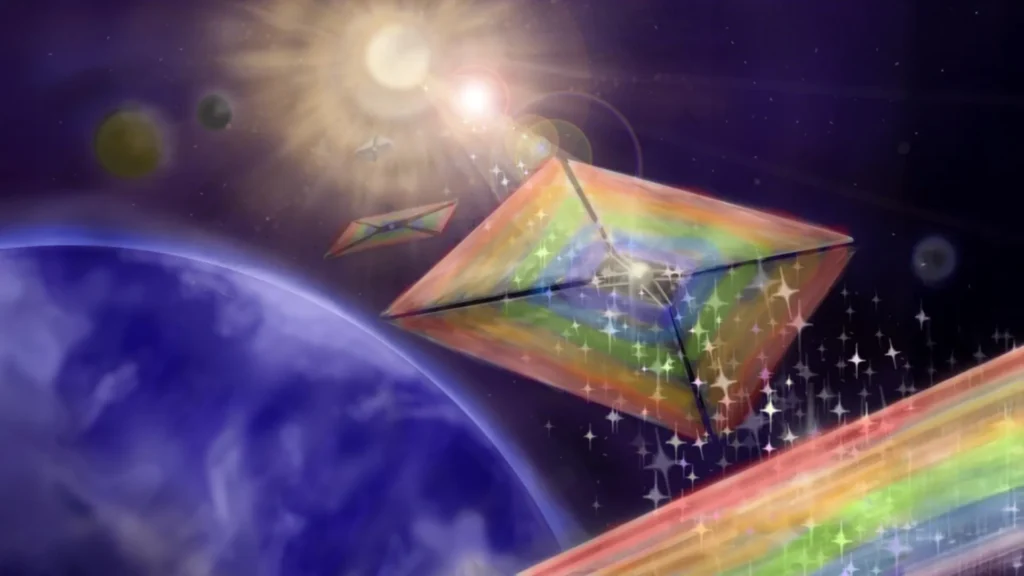
The ambitious quest to reach other star systems within a practical human timeframe demands propulsion technologies far beyond the capabilities of conventional chemical rockets. Among the most promising and widely discussed concepts is the solar sail, a vast, ultra-thin, highly reflective membrane designed to harness the minuscule but persistent pressure exerted by light. When coupled with immensely powerful ground-based or orbital laser arrays, such a sail could theoretically be accelerated to extraordinary velocities, potentially a significant fraction of the speed of light, opening the door to interstellar travel. However, a recent theoretical paper, published on arXiv by researchers Chao Shen and Jiaze Li of the Harbin Institute of Technology, has illuminated a previously unconsidered challenge: the very light propelling the sail could, under certain relativistic conditions, begin to act as a drag force, introducing an unexpected speed limit to these pioneering spacecraft.
The Allure of Interstellar Travel and the Promise of Light Sails
Humanity’s innate curiosity has long driven us to explore beyond our immediate horizons. In the context of space exploration, this ambition culminates in the dream of interstellar travel – voyages to exoplanets orbiting distant stars, seeking answers to fundamental questions about life, the universe, and our place within it. Proxima Centauri, the nearest star to our Sun, lies a daunting 4.2 light-years away, a distance that renders conventional rocket propulsion impractical. Even the fastest spacecraft ever built, NASA’s Parker Solar Probe, which can reach speeds up to 690,000 km/h (0.064% of the speed of light) during its solar flybys, would take thousands of years to cover such a distance.
This fundamental limitation of chemical rockets – their reliance on carrying vast amounts of propellant, which paradoxically requires more propellant to accelerate – has spurred scientists and engineers to investigate alternative propulsion methods. Among these, the solar sail stands out as a leading contender for interstellar probes. The basic principle is elegantly simple: photons, despite having no rest mass, carry momentum. When billions of these photons strike a reflective surface, they impart a tiny push. Over vast distances and with continuous exposure, this cumulative push can accelerate a spacecraft to incredible speeds without requiring it to carry its own fuel.
The concept gains revolutionary potential when paired with laser propulsion. Instead of relying solely on diffuse sunlight, which diminishes rapidly with distance from the Sun, a powerful laser array could continuously beam light onto the sail, providing a concentrated and controllable thrust. Projects like Breakthrough Starshot, initiated in 2016 by Yuri Milner and Stephen Hawking, envision a fleet of "nanocraft" weighing just a few grams, equipped with kilometer-scale light sails, accelerated by gigawatt-to-terawatt class lasers to 20% the speed of light (approximately 60,000 km/s). At this velocity, a probe could reach Proxima Centauri in about 20 years, a truly generational leap in interstellar capability.
A Brief History of Light Propulsion Concepts
The idea of harnessing light for propulsion is not new. As far back as the 17th century, astronomer Johannes Kepler observed that comet tails always point away from the Sun, speculating that "the ethereal spirit of the sun" was responsible – an early, intuitive grasp of solar radiation pressure. In the late 19th and early 20th centuries, Russian visionary Konstantin Tsiolkovsky, a pioneer of astronautics, discussed the potential of using "enormous mirrors" to harness sunlight for space travel.
Throughout the 20th century, the concept remained largely theoretical, appearing frequently in science fiction. However, with advancements in materials science and laser technology, solar sails began to transition from science fiction to scientific possibility. Practical demonstrations have been made:
- IKAROS (Interplanetary Kite-craft Accelerated by Radiation Of the Sun): Launched by the Japan Aerospace Exploration Agency (JAXA) in 2010, IKAROS was the first spacecraft to successfully demonstrate solar sail propulsion in interplanetary space. Its 14-meter square sail proved the feasibility of using solar radiation pressure for primary propulsion.
- LightSail 2: Developed by The Planetary Society and launched in 2019, LightSail 2 successfully demonstrated controlled solar sailing in Earth orbit, raising its orbit using only light pressure.
These missions, while operating at vastly lower speeds than those envisioned for interstellar travel, have validated the fundamental physics. The next leap – to relativistic velocities – introduces a host of new, complex physical phenomena that must be thoroughly understood.
The Physics of Light Pressure: A Deeper Dive
To understand the findings of Shen and Li, it’s crucial to grasp how photons impart momentum to a solar sail. The researchers categorize these forces into three distinct components:
- Incident Light (Direct Momentum): This is the primary and strongest contribution. It refers to the momentum directly transferred by photons as they initially strike the sail’s surface. The more photons hitting the sail per unit time, and the higher their individual energy (and thus momentum), the greater this push.
- Specular Reflection: When photons bounce off the sail’s surface perfectly, like a billiard ball off a cushion, they not only transfer their initial momentum but also undergo a change in direction, imparting additional momentum to the sail. For a perfectly reflective surface, the momentum transferred is twice that of a photon being absorbed.
- Diffuse Scattering: This is the weakest but most complex component. Some photons are not perfectly reflected but are instead absorbed by the sail material and then re-emitted in random directions as thermal radiation. While random, on average, this re-emission still contributes a net forward momentum at low speeds, as the absorbed energy is re-radiated, and the average direction of re-emission still has a component opposite to the incoming light.
At relatively low speeds, these three effects collectively work in harmony to propel the sail forward, steadily increasing its velocity. However, as the spacecraft begins to approach a significant fraction of the speed of light, the situation becomes profoundly more complicated due to relativistic effects.
Relativistic Effects: The Doppler Shift’s Role
One of the first relativistic effects to significantly impact sail performance is the Doppler shift. Just as the pitch of a siren changes as an ambulance moves towards or away from an observer, the frequency (and thus energy) of light changes as its source and observer move relative to each other.
As a solar sail races away from its laser source at increasing speeds, the light waves reaching it become stretched out. This phenomenon, known as relativistic redshift, causes the frequency of the incoming photons to decrease. Since the energy of a photon is directly proportional to its frequency (E=hν, where h is Planck’s constant and ν is frequency), a lower frequency means lower energy per photon. Consequently, each photon carries less momentum.
The reduction in individual photon momentum directly translates to a weaker push from all three components of light pressure – incident, specular, and diffuse. As a result, continuous acceleration becomes progressively less efficient. The faster the sail travels, the less effective the laser becomes at increasing its speed, requiring exponentially more power to achieve smaller increments of velocity. This Doppler effect alone presents a significant hurdle for achieving ultra-high relativistic speeds.
The Unexpected Turn: Relativistic Aberration and Drag
While the Doppler shift reduces efficiency, the Shen and Li paper uncovers an even more counter-intuitive phenomenon that occurs at extreme velocities: the diffuse scattering component, which initially contributes to forward thrust, can actually transform into a drag force. This happens when the lightsail reaches approximately 75% of the speed of light.
The key to this reversal lies in another relativistic effect known as relativistic light aberration. From the perspective of a stationary observer (e.g., on Earth where the laser array is located), as the sail approaches relativistic speeds, the apparent direction of incoming light shifts. Light that might be aimed directly at the sail from Earth appears to be coming from a more forward-skewed direction relative to the sail’s motion as the sail’s velocity increases.
Crucially, this aberration also affects how light is re-emitted from the sail’s surface. At around 75% of the speed of light (approximately 225,000 kilometers per second or 140,000 miles per second), the researchers found that diffusely scattered photons – those absorbed and then re-emitted in random directions from the sail’s frame of reference – begin to be directed forward relative to the sail’s overall direction of travel, when observed from a stationary frame.
According to Newton’s Third Law of Motion, every action has an equal and opposite reaction. If the sail is effectively radiating photons predominantly forward (relative to its motion) due to relativistic aberration, then the recoil force generated by this emission will be directed backward, opposite to the sail’s direction of travel. This backward force is, by definition, a drag.
Therefore, once a lightsail surpasses roughly 75% of the speed of light, the weakest of the three forces – diffuse scattering – starts acting as a drag. It is important to clarify that the overall force on the sail does not become negative; the incident and specular reflection components still provide a net forward thrust, even if diminished by the Doppler effect. However, the efficiency of the propulsion system drops substantially, as a portion of the energy that was once contributing to acceleration now actively works against it. This introduces a subtle but significant speed limiter that must be accounted for in future designs.
The Shen and Li Paper: Context and Methodology
The research by Chao Shen and Jiaze Li, detailed in their paper titled "Relativistic radiation pressure on a solar sail," provides a rigorous theoretical framework for analyzing these effects. Published on the preprint server arXiv, which allows for rapid dissemination of scientific work prior to formal peer review, the paper focuses specifically on the radiative dynamics of light pressure at relativistic speeds.
For simplicity and to isolate the core physical phenomena, the researchers modeled the lightsail as an "idealized mirror." This simplification allowed them to focus purely on the interactions between photons and the sail material, abstracting away the complexities of real-world materials and environmental factors. While an idealized model provides crucial insights, it also highlights the need for subsequent research to incorporate more realistic conditions.
Challenges Beyond Radiative Dynamics
The Shen and Li study sheds light on a fundamental physical limitation, but it is just one piece of a much larger, intricate puzzle of interstellar travel. Real solar sails would face an array of additional challenges not included in this particular theoretical paper:
- Interstellar Medium Drag: Space, while largely a vacuum, is not entirely empty. Interstellar gas (primarily hydrogen atoms at densities of roughly 0.1 to 1 atom per cubic centimeter) and microscopic dust particles pervade the cosmos. At relativistic speeds, collisions with even these sparse particles would become highly energetic, acting as a form of drag. These impacts could also cause erosion or damage to the ultra-thin sail material over a multi-decade journey.
- Thermal Management: The immense power required from the laser array to accelerate a sail to relativistic speeds (potentially terawatts of power focused onto a relatively small area) would generate colossal heat. Sail materials, typically envisioned as mere nanometers thick, would need to withstand extreme temperatures without melting, deforming, or losing their reflective properties. Current materials science is far from developing such resilient, ultra-light structures.
- Sail Material Science: The idealized mirror used in the study is a theoretical construct. Real spacecraft would require much more sophisticated materials. Engineers are actively investigating advanced metamaterials and photonic crystals. These engineered materials could be designed to exhibit specific optical properties, optimized for particular laser wavelengths, and potentially even dynamically adjust their reflectivity or scattering characteristics.
- Orientation and Stability: Maintaining the sail’s precise orientation and keeping it centered within a laser beam over light-year distances is an enormous engineering challenge. Even slight deviations could drastically reduce efficiency or cause the sail to miss the beam entirely. The dynamic nature of relativistic aberration might even be leveraged by advanced materials to help a lightsail automatically correct its orientation and stabilize its trajectory, perhaps by varying reflectivity across its surface.
- Navigation and Communication: Guiding a probe across interstellar distances, avoiding potential hazards, and maintaining communication links across light-years are daunting tasks. The immense time delays for signals and the engineering challenges of transmitting data over such vast distances require breakthrough solutions.
- Space-time Curvature: For very long interstellar journeys, even the curvature of spacetime, as described by Einstein’s theory of general relativity, could have subtle effects on trajectory, though these are typically orders of magnitude smaller than other propulsion challenges. The Shen and Li paper, like many theoretical models, simplifies out such complexities.
The Role of Advanced Materials: Turning Challenges into Opportunities
The very challenges identified by Shen and Li’s research underscore the critical importance of ongoing advancements in materials science. The next generation of solar sail designs will likely move far beyond simple reflective films.
- Metamaterials: These are materials engineered to have properties not found in naturally occurring substances, often by structuring them at scales smaller than the wavelength of light. They could be designed to precisely control how light interacts with the sail, potentially mitigating the negative effects of Doppler shift and aberration.
- Photonic Crystals: These are periodic optical nanostructures that affect the motion of photons in a way similar to how semiconductor crystals affect electrons. They could be tailored to reflect specific laser wavelengths with near-perfect efficiency while minimizing diffuse scattering, or even to redirect scattered light in advantageous ways.
In principle, these advanced materials might even be designed to actively take advantage of aberration effects. For instance, by dynamically altering the sail’s surface properties, a smart sail could potentially use the changing apparent direction of light to automatically correct its orientation and maintain its position within the laser beam, thereby enhancing stability and propulsion efficiency. This would transform a potential drag into a self-correcting mechanism.
Implications for Interstellar Mission Design
The findings of Shen and Li represent a crucial step in the iterative process of designing future interstellar spacecraft. They highlight that achieving truly relativistic speeds – speeds approaching the speed of light – is not merely an engineering problem of building powerful enough lasers and light enough sails, but also a profound physics problem.
For projects like Breakthrough Starshot, which aim for 20% c, the drag effect discussed in the paper might not be the dominant limiting factor, as it becomes significant around 75% c. However, the Doppler shift’s efficiency reduction is relevant even at lower relativistic speeds. Moreover, if the ultimate goal is to push beyond 20% c towards even higher fractions of light speed, then the relativistic aberration drag becomes absolutely critical.
This research necessitates:
- Re-evaluation of Maximum Achievable Speeds: Designers must now factor in this drag effect when calculating the theoretical maximum velocities attainable by laser-driven light sails.
- Optimization of Acceleration Profiles: Understanding how efficiency changes with speed will allow for more precise planning of laser power output over the course of a mission, potentially aiming for a rapid initial acceleration phase before encountering significant drag effects.
- Emphasis on Diffuse Scattering Minimization: Material scientists will need to prioritize the development of sail materials that exhibit exceptionally low diffuse scattering, focusing instead on maximizing specular reflection.
- Integrated Theoretical Models: Future models will need to combine radiative dynamics with other forms of drag (interstellar medium, thermal limits) to provide a holistic picture of a lightsail’s journey.
Expert Perspectives and The Long Road Ahead
While the paper identifies a new challenge, the general sentiment within the scientific community is likely one of informed optimism and a call for further research, rather than discouragement. Experts familiar with the complexities of interstellar propulsion would likely view this as a valuable piece of the puzzle.
Chao Shen and Jiaze Li’s work underscores that the path to interstellar flight is paved with intricate physical phenomena that must be meticulously understood and overcome. It is a testament to the fact that scientific discovery is an ongoing, iterative process. Each new finding, even one that reveals a potential limitation, provides invaluable data that refines our understanding, challenges engineers, and ultimately pushes us closer to viable solutions.
A fully operational, interstellar solar sail capable of traversing light-years is still far from becoming a reality. The journey will require breakthroughs across multiple disciplines – theoretical physics, materials science, laser engineering, spacecraft design, and computational modeling. However, by systematically understanding every force that could affect such a journey, from the subtle push of photons to the unexpected drag they can create at relativistic velocities, humanity continues to chart a course towards the stars, one discovery at a time. The detailed understanding of these high-speed effects is an indispensable part of determining how such spacecraft might eventually work, ensuring that if humanity someday sends a probe to another star, its engineers will have accounted for every conceivable challenge.