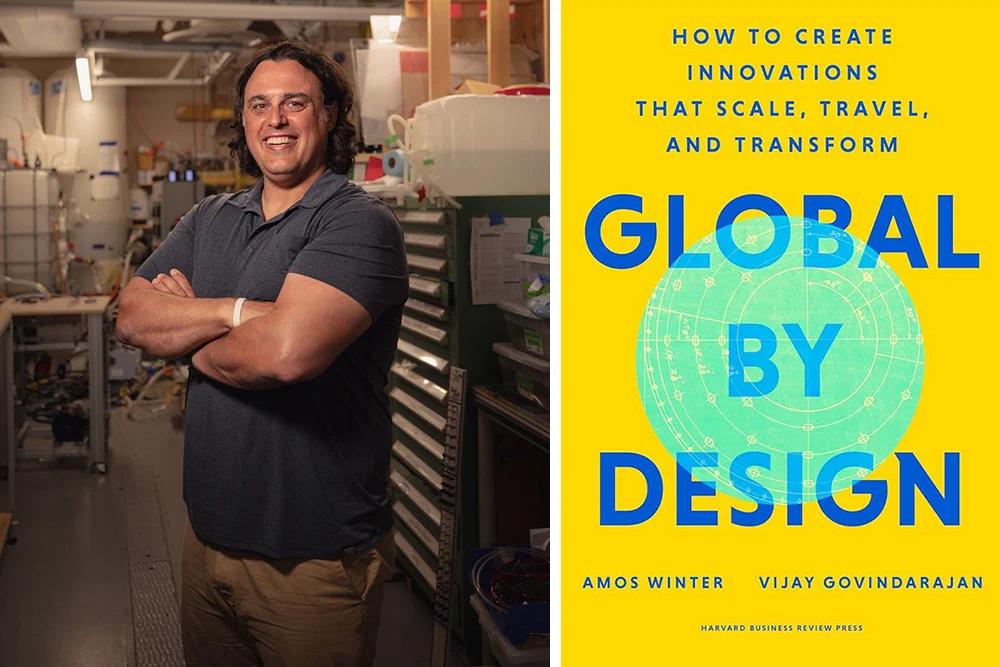
A groundbreaking new book, "Global by Design: How to Create Innovations That Scale, Travel, and Transform," co-authored by MIT’s Germeshausen Professor of Mechanical Engineering, Amos Winter, and renowned strategy and innovation expert Vijay Govindarajan, offers a comprehensive framework for developing innovations capable of thriving across diverse markets, industries, and income levels. Published by Harvard Business Review Press, the book challenges conventional innovation paradigms, advocating for a targeted and thoughtful design process that recognizes the immense potential and unique demands of emerging markets while simultaneously creating solutions that resonate globally.
The Imperative for Global Innovation
The global economic landscape has seen a significant shift, with emerging markets consistently outpacing the growth rates of developed economies. As Professor Winter highlights, these regions are expanding at approximately twice the rate of the United States and Europe. This demographic and economic dynamism presents an undeniable opportunity for multinational corporations (MNCs) seeking to maximize their growth trajectories. However, the prevailing approach of simply transplanting products successful in wealthy markets to developing ones often falls short.
"If you’re a multinational company that really wants to maximize your growth rate, it’s not going to be in wealthy markets, it has to be in emerging markets," Winter states, emphasizing the critical need for a new strategy. He further elaborates on the pitfalls of a "copy-paste" mentality, particularly for legacy companies accustomed to affluent consumer bases. Products designed for high-income markets are frequently too expensive, too complex, or fail to address the specific needs and constraints of consumers in regions like India or Sub-Saharan Africa. This disconnect underscores a crucial gap in current innovation strategies, which "Global by Design" aims to bridge by providing actionable guidance on leveraging existing knowledge without direct replication.
Historically, innovation has often followed a "trickle-down" model, where products developed for affluent consumers in developed nations are later adapted, often with reduced features or quality, for lower-income markets. However, this approach frequently results in suboptimal solutions that merely compromise rather than truly innovate for the target context. The book champions a more deliberate and inclusive design philosophy, acknowledging that the future of significant growth and impactful innovation lies in understanding and designing for the global majority.
"Global by Design": A New Framework for a New Era
The core of "Global by Design" is a practical, disciplined framework structured around three distinct phases, meticulously guiding readers through the entire innovation lifecycle. This process begins with the critical identification of opportunities, progresses to the design of appropriate solutions, and culminates in the strategic scaling of these innovations both locally and globally. The authors move beyond abstract theoretical concepts, providing a roadmap for spotting genuine problems, intelligently leveraging existing innovation, and ultimately building high-value, low-cost solutions with universal appeal.
The publication of "Global by Design" by Harvard Business Review Press positions it as a significant contribution to business literature, targeting not only corporate leaders and entrepreneurs but also policymakers and academics grappling with global development challenges. The book’s release is particularly timely, coinciding with increasing global awareness of sustainable development goals and the role of innovation in achieving them.
Authors’ Vision and Expertise
Amos Winter, the Germeshausen Professor of Mechanical Engineering at MIT, is a recognized pioneer in engineering design, with a career dedicated to solving complex technical challenges in low-resource settings. His extensive research and practical experience, particularly through the K. Lisa Yang Global Engineering and Research (GEAR) Center, which he directs, form the empirical backbone of the book’s methodology. Winter’s philosophy centers on approaching problems with "fresh eyes," distilling unique requirements often overlooked by conventional design processes, and focusing on creating not just low-cost solutions, but genuinely high-value ones.
Co-author Vijay Govindarajan is a world-renowned authority on strategy and innovation, widely recognized for his work on "reverse innovation." Govindarajan’s concept posits that innovations developed for emerging markets can often be successfully introduced into developed markets, disrupting established players and creating new growth opportunities. This synergistic partnership between Winter’s engineering design acumen and Govindarajan’s strategic foresight provides a robust and holistic perspective on global innovation. Their combined expertise allows the book to offer a rare blend of technical depth and strategic breadth, making its guidance particularly potent for a wide audience.
Addressing Unsolved Global Challenges
A significant focus of "Global by Design" is on addressing historically unsolved problems, particularly those prevalent in the developing world. Winter points to critical issues such as access to clean water, affordable healthcare, and reliable energy – fundamental needs that remain unmet for billions globally. While solutions exist for these problems in wealthier nations, they often fail to translate effectively to low-resource contexts.
"Even though we have solutions to these problems in wealthy countries, they just haven’t mapped over, often because the solutions are too expensive or they’re not robust enough, leading these problems to persist for generations unsolved," Winter explains. This persistent gap highlights the inadequacy of simply adapting existing technologies. Instead, the book advocates for a ground-up design approach that considers the unique socio-economic, environmental, and infrastructural realities of these communities. For instance, a sophisticated medical device designed for a modern hospital with stable electricity and trained technicians will be utterly impractical in a rural clinic lacking both. The "Global by Design" framework encourages innovators to rethink fundamental assumptions and create solutions inherently suited to challenging environments.
The scale of these global challenges is immense. According to the World Health Organization, over 2 billion people lack safely managed drinking water, and billions more lack access to essential healthcare services. The International Energy Agency reports that hundreds of millions still live without electricity. These statistics underscore the urgent need for innovative, scalable, and context-appropriate solutions that can genuinely transform lives. The book’s emphasis on high-value, low-cost solutions directly targets this humanitarian and economic imperative.
Beyond Emerging Markets: Universal Appeal
A key insight presented in "Global by Design" is that solutions initially conceived for emerging markets possess a remarkable potential for universal appeal. Far from being niche products, globally minded innovations can also resonate powerfully with more resource-constrained consumers in developed markets and even create unexpected upsell opportunities for wealthy consumers. This concept aligns closely with the principles of "reverse innovation," demonstrating that constraints can be powerful drivers of superior design.
For instance, a robust, energy-efficient, and low-maintenance device designed for a remote village might appeal to an eco-conscious consumer in a developed country or to someone seeking a more resilient and self-sufficient lifestyle. The book provides guidance on how to strategically differentiate products across various segments, ensuring that new, globally designed offerings complement rather than cannibalize existing product lines. This strategic approach allows companies to expand their market reach without undermining their established brand equity or sales. The principles of "design for extreme affordability and robustness" often lead to innovations that are simply better for everyone, regardless of income level, because they prioritize efficiency, durability, and essential functionality.
Case Studies: Theory into Practice
To illustrate its framework, "Global by Design" incorporates five detailed case studies derived from Professor Winter’s research group, alongside various industry examples. These real-world applications demonstrate how the theoretical framework translates into tangible, impactful innovations. One particularly compelling case study details a product on the verge of commercial production that promises to reshape agricultural practices globally.
"We created new drip irrigation emitter technology that cuts pumping power in half, reduces the price of solar-powered irrigation by about 40 percent, requires less than half the plastic to make, and is an industry leader in clog prevention," Winter explains. This innovation is a prime example of a "global by design" solution. Drip irrigation is crucial for water-stressed regions, as it delivers water directly to plant roots, minimizing waste. However, traditional systems can be expensive, energy-intensive, and prone to clogging, making them less accessible for smallholder farmers in developing countries.
The new emitter technology directly addresses these pain points. By significantly reducing pumping power, it drastically lowers operational costs, making solar-powered irrigation more viable and affordable. The reduction in plastic usage not only lowers manufacturing costs but also aligns with global sustainability goals. Furthermore, its superior clog prevention capability reduces maintenance burdens, a critical factor in regions with limited technical support. This innovation is poised to enable the widespread adoption of water-saving, renewable-powered irrigation in low-resource, water-stressed markets, contributing significantly to food security and climate resilience. Simultaneously, it offers a highly valuable alternative to farmers in wealthy countries who are increasingly facing water scarcity and rising energy costs.
The commercialization of this technology by Toro, a global leader in irrigation products, with an expected market launch in early 2027, underscores its market readiness and transformative potential. Winter proudly asserts, "It is truly a global product that is a better mousetrap, as it meets or exceeds the performance of any other product on the market in every category." The scientific rigor behind this innovation is further validated by its publication in prestigious peer-reviewed journals, Nature Communications and Water, demonstrating its foundational research quality.
The K. Lisa Yang Global Engineering and Research (GEAR) Center
Professor Winter’s role as director of the K. Lisa Yang Global Engineering and Research (GEAR) Center at MIT is central to the development of these "global by design" innovations. The GEAR Center is dedicated to focusing research efforts on solving technical challenges specifically within low-resource communities. This institutional commitment provides a fertile ground for the kind of problem-solving approach advocated in the book.
Beyond the drip irrigation system, Winter’s team at GEAR has developed other notable solutions across various critical sectors. These include advancements in water purification technologies, which are vital for public health in regions lacking safe drinking water; agricultural equipment designed to enhance productivity and sustainability for small farmers; and assistive technology aimed at improving the quality of life for individuals with disabilities in underserved areas. Each of these projects embodies the principles outlined in "Global by Design": identifying acute needs, designing context-appropriate and cost-effective solutions, and ensuring scalability and impact.
Broader Implications and Future Outlook
The framework presented in "Global by Design" carries profound implications for a diverse range of stakeholders. For multinational corporations, it offers a blueprint for unlocking new growth engines in fast-expanding markets, shifting their innovation strategies from merely adapting existing products to creating truly global solutions from inception. For startups and social enterprises, it provides a structured methodology for developing impactful innovations that are both financially viable and deeply rooted in local needs. Non-governmental organizations (NGOs) and development agencies can leverage these insights to optimize their interventions and ensure the sustainability of their projects.
Academically, the book is anticipated to broaden the scope of design thinking, integrating social impact and global equity into core engineering and business curricula. It challenges the traditional Western-centric view of innovation, advocating for a more inclusive and empathetic approach. The emphasis on "high-value, low-cost" design aligns perfectly with the United Nations’ Sustainable Development Goals (SDGs), particularly those related to poverty, hunger, health, water, and innovation itself. By providing a clear methodology, the book empowers innovators to contribute meaningfully to these global objectives.
The anticipated reception of "Global by Design" in both academic and business circles is expected to be highly positive, given the credentials of its authors and the pressing relevance of its subject matter. It is likely to become a standard reference for courses in global innovation, development engineering, and strategic management, fostering a new generation of designers and business leaders equipped to tackle the world’s most complex challenges.
Conclusion: A Call to Action for Innovators
Ultimately, Professor Winter expresses a fervent hope that "Global by Design" will serve as a catalyst for a new wave of innovation. He envisions the book broadening the horizons of design thinking and equipping innovators with the necessary toolsets to solve meaningful, multifaceted, and truly global problems.
"We want readers to walk away from ‘Global by Design’ inspired to create solutions that are financially viable and create positive social impact," Winter concludes. More than just a guide, the book is a call to action, aiming to empower individuals and organizations alike. "Furthermore, we want them to feel empowered, seeing how they can apply their unique experience, perspectives, knowledge, and resources to make meaningful change in the world." In an increasingly interconnected yet deeply unequal world, "Global by Design" offers a timely and essential roadmap for designing a more equitable and prosperous future for all.