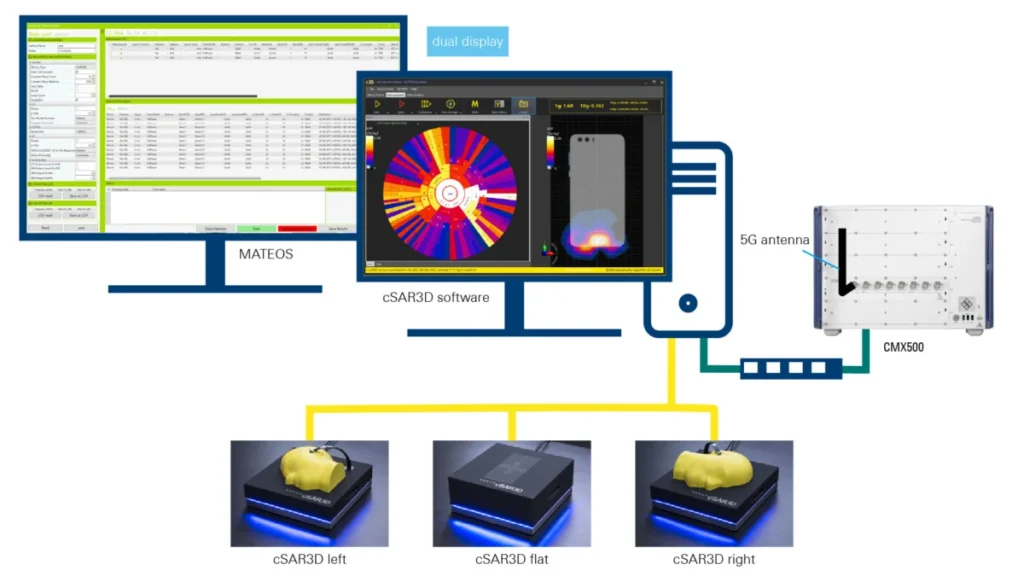
Microwave Factory (MWF) has announced a significant advancement in wireless device compliance testing by integrating support for the Rohde & Schwarz CMX500 5G one-box signaling tester into its MATEOS Specific Absorption Rate (SAR) measurement software. This pivotal development enables fully automated SAR measurements for the increasingly complex landscape of 5G New Radio (NR) and established LTE devices, streamlining a critical aspect of product certification for manufacturers, test houses, and certification laboratories worldwide. The integration addresses a growing industry demand for more efficient, accurate, and repeatable SAR testing methodologies, particularly as wireless technologies evolve to incorporate more frequency bands, advanced antenna systems, and dynamic operating modes.
The Crucial Role of Specific Absorption Rate (SAR) Testing
Specific Absorption Rate (SAR) measurements are a cornerstone of wireless device compliance, designed to quantify the amount of radio frequency (RF) energy absorbed by the human body from mobile phones and other wireless transmitting devices. Regulatory bodies across the globe, such as the Federal Communications Commission (FCC) in the United States, the International Commission on Non-Ionizing Radiation Protection (ICNIRP) in Europe and many other regions, and various national authorities, establish strict limits on SAR levels to protect public health. These limits are based on extensive scientific research and ensure that devices operating close to the body, such as smartphones, tablets, and wearables, do not expose users to RF energy levels exceeding safety thresholds.
Historically, SAR testing has been a meticulous and often time-consuming process, involving precise positioning of devices in phantoms filled with tissue-equivalent liquid and careful measurement of RF absorption. The complexity of these tests has escalated dramatically with the advent of 5G technology. Older wireless generations (2G, 3G, 4G LTE) primarily operated on a limited set of frequency bands and simpler antenna configurations. However, 5G NR introduces a multitude of new challenges, including operation across a wider spectrum (from sub-6 GHz to millimeter-wave frequencies), sophisticated antenna technologies like beamforming and MIMO (Multiple-Input, Multiple-Output), and dynamic power control mechanisms. These advancements mean that a single 5G device can operate in numerous modes, across multiple frequency bands, and with varying power levels depending on network conditions and user interaction. Manually configuring and testing each permutation to ensure SAR compliance becomes an enormous, often prohibitive, task without significant automation.
Addressing the Complexities of 5G NR and LTE Devices
The new implementation directly supports 5G NR standalone (SA), 5G NR non-standalone (NSA), and legacy LTE devices. 5G NR SA represents the full deployment of 5G, with the core network built for 5G from the ground up, offering ultra-low latency and enhanced mobile broadband. 5G NR NSA, on the other hand, leverages existing LTE infrastructure for the control plane while using 5G NR for the data plane, serving as an intermediate step in the 5G rollout. The continued support for LTE is vital, as most modern devices are multi-mode, falling back to LTE networks when 5G is unavailable, and therefore require comprehensive testing across all supported technologies.
The companies involved—Microwave Factory, Rohde & Schwarz, and SPEAG (Schmid & Partner Engineering AG)—explicitly stated that this integration was developed in direct response to customer requests for automated SAR measurements that combine the capabilities of the Rohde & Schwarz CMX500 and SPEAG’s advanced SAR systems. This highlights a clear market need for solutions that can keep pace with the rapid innovation in wireless communications while maintaining stringent safety standards. The manual configuration of calls and separate setup steps on the CMX500, a common procedure prior to this integration, presented a bottleneck in the testing workflow. By consolidating these steps into a single, intuitive MATEOS interface, engineers can now control the entire measurement process from one console, drastically reducing setup time, minimizing human error, and improving the overall efficiency and repeatability of SAR tests.
A Deep Dive into the Integrated Technologies
The robust functionality of this automated SAR testing solution is derived from the seamless interplay of three highly specialized components:
-
Rohde & Schwarz CMX500 5G One-Box Signaling Tester: At the heart of the wireless device signaling, the CMX500 is a state-of-the-art test solution designed to simulate 5G and LTE network environments. It provides the necessary base station emulation to establish a stable and controllable connection with the device under test (DUT). This allows engineers to precisely control the device’s operating parameters, such as power levels, frequency bands, and data rates, mimicking real-world network conditions. Its "one-box" design signifies its comprehensive capability to handle a wide array of 5G NR and LTE test cases, from protocol testing to RF performance, making it an indispensable tool for wireless device development and certification. In the context of SAR testing, the CMX500 ensures that the DUT transmits at specified power levels and frequencies, providing the exact RF conditions required for accurate SAR assessment.
-
SPEAG cSAR3D Vector Array System: Developed by SPEAG, a global leader in near-field measurement and computational dosimetry, the cSAR3D system is a high-speed, vector array SAR measurement system. Unlike traditional robotic arm-based systems that measure SAR point by point, the cSAR3D utilizes an array of specialized sensors to capture the electric field distribution across a broad area almost instantaneously. This significantly accelerates the measurement process, allowing for rapid assessment of SAR distribution. Its ability to perform volumetric SAR measurements quickly and with high spatial resolution makes it ideal for the demanding throughput requirements of modern testing laboratories. The system ensures that the SAR measurements are performed accurately and consistently, capturing the nuances of RF energy absorption in complex device operating modes.

-
Microwave Factory MATEOS SAR Measurement Software: MATEOS serves as the intelligent control hub that orchestrates the entire automated SAR testing workflow. It provides the user-friendly interface through which engineers define test plans, initiate measurements, and analyze results. By integrating the CMX500 and cSAR3D, MATEOS transforms a multi-step, multi-interface process into a unified, streamlined operation. The software handles the complex communication between the signaling tester and the SAR measurement system, automating tasks that previously required manual intervention. This includes configuring call setups on the CMX500 to drive the device under test into specific 5G NR or LTE modes and coordinating with the cSAR3D to perform the actual SAR measurements. MATEOS also manages data acquisition, processing, and reporting, ensuring that all collected data is compliant with regulatory standards and easily interpretable.
Benefits and Broader Implications for the Wireless Industry
The implications of this integration are far-reaching, impacting various stakeholders across the wireless ecosystem:
- For Device Manufacturers: The primary benefit is a significantly accelerated time-to-market. By automating SAR testing, manufacturers can reduce the development cycle for new 5G and LTE devices, allowing them to bring innovative products to consumers faster. The reduction in manual labor also translates into lower operational costs and the ability to conduct more comprehensive testing within shorter timeframes, leading to higher confidence in product compliance.
- For Test Houses and Certification Laboratories: These entities often face immense pressure to process a high volume of devices efficiently while maintaining rigorous accuracy. The MATEOS integration with the CMX500 and cSAR3D enables increased throughput, reduces the potential for human error inherent in manual setups, and provides highly repeatable measurements. This is crucial for maintaining accreditation and delivering reliable certification services. It allows them to scale their operations to meet the escalating demands of the 5G era.
- Enhanced Compliance and Safety: By making SAR testing more efficient and repeatable, the integration indirectly enhances overall compliance with international safety standards. The ability to thoroughly test complex 5G scenarios ensures that devices entering the market consistently meet regulatory limits, reinforcing consumer trust in wireless technology.
- Setting a New Industry Benchmark: This collaboration between Microwave Factory, Rohde & Schwarz, and SPEAG establishes a new benchmark for automated SAR testing. It demonstrates a clear path forward for addressing the escalating complexities of wireless device certification, encouraging further innovation in integrated test solutions across the industry.
- Addressing Customer-Driven Innovation: The fact that this integration was developed in response to direct customer requests underscores a proactive, market-driven approach to innovation. It highlights a commitment from these companies to listen to their clients’ pain points and deliver solutions that directly address industry challenges.
Chronology and Evolution of Testing Paradigms
The evolution of SAR testing has mirrored the progression of wireless communication technologies. In the early days of 2G and 3G, SAR measurements were relatively straightforward, dealing with fewer frequency bands and simpler transmission protocols. The introduction of 4G LTE brought increased complexity with wider bandwidths and more sophisticated modulation schemes. However, 5G NR represents a paradigm shift, pushing the boundaries with millimeter-wave frequencies, dynamic beamforming, and multiple operational modes that can change in real-time.
Historically, SAR testing involved cumbersome manual processes, requiring technicians to physically set up each test scenario, manually configure network emulators, and then initiate measurements. This was not only time-consuming but also prone to variability due to human intervention. The gradual move towards automation began with the development of robotic systems for precise device positioning and increasingly sophisticated software for data acquisition. This latest integration marks a significant leap, moving beyond mere automation of physical movements to full end-to-end workflow automation, from network signaling control to measurement execution and data analysis, all managed through a single, intelligent software platform. This trend towards comprehensive, integrated solutions is a natural progression in the test and measurement sector, driven by the relentless pace of technological advancement and the imperative for efficiency and accuracy.
Statements from Involved Parties (Inferred)
While direct quotes are not provided in the original text, the context allows for logical inference of the sentiment from the involved parties. A representative from Microwave Factory would likely emphasize the user-centric design of MATEOS and its role in simplifying complex workflows. "Our MATEOS software is designed to be the central nervous system for SAR testing, and this integration with the Rohde & Schwarz CMX500 perfectly exemplifies our commitment to providing seamless, efficient, and highly accurate solutions that meet the evolving needs of our customers," a Microwave Factory spokesperson might state. "By eliminating manual configuration steps, we empower engineers to focus on analysis rather than setup, dramatically improving productivity."
Similarly, a spokesperson from Rohde & Schwarz would highlight the CMX500’s versatility and its critical role in enabling comprehensive 5G testing. "The Rohde & Schwarz CMX500 is a foundational tool for 5G development and certification," a company official could comment. "Its integration into the MATEOS workflow extends its value proposition, allowing our customers to leverage its advanced signaling capabilities within an automated SAR test environment. This collaboration underscores our dedication to supporting the entire product lifecycle, from R&D to final compliance."
SPEAG, as the provider of the measurement system, would likely underscore the precision and speed of its cSAR3D technology. "The cSAR3D system was engineered for rapid, accurate, and repeatable SAR measurements, critical attributes for the demanding nature of 5G testing," a SPEAG representative might add. "Working with Microwave Factory and Rohde & Schwarz allows us to bring our advanced measurement capabilities into a fully integrated solution, ensuring that our collective customers can achieve regulatory compliance with unparalleled efficiency and confidence."
Future Outlook and Continued Collaboration
This integration builds upon previous collaborations between Rohde & Schwarz and SPEAG in SAR testing, indicating a long-standing commitment to advancing compliance methodologies. The extension of the CMX500’s role within automated wireless device test environments signifies a strategic move towards more holistic and integrated test solutions. As wireless technologies continue to advance towards 6G and beyond, the demands for even greater automation, higher accuracy, and broader testing capabilities will only intensify. This kind of collaborative integration between specialized technology providers sets a precedent for how the industry can collectively address these future challenges. It paves the way for test systems that are not only capable of handling current complexities but are also adaptable and scalable for future innovations, ultimately ensuring that new wireless devices can be brought to market safely, efficiently, and in full compliance with global standards.